Sri Lanka
Background
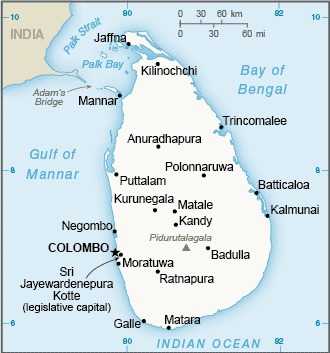
The first Sinhalese arrived in Sri Lanka late in the 6th century B.C., probably from northern India. Buddhism was introduced circa 250 B.C., and the first kingdoms developed at the cities of Anuradhapura (from about 200 B.C. to about A.D. 1000) and Polonnaruwa (from about A.D. 1070 to 1200). In the 14th century, a South Indian dynasty established a Tamil kingdom in northern Sri Lanka. The Portuguese controlled the coastal areas of the island in the 16th century, followed by the Dutch in the 17th century. The island was ceded to the British in 1796, became a crown colony in 1802, and was formally united under British rule by 1815. As Ceylon, it became independent in 1948; the name was changed to Sri Lanka in 1972. Prevailing tensions between the Sinhalese majority and Tamil separatists erupted into war in 1983. Fighting between the government and Liberation Tigers of Tamil Eelam (LTTE) continued for over a quarter-century. Although Norway brokered peace negotiations that led to a cease-fire in 2002, the fighting slowly resumed and was again in full force by 2006. The government defeated the LTTE in 2009.
During the post-conflict years under then-President Mahinda RAJAPAKSA, the government initiated infrastructure development projects, many of which were financed by loans from China. His regime faced allegations of human rights violations and a shrinking democratic space for civil society. In 2015, a new coalition government headed by President Maithripala SIRISENA of the Sri Lanka Freedom Party and Prime Minister Ranil WICKREMESINGHE of the United National Party came to power with pledges to advance economic, political, and judicial reforms. However, implementation of these reforms was uneven. In 2019, Gotabaya RAJAPAKSA won the presidential election and appointed his brother Mahinda prime minister. Civil society raised concerns about the RAJAPAKSA administration’s commitment to pursuing justice, human rights, and accountability reforms, as well as the risks to foreign creditors that Sri Lanka faced given its ongoing economic crisis. A combination of factors including the COVID-19 pandemic; severe shortages of food, medicine, and fuel; and power outages triggered increasingly violent protests in Columbo beginning in 2022. In response, WICKREMESINGHE -- who had already served as prime minister five times -- was named to replace the prime minister, but he became president within a few months when Gotabaya RAJAPAKSA fled the country.
Geographic coordinates
Natural hazards
Area - comparative
Environmental issues
International environmental agreements
Signed, but not ratified: Comprehensive Nuclear Test Ban, Marine Life Conservation
Climate
Coastline
Land boundaries
Land use
Arable land: 22.2% (2023 est.)
Permanent crops: 19.3% (2023 est.)
Permanent pasture: 7.1% (2023 est.)
Forest: 34.4% (2023 est.)
Other: 16.7% (2023 est.)
Maritime claims
Contiguous zone: 24 nm
Exclusive economic zone: 200 nm
Continental shelf: 200 nm or to the edge of the continental margin
Natural resources
Geography - note
Terrain
Location
Map references
Irrigated land
Total renewable water resources
Population distribution
Elevation
Lowest point: Indian Ocean 0 m
Mean elevation: 228 m
Area
Land: 64,630 sq km
Water: 980 sq km
Age structure
15-64 years: 65% (male 6,954,869/female 7,336,897)
65 years and over: 12.4% (2024 est.) (male 1,149,256/female 1,580,053)
Sex ratio
0-14 years: 1.05 male(s)/female
15-64 years: 0.95 male(s)/female
65 years and over: 0.73 male(s)/female
Total population: 0.94 male(s)/female (2024 est.)
Literacy
Male: 93.4% (2023 est.)
Female: 92% (2023 est.)
Nationality
Adjective: Sri Lankan
School life expectancy (primary to tertiary education)
Male: 12 years (2023 est.)
Female: 14 years (2023 est.)
Urbanization
Rate of urbanization: 1.22% annual rate of change (2020-25 est.)
Drinking water source
Urban: 98.1% of population (2022 est.)
Rural: 87.2% of population (2022 est.)
Total: 89.3% of population (2022 est.)
Unimproved:
Urban: 1.9% of population (2022 est.)
Rural: 12.8% of population (2022 est.)
Total: 10.7% of population (2022 est.)
Major urban areas - population
Physician density
Hospital bed density
Mother's mean age at first birth
Note: Data represents median age at first birth among women 30-34
Dependency ratios
Youth dependency ratio: 34.7 (2024 est.)
Elderly dependency ratio: 19.1 (2024 est.)
Potential support ratio: 5.2 (2024 est.)
Sanitation facility access
Urban: 97.9% of population (2022 est.)
Rural: 99.2% of population (2022 est.)
Total: 99% of population (2022 est.)
Unimproved:
Urban: 2.1% of population (2022 est.)
Rural: 0.8% of population (2022 est.)
Total: 1% of population (2022 est.)
Ethnic groups
Religions
Languages
Note: Data represent main languages spoken by the population aged 10 years and older; shares sum to more than 100% because some respondents gave more than one answer on the census; English is commonly used in government and is referred to as the "link language" in the constitution
Health expenditure
9.5% of national budget (2022 est.)
Child marriage
Women married by age 18: 9.8% (2016)
Gross reproduction rate
Currently married women (ages 15-49)
Youth unemployment rate (ages 15-24)
Male: 18.4% (2024 est.)
Female: 29.6% (2024 est.)
note: % of labor force ages 15-24 seeking employment
Net migration rate
Median age
Male: 32.2 years
Female: 35.8 years
Maternal mortality ratio
Total fertility rate
Population
Male: 10,642,043
Female: 11,340,565
Infant mortality rate
Male: 7.5 deaths/1,000 live births
Female: 6.1 deaths/1,000 live births
Tobacco use
Male: 36.3% (2025 est.)
Female: 2% (2025 est.)
Obesity - adult prevalence rate
Death rate
Birth rate
Children under the age of 5 years underweight
Alcohol consumption per capita
Beer: 0.22 liters of pure alcohol (2019 est.)
Wine: 0.01 liters of pure alcohol (2019 est.)
Spirits: 2.32 liters of pure alcohol (2019 est.)
Other alcohols: 0.03 liters of pure alcohol (2019 est.)
Life expectancy at birth
Male: 73.7 years
Female: 79.9 years
Education expenditure
7.2% national budget (2024 est.)
Population growth rate
Total water withdrawal
Industrial: 831 million cubic meters (2022 est.)
Agricultural: 11.31 billion cubic meters (2022 est.)
Waste and recycling
Percent of municipal solid waste recycled: 24.5% (2022 est.)
Particulate matter emissions
Carbon dioxide emissions
From coal and metallurgical coke: 5.15 million metric tonnes of CO2 (2023 est.)
From petroleum and other liquids: 14.003 million metric tonnes of CO2 (2023 est.)
Energy consumption per capita
Diplomatic representation from the US
Embassy: 210 Galle Road, Colombo 03
Mailing address: 6100 Colombo Place, Washington DC 20521-6100
Telephone: [94] (11) 249-8500
FAX: [94] (11) 243-7345
Email address and website:
Colomboacs@state.gov
https://lk.usembassy.gov/
Administrative divisions
Capital
Geographic coordinates: 6 55 N, 79 50 E
Time difference: UTC+5.5 (10.5 hours ahead of Washington, DC, during Standard Time)
Etymology: The origin of Colombo's name is unclear; it may derive from the Sinhalese words kola (leaves) and amba (mango), referring to local mango trees, or from the name Kelantotta, referring to a ferry that crossed the Kelani River; the name was corrupted to Kolambu by Arab traders, and 16th-century Portuguese settlers then called it Colombo, possibly referring to explorer Christopher COLUMBUS; the legislative capital's name, Sri Jayewardenepura Kotte, is composed of the Sanskrit honorific sri, the name of Sri Lankan President J.R. JAYEWARDENE, and the Hindi word pura (town)
Constitution
Amendment process: Proposed by Parliament; passage requires at least two-thirds majority vote of its total membership, certification by the president of the republic or the Parliament speaker, and in some cases approval in a referendum by absolute majority of valid votes
Executive branch
Head of government: Prime Minister Harini AMARASURIYA (since 24 September 2024)
Cabinet: Cabinet appointed by the president in consultation with the prime minister
Election/appointment process: President directly elected by preferential majority popular vote for a 5-year term (eligible for a second term); prime minister appointed by the president
Most recent election date: 21 September 2024
Election results:
2024: Anura Kumara DISSANAYAKE elected president; percent of vote after reallocation - Anura Kumara DISSANAYAKE (JVP) 55.9%, Sajith PREMADASA (SJB) 44.1%
2022: Ranil WICKREMESINGHE elected president by Parliament on 20 July 2022; Parliament vote - WICKREMESINGHE (UNP) 134, Dullas ALAHAPPERUMA (SLPP) 82
Expected date of next election: 2029
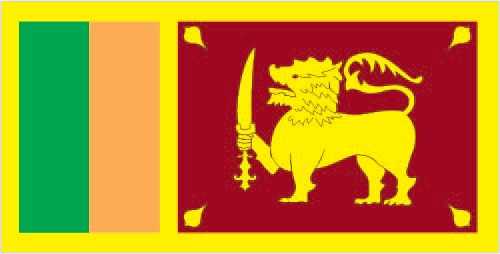
Flag
Meaning: The sword stands for national sovereignty; the lion for Sinhalese ethnicity, the strength of the nation, and bravery; the four bo leaves for Buddhism and the four virtues of kindness, friendliness, happiness, and equanimity; orange stands for Tamils, green for Moors, and maroon for the Sinhalese majority; yellow represents other ethnic groups
Note: The banner is sometimes referred to as the Lion Flag
Independence
Judicial branch
Judge selection and term of office: Chief justice nominated by the Constitutional Council (CC), a 9-member high-level advisory body, and appointed by the president; other justices nominated by the CC and appointed by the president on the advice of the chief justice; all justices can serve until age 65
Subordinate courts: Court of Appeals; High Courts; Magistrates' Courts; municipal and primary courts
Legal system
Legislative branch
Legislative structure: Unicameral
Number of seats: 225 (196 directly elected; 29 indirectly elected)
Electoral system: Proportional representation
Scope of elections: Full renewal
Term in office: 5 years
Most recent election date: 11/14/2024
Parties elected and seats per party: National People's Power (Jathika Jana Balawegaya, NPP) (159); Samagi Jana Balawegaya (SJB) (40); Other (26)
Percentage of women in chamber: 9.8%
Expected date of next election: November 2029
International organization participation
National holiday
Political parties
Eelam People's Democratic Party or EPDP
Eelam People's Revolutionary Liberation Front or EPRLF
Illankai Tamil Arasu Kachchi or ITAK
Janatha Vimukthi Peramuna or JVP
Jathika Hela Urumaya or JHU
National People's Power or NPP (also known as Jathika Jana Balawegaya or JJB)
People's Liberation Organisation of Tamil Eelam or PLOTE
Samagi Jana Balawegaya or SJB
Sri Lanka Freedom Party or SLFP
Sri Lanka Muslim Congress or SLMC
Sri Lanka People's Freedom Alliance or SLPFA (includes SLPFP, SLPP, and several smaller parties)
Sri Lanka Podujana Peramuna (Sri Lanka's People's Front) or SLPP
Tamil Eelam Liberation Organization or TELO
Tamil National Alliance or TNA (includes ITAK, PLOTE, TELO)
Tamil National People's Front or TNPF
Tamil People's National Alliance or TPNA
United National Front for Good Governance or UNFGG (coalition includes JHU, UNP)
United National Party or UNP
Suffrage
Government type
Country name
Conventional short form: Sri Lanka
Local long form: Shri Lanka Prajatantrika Samajavadi Janarajaya (Sinhala)/ Ilankai Jananayaka Choshalichak Kutiyarachu (Tamil)
Local short form: Shri Lanka (Sinhala)/ Ilankai (Tamil)
Former: Serendib, Ceylon
Etymology: The name is composed of the Sanskrit words shri (happiness or holiness) and lanka (island); the former name Serendib was an Arabic derivation of the Sanskrit word simhaladvipa, or "island of the place of lions;" the former name Ceylon came from the Sanskrit simha, or "lion"
Diplomatic representation in the US
Chancery: 3025 Whitehaven Street NW, Washington, DC 20008
Telephone: [1] (202) 483-4025
FAX: [1] 202-232-2329
Email address and website:
Slemb.washington@mfa.gov.lk
https://slembassyusa.org/
Consulate(s) general: Los Angeles
Consulate(s): New York
National anthem(s)
Lyrics/music: Ananda SAMARKONE (Sinhala),M. NALLATHAMBY (Tamil)/Ananda SAMARKONE
History: Adopted 1951
International law organization participation
National symbol(s)
Citizenship
Citizenship by descent only: At least one parent must be a citizen of Sri Lanka
Dual citizenship recognized: No, except in cases where the government rules it is to the benefit of Sri Lanka
Residency requirement for naturalization: 7 years
National heritage
Selected World Heritage Site locales: Ancient City of Polonnaruwa (c); Ancient City of Sigiriya (c); Sacred City of Anuradhapura (c); Old Town of Galle and its Fortifications (c); Sacred City of Kandy (c); Sinharaja Forest Reserve (n); Rangiri Dambulla Cave Temple (c); Central Highlands of Sri Lanka (n)
National color(s)
Population below poverty line
note: % of population with income below national poverty line
Household income or consumption by percentage share
Highest 10%: 30.8% (2019 est.)
note: % share of income accruing to lowest and highest 10% of population
Exports - commodities
note: top five export commodities based on value in dollars
Exports - partners
note: top five export partners based on percentage share of exports
Agricultural products
note: top ten agricultural products based on tonnage
Budget
Expenditures: $17.144 billion (2023 est.)
note: central government revenues and expenses (excluding grants/extrabudgetary units/social security funds) converted to US dollars at average official exchange rate for year indicated
Imports - commodities
note: top five import commodities based on value in dollars
Exchange rates
Exchange rates:
327.507 (2023 est.)
322.633 (2022 est.)
198.764 (2021 est.)
185.593 (2020 est.)
178.745 (2019 est.)
Industries
Economic overview
GDP (official exchange rate)
note: data in current dollars at official exchange rate
GDP - composition, by end use
Government consumption: 7% (2024 est.)
Investment in fixed capital: 18.8% (2024 est.)
Investment in inventories: 8.2% (2024 est.)
Exports of goods and services: 19.9% (2024 est.)
Imports of goods and services: -22.5% (2024 est.)
note: figures may not total 100% due to rounding or gaps in data collection
Imports - partners
note: top five import partners based on percentage share of imports
Average household expenditures
On alcohol and tobacco: 3.4% of household expenditures (2023 est.)
Remittances
5.2% of GDP (2022 est.)
6.2% of GDP (2021 est.)
note: personal transfers and compensation between resident and non-resident individuals/households/entities
Labor force
note: number of people ages 15 or older who are employed or seeking work
Debt - external
note: present value of external debt in current US dollars
Reserves of foreign exchange and gold
$4.405 billion (2023 est.)
$1.896 billion (2022 est.)
note: holdings of gold (year-end prices)/foreign exchange/special drawing rights in current dollars
Public debt
note: central government debt as a % of GDP
Unemployment rate
6% (2023 est.)
4.6% (2022 est.)
note: % of labor force seeking employment
Taxes and other revenues
note: central government tax revenue as a % of GDP
Real GDP (purchasing power parity)
$287.031 billion (2023 est.)
$293.878 billion (2022 est.)
note: data in 2021 dollars
Inflation rate (consumer prices)
16.5% (2023 est.)
49.7% (2022 est.)
note: annual % change based on consumer prices
Current account balance
-$1.448 billion (2022 est.)
-$3.284 billion (2021 est.)
note: balance of payments - net trade and primary/secondary income in current dollars
Real GDP per capita
$13,000 (2023 est.)
$13,200 (2022 est.)
note: data in 2021 dollars
Imports
$19.244 billion (2022 est.)
$21.526 billion (2021 est.)
note: balance of payments - imports of goods and services in current dollars
Exports
$16.169 billion (2022 est.)
$14.974 billion (2021 est.)
note: balance of payments - exports of goods and services in current dollars
Real GDP growth rate
-2.3% (2023 est.)
-7.3% (2022 est.)
note: annual GDP % growth based on constant local currency
Industrial production growth rate
note: annual % change in industrial value added based on constant local currency
GDP - composition, by sector of origin
Industry: 25.5% (2024 est.)
Services: 57.5% (2024 est.)
note: figures may not total 100% due to non-allocated consumption not captured in sector-reported data
Electricity access
Coal
Imports: 2.238 million metric tons (2023 est.)
Electricity generation sources
Solar: 4.6% of total installed capacity (2023 est.)
Wind: 4.6% of total installed capacity (2023 est.)
Hydroelectricity: 40.7% of total installed capacity (2023 est.)
Biomass and waste: 0.7% of total installed capacity (2023 est.)
Petroleum
Electricity
Consumption: 15.763 billion kWh (2023 est.)
Transmission/distribution losses: 1.457 billion kWh (2023 est.)
Internet users
Internet country code
Broadcast media
Telephones - mobile cellular
Subscriptions per 100 inhabitants: 143 (2022 est.)
Broadband - fixed subscriptions
Subscriptions per 100 inhabitants: 9 (2023 est.)
Telephones - fixed lines
Subscriptions per 100 inhabitants: 7 (2023 est.)
Railways
Broad gauge: 1,562 km (2016) 1.676-m gauge
Civil aircraft registration country code prefix
Airports
Merchant marine
By type: Bulk carrier 5, general cargo 15, oil tanker 11, other 65
Heliports
Military service age and obligation
Military expenditures
1.6% of GDP (2023 est.)
1.7% of GDP (2022 est.)
1.9% of GDP (2021 est.)
2% of GDP (2020 est.)
Military and security forces
Ministry of Public Security: Sri Lanka Police (2025)
Note: The Civil Security Department, also known as the Civil Defense Force, is an auxiliary force administered by the Ministry of Defense
Military - note
Sri Lanka traditionally has had close security ties to India; the Sri Lankan and Indian militaries conduct exercises together, and India trains approximately 1,000 Sri Lankan soldiers per year; in recent years, Sri Lanka has increased military ties with China, including acquiring military equipment, hosting naval port calls, and sending personnel to China for training (2025)
Military and security service personnel strengths
Note: The Sri Lankan military has been downsizing for several years; in 2025, the Sri Lankan Government announced its intent to decrease the size of the Army to 100,000, the Air Force to 18,000, and the Navy to 40,000 by 2030
Military deployments
Military equipment inventories and acquisitions
Refugees and internally displaced persons
IDPs: 5,549 (2024 est.)
Stateless persons: 229 (2024 est.)
Terrorist group(s)
Note: Details about the history, aims, leadership, organization, areas of operation, tactics, targets, weapons, size, and sources of support of the group(s) appear(s) in the Terrorism reference guide
Ports
Large: 0
Medium: 2
Small: 1
Very small: 1
Size unknown: 2
Ports with oil terminals: 2
Key ports: Batticaloa Roads, Colombo, Galle Harbor, Hambantota, Kankesanturai, Trincomalee Harbor
Gini Index coefficient - distribution of family income
note: index (0-100) of income distribution; higher values represent greater inequality