Bangladesh
South AsiaBG December 31, 2025
Background
The huge delta region at the confluence of the Ganges and Brahmaputra River systems -- now referred to as Bangladesh -- was a loosely incorporated outpost of various empires for much of the first millennium A.D. Muslim conversions and settlement in the region began in the 10th century, primarily from Arab and Persian traders and preachers. Europeans established trading posts in the area in the 16th century. Eventually the area known as Bengal, which is primarily Hindu in the western section and mostly Muslim in the eastern half, became part of British India. After the partition of India in 1947, the Muslim-majority area became East Pakistan. Calls for greater autonomy and animosity between the eastern and western areas of Pakistan led to a Bengali independence movement. That movement, led by the Awami League (AL) and supported by India, won the independence war for Bangladesh in 1971.
The military overthrew the post-independence AL government in 1975, the first of a series of military coups that resulted in a military-backed government and the subsequent creation of the Bangladesh Nationalist Party (BNP) that took power in 1979. That government also ended in a coup in 1981, followed by military-backed rule until democratic elections were held in 1991. The BNP and AL alternated in power from 1991 to 2008, with the exception of a military-backed, emergency caretaker regime in 2007. The country returned to fully democratic rule in 2008 with the election of the AL and Prime Minister Sheikh HASINA. With the help of international development assistance, Bangladesh is on track to graduate from the UN’s Least Developed Countries (LDC) list in 2026.
The economy has grown at an annual average of about 6.25% for the last two decades. Poverty declined from 11.8 percent in 2010 to 5.0 percent in 2022, based on the international poverty line of $2.15 a day (using 2017 Purchasing Power Parity exchange rate). The country made a rapid recovery from the COVID-19 pandemic, but still faces economic challenges.
The military overthrew the post-independence AL government in 1975, the first of a series of military coups that resulted in a military-backed government and the subsequent creation of the Bangladesh Nationalist Party (BNP) that took power in 1979. That government also ended in a coup in 1981, followed by military-backed rule until democratic elections were held in 1991. The BNP and AL alternated in power from 1991 to 2008, with the exception of a military-backed, emergency caretaker regime in 2007. The country returned to fully democratic rule in 2008 with the election of the AL and Prime Minister Sheikh HASINA. With the help of international development assistance, Bangladesh is on track to graduate from the UN’s Least Developed Countries (LDC) list in 2026.
The economy has grown at an annual average of about 6.25% for the last two decades. Poverty declined from 11.8 percent in 2010 to 5.0 percent in 2022, based on the international poverty line of $2.15 a day (using 2017 Purchasing Power Parity exchange rate). The country made a rapid recovery from the COVID-19 pandemic, but still faces economic challenges.
Geographic coordinates
24 00 N, 90 00 E
Natural hazards
droughts; cyclones; much of the country routinely inundated during the summer monsoon season
Area - comparative
slightly larger than Pennsylvania and New Jersey combined; slightly smaller than Iowa
Environmental issues
flooding; water pollution, especially of fishing areas, from the use of commercial pesticides; groundwater pollution from naturally occurring arsenic; falling water tables in the northern and central parts of the country; soil degradation and erosion; deforestation; destruction of wetlands; severe overpopulation with noise pollution
International environmental agreements
Party to: Biodiversity, Climate Change, Climate Change-Kyoto Protocol, Climate Change-Paris Agreement, Comprehensive Nuclear Test Ban, Desertification, Endangered Species, Environmental Modification, Hazardous Wastes, Law of the Sea, Nuclear Test Ban, Ozone Layer Protection, Ship Pollution, Wetlands
Signed, but not ratified: None of the selected agreements
Signed, but not ratified: None of the selected agreements
Climate
tropical; mild winter (October to March); hot, humid summer (March to June); humid, warm rainy monsoon (June to October)
Coastline
580 km
Land boundaries
Total: 4,413 km
Border countries (2): Burma 271 km; India 4,142 km
Border countries (2): Burma 271 km; India 4,142 km
Land use
Agricultural land: 72.3% (2023 est.)
Arable land: 60.6% (2023 est.)
Permanent crops: 7.1% (2023 est.)
Permanent pasture: 4.6% (2023 est.)
Forest: 14.4% (2023 est.)
Other: 13.3% (2023 est.)
Arable land: 60.6% (2023 est.)
Permanent crops: 7.1% (2023 est.)
Permanent pasture: 4.6% (2023 est.)
Forest: 14.4% (2023 est.)
Other: 13.3% (2023 est.)
Maritime claims
Territorial sea: 12 nm
Contiguous zone: 18 nm
Exclusive economic zone: 200 nm
Continental shelf: To the outer limits of the continental margin
Contiguous zone: 18 nm
Exclusive economic zone: 200 nm
Continental shelf: To the outer limits of the continental margin
Natural resources
natural gas, arable land, timber, coal
Geography - note
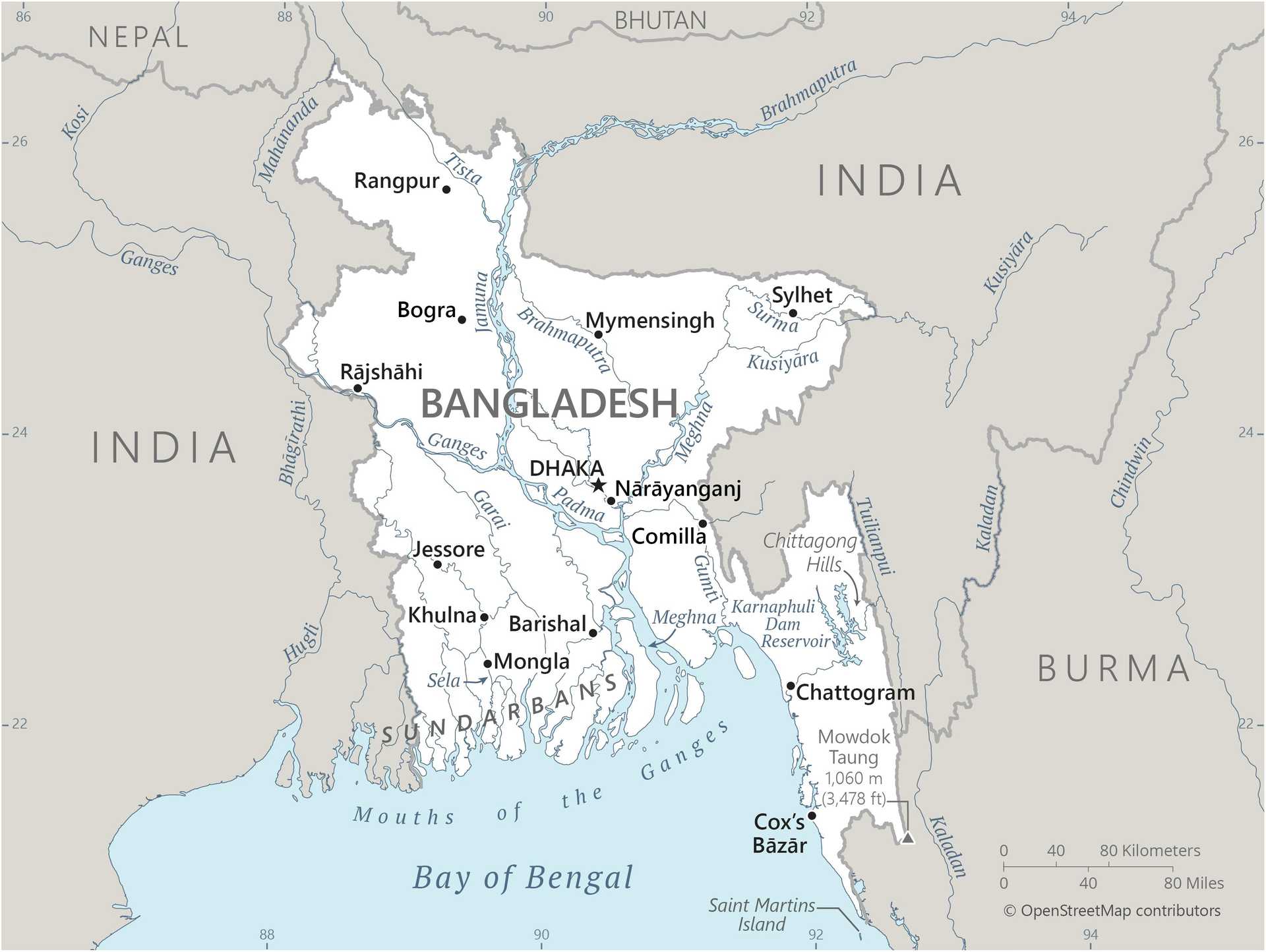
most of the country is situated on deltas of large rivers flowing from the Himalayas: the Ganges unites with the Jamuna (main channel of the Brahmaputra) and later joins the Meghna to eventually empty into the Bay of Bengal
Terrain
mostly flat alluvial plain; hilly in southeast
Location
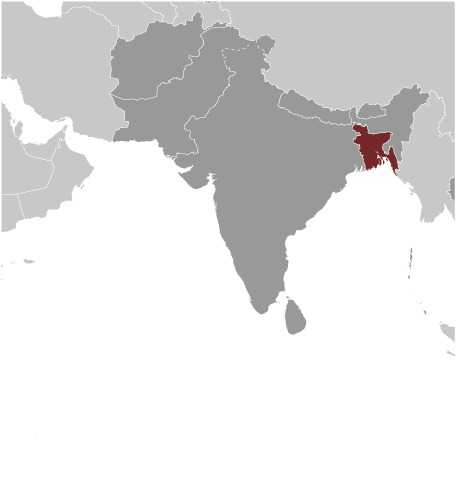
Southern Asia, bordering the Bay of Bengal, between Burma and India
Map references
Asia
Irrigated land
83,690 sq km (2022)
Total renewable water resources
1.227 trillion cubic meters (2022 est.)
Elevation
Highest point: Mowdok Taung 1,060 m
Lowest point: Bay of Bengal 0 m
Mean elevation: 85 m
Lowest point: Bay of Bengal 0 m
Mean elevation: 85 m
Major aquifers
Indus-Ganges-Brahmaputra Basin
Major watersheds (area sq km)
Indian Ocean drainage: Brahmaputra (651,335 sq km), Ganges (1,016,124 sq km)
Major rivers (by length in km)
Brahmaputra river mouth (shared with China [s] and India) - 3,969 km; Ganges river mouth (shared with India [s]) - 2,704 km
Note: [s] after country name indicates river source; [m] after country name indicates river mouth
Note: [s] after country name indicates river source; [m] after country name indicates river mouth
Area
Total : 148,460 sq km
Land: 130,170 sq km
Water: 18,290 sq km
Land: 130,170 sq km
Water: 18,290 sq km
Age structure
0-14 years: 25.1% (male 21,540,493/female 20,800,712)
15-64 years: 67.1% (male 55,071,592/female 58,180,322)
65 years and over: 7.8% (2024 est.) (male 6,096,167/female 7,007,898)
15-64 years: 67.1% (male 55,071,592/female 58,180,322)
65 years and over: 7.8% (2024 est.) (male 6,096,167/female 7,007,898)
Sex ratio
At birth: 1.04 male(s)/female
0-14 years: 1.04 male(s)/female
15-64 years: 0.95 male(s)/female
65 years and over: 0.87 male(s)/female
Total population: 0.96 male(s)/female (2024 est.)
0-14 years: 1.04 male(s)/female
15-64 years: 0.95 male(s)/female
65 years and over: 0.87 male(s)/female
Total population: 0.96 male(s)/female (2024 est.)
Literacy
Total population: 79% (2022 est.)
Male: 81.4% (2022 est.)
Female: 76.5% (2022 est.)
Male: 81.4% (2022 est.)
Female: 76.5% (2022 est.)
Nationality
Noun: Bangladeshi(s)
Adjective: Bangladeshi
Adjective: Bangladeshi
School life expectancy (primary to tertiary education)
Total: 11 years (2023 est.)
Male: 11 years (2023 est.)
Female: 12 years (2023 est.)
Male: 11 years (2023 est.)
Female: 12 years (2023 est.)
Urbanization
Urban population: 40.5% of total population (2023)
Rate of urbanization: 2.88% annual rate of change (2020-25 est.)
Rate of urbanization: 2.88% annual rate of change (2020-25 est.)
Drinking water source
Improved:
Urban: 98.3% of population (2022 est.)
Rural: 98.5% of population (2022 est.)
Total: 98.4% of population (2022 est.)
Unimproved:
Urban: 1.7% of population (2022 est.)
Rural: 1.5% of population (2022 est.)
Total: 1.6% of population (2022 est.)
Urban: 98.3% of population (2022 est.)
Rural: 98.5% of population (2022 est.)
Total: 98.4% of population (2022 est.)
Unimproved:
Urban: 1.7% of population (2022 est.)
Rural: 1.5% of population (2022 est.)
Total: 1.6% of population (2022 est.)
Major urban areas - population
23.210 million DHAKA (capital), 5.380 million Chittagong, 955,000 Khulna, 962,000 Rajshahi, 964,000 Sylhet, 906,000 Bogra (2023)
Physician density
0.72 physicians/1,000 population (2023)
Hospital bed density
0.9 beds/1,000 population (2019 est.)
Mother's mean age at first birth
18.6 years (2017/18 est.)
Note: Data represents median age at first birth among women 20-49
Note: Data represents median age at first birth among women 20-49
Dependency ratios
Total dependency ratio: 49 (2024 est.)
Youth dependency ratio: 37.4 (2024 est.)
Elderly dependency ratio: 11.6 (2024 est.)
Potential support ratio: 8.6 (2024 est.)
Youth dependency ratio: 37.4 (2024 est.)
Elderly dependency ratio: 11.6 (2024 est.)
Potential support ratio: 8.6 (2024 est.)
Sanitation facility access
Improved:
Urban: 90.3% of population (2022 est.)
Rural: 81.4% of population (2022 est.)
Total: 84.9% of population (2022 est.)
Unimproved:
Urban: 9.7% of population (2022 est.)
Rural: 18.6% of population (2022 est.)
Total: 15.1% of population (2022 est.)
Urban: 90.3% of population (2022 est.)
Rural: 81.4% of population (2022 est.)
Total: 84.9% of population (2022 est.)
Unimproved:
Urban: 9.7% of population (2022 est.)
Rural: 18.6% of population (2022 est.)
Total: 15.1% of population (2022 est.)
Ethnic groups
Bengali at least 99%, other indigenous ethnic groups 1% (2022 est.)
Note: Bangladesh's government recognizes 27 indigenous ethnic groups under the 2010 Cultural Institution for Small Anthropological Groups Act; other sources estimate there are about 75 ethnic groups
Note: Bangladesh's government recognizes 27 indigenous ethnic groups under the 2010 Cultural Institution for Small Anthropological Groups Act; other sources estimate there are about 75 ethnic groups
Religions
Muslim 91%, Hindu 8%, other 1% (2022 est.)
Languages
Bangla 98.8% (official, also known as Bengali), other 1.2% (2011 est.)
Major-language sample(s):
The World Factbook, the indispensable source for basic information.
Major-language sample(s):
বিশ্ব ফ্যাক্টবুক, মৌলিক তথ্যের অপরিহার্য উৎস (Bangla)
The World Factbook, the indispensable source for basic information.
Health expenditure
2.4% of GDP (2021)
1.2% of national budget (2022 est.)
1.2% of national budget (2022 est.)
Child marriage
Women married by age 15: 15.5% (2019)
Women married by age 18: 51.4% (2019)
Women married by age 18: 51.4% (2019)
Gross reproduction rate
1.01 (2024 est.)
Currently married women (ages 15-49)
80.6% (2022 est.)
Youth unemployment rate (ages 15-24)
Total: 11.5% (2024 est.)
Male: 13.7% (2024 est.)
Female: 9.2% (2024 est.)
note: % of labor force ages 15-24 seeking employment
Male: 13.7% (2024 est.)
Female: 9.2% (2024 est.)
note: % of labor force ages 15-24 seeking employment
Net migration rate
-2.9 migrant(s)/1,000 population (2024 est.)
Median age
Total: 29.6 years (2024 est.)
Male: 28.7 years
Female: 30.4 years
Male: 28.7 years
Female: 30.4 years
Maternal mortality ratio
115 deaths/100,000 live births (2023 est.)
Total fertility rate
2.07 children born/woman (2024 est.)
Population
Total: 168,697,184 (2024 est.)
Male: 82,708,252
Female: 85,988,932
Male: 82,708,252
Female: 85,988,932
Infant mortality rate
Total: 28.8 deaths/1,000 live births (2024 est.)
Male: 31.3 deaths/1,000 live births
Female: 26.3 deaths/1,000 live births
Male: 31.3 deaths/1,000 live births
Female: 26.3 deaths/1,000 live births
Tobacco use
Total: 29.7% (2025 est.)
Male: 47.6% (2025 est.)
Female: 12.5% (2025 est.)
Male: 47.6% (2025 est.)
Female: 12.5% (2025 est.)
Obesity - adult prevalence rate
3.6% (2016)
Death rate
5.5 deaths/1,000 population (2024 est.)
Birth rate
17.3 births/1,000 population (2024 est.)
Children under the age of 5 years underweight
21.7% (2022 est.)
Alcohol consumption per capita
Total: 0 liters of pure alcohol (2019 est.)
Beer: 0 liters of pure alcohol (2019 est.)
Wine: 0 liters of pure alcohol (2019 est.)
Spirits: 0 liters of pure alcohol (2019 est.)
Other alcohols: 0 liters of pure alcohol (2019 est.)
Beer: 0 liters of pure alcohol (2019 est.)
Wine: 0 liters of pure alcohol (2019 est.)
Spirits: 0 liters of pure alcohol (2019 est.)
Other alcohols: 0 liters of pure alcohol (2019 est.)
Life expectancy at birth
Total population: 75.2 years (2024 est.)
Male: 73.1 years
Female: 77.5 years
Male: 73.1 years
Female: 77.5 years
Education expenditure
2% of GDP (2024 est.)
11.9% national budget (2025 est.)
11.9% national budget (2025 est.)
Population growth rate
0.89% (2024 est.)
Total water withdrawal
Municipal: 3.6 billion cubic meters (2022 est.)
Industrial: 770 million cubic meters (2022 est.)
Agricultural: 31.5 billion cubic meters (2022 est.)
Industrial: 770 million cubic meters (2022 est.)
Agricultural: 31.5 billion cubic meters (2022 est.)
Waste and recycling
Municipal solid waste generated annually: 14.778 million tons (2024 est.)
Percent of municipal solid waste recycled: 15.7% (2022 est.)
Percent of municipal solid waste recycled: 15.7% (2022 est.)
Particulate matter emissions
42.5 micrograms per cubic meter (2019 est.)
Carbon dioxide emissions
125.956 million metric tonnes of CO2 (2023 est.)
From coal and metallurgical coke: 26.967 million metric tonnes of CO2 (2023 est.)
From petroleum and other liquids: 42.083 million metric tonnes of CO2 (2023 est.)
From consumed natural gas: 56.906 million metric tonnes of CO2 (2023 est.)
From coal and metallurgical coke: 26.967 million metric tonnes of CO2 (2023 est.)
From petroleum and other liquids: 42.083 million metric tonnes of CO2 (2023 est.)
From consumed natural gas: 56.906 million metric tonnes of CO2 (2023 est.)
Energy consumption per capita
11.472 million Btu/person (2023 est.)
Diplomatic representation from the US
Chief of mission: Ambassador (vacant); Chargé d’Affaires Ambassador Tracey Ann JACOBSEN (since 11 January 2025)
Embassy: Madani Avenue, Baridhara, Dhaka - 1212
Mailing address: 6120 Dhaka Place, Washington DC 20521-6120
Telephone: [880] (2) 5566-2000
FAX: [880] (2) 5566-2907
Email address and website:
DhakaACS@state.gov
https://bd.usembassy.gov/
Embassy: Madani Avenue, Baridhara, Dhaka - 1212
Mailing address: 6120 Dhaka Place, Washington DC 20521-6120
Telephone: [880] (2) 5566-2000
FAX: [880] (2) 5566-2907
Email address and website:
DhakaACS@state.gov
https://bd.usembassy.gov/
Administrative divisions
8 divisions; Barishal, Chattogram, Dhaka, Khulna, Mymensingh, Rajshahi, Rangpur, Sylhet
Capital
Name: Dhaka
Geographic coordinates: 23 43 N, 90 24 E
Time difference: UTC+6 (11 hours ahead of Washington, DC, during Standard Time)
Etymology: The origins of the name are unclear, but it may be derived from either the dhak tree or Dhakeshwari, a goddess with a shrine in the city
Geographic coordinates: 23 43 N, 90 24 E
Time difference: UTC+6 (11 hours ahead of Washington, DC, during Standard Time)
Etymology: The origins of the name are unclear, but it may be derived from either the dhak tree or Dhakeshwari, a goddess with a shrine in the city
Constitution
History: Previous 1935, 1956, 1962 (pre-independence); latest enacted 4 November 1972, effective 16 December 1972, suspended March 1982, restored November 1986
Amendment process: Proposed by the House of the Nation; approval requires at least two-thirds majority vote of the House membership and assent of the president of the republic
Amendment process: Proposed by the House of the Nation; approval requires at least two-thirds majority vote of the House membership and assent of the president of the republic
Executive branch
Chief of state: President Mohammad SHAHABUDDIN Chuppi (since 24 April 2023)
Head of government: Interim Prime Minister Muhammad YUNUS (since 8 August 2024)
Cabinet: Cabinet selected by the prime minister, appointed by the president
Election/appointment process: President indirectly elected by the National Parliament for a 5-year term (eligible for a second term); the president appoints as prime minister the majority party leader in the National Parliament
Most recent election date: 13 February 2023
Election results: President Mohammad SHAHABUDDIN Chuppi (AL) elected unopposed by the National Parliament; Sheikh HASINA reappointed prime minister for a fifth term following the 7 January 2024 parliamentary election; note - Sheikh HASINA resigned and fled the country on 5 August 2024 following mass protests against her government in July and August 2024, and Mohammad YUNIS was appointed as interim Prime Minister on 8 August 2024
Expected date of next election: 2028
Head of government: Interim Prime Minister Muhammad YUNUS (since 8 August 2024)
Cabinet: Cabinet selected by the prime minister, appointed by the president
Election/appointment process: President indirectly elected by the National Parliament for a 5-year term (eligible for a second term); the president appoints as prime minister the majority party leader in the National Parliament
Most recent election date: 13 February 2023
Election results: President Mohammad SHAHABUDDIN Chuppi (AL) elected unopposed by the National Parliament; Sheikh HASINA reappointed prime minister for a fifth term following the 7 January 2024 parliamentary election; note - Sheikh HASINA resigned and fled the country on 5 August 2024 following mass protests against her government in July and August 2024, and Mohammad YUNIS was appointed as interim Prime Minister on 8 August 2024
Expected date of next election: 2028
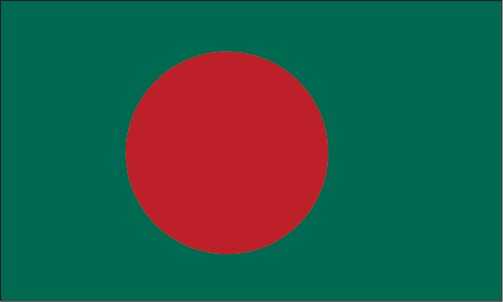
Flag
Description: Green field with a large red disk shifted slightly to the left
Meaning: The red disk represents the rising sun and the sacrifice to achieve independence; the green field symbolizes the lush vegetation of Bangladesh
Meaning: The red disk represents the rising sun and the sacrifice to achieve independence; the green field symbolizes the lush vegetation of Bangladesh
Independence
16 December 1971 (from Pakistan)
Judicial branch
Highest court(s): Supreme Court of Bangladesh (organized into the Appellate Division with 7 justices and the High Court Division with 99 justices)
Judge selection and term of office: Chief justice and justices appointed by the president; justices serve until retirement at age 67
Subordinate courts: Civil courts include: Assistant Judge's Court; Joint District Judge's Court; Additional District Judge's Court; District Judge's Court; criminal courts include: Court of Sessions; Court of Metropolitan Sessions; Metropolitan Magistrate Courts; Magistrate Court; special courts/tribunals
Judge selection and term of office: Chief justice and justices appointed by the president; justices serve until retirement at age 67
Subordinate courts: Civil courts include: Assistant Judge's Court; Joint District Judge's Court; Additional District Judge's Court; District Judge's Court; criminal courts include: Court of Sessions; Court of Metropolitan Sessions; Metropolitan Magistrate Courts; Magistrate Court; special courts/tribunals
Legal system
common law, incorporating elements of English common law; since independence, statutory law has been the primary form of legislation; Islamic law applies to Muslims in family and inheritance laws, with Hindu personal law applying to Hindus and Buddhists
Legislative branch
Expected date of next election: February 2026
Note: The Parliament (House of the Nation) was dissolved on 6 August 2024 by President Mohammad SHAHABUDDIN Chuppi following the resignation of Prime Minister Sheikh HASINA Wazed on 5 August 2024; new national elections will be held in February 2026
Note: The Parliament (House of the Nation) was dissolved on 6 August 2024 by President Mohammad SHAHABUDDIN Chuppi following the resignation of Prime Minister Sheikh HASINA Wazed on 5 August 2024; new national elections will be held in February 2026
International organization participation
ADB, ARF, BIMSTEC, C, CD, CICA (observer), CP, D-8, FAO, G-77, IAEA, IBRD, ICAO, ICC (national committees), ICRM, IDA, IDB, IFAD, IFC, IFRCS, IHO, ILO, IMF, IMO, IMSO, Interpol, IOC, IOM, IPU, ISO, ITSO, ITU, ITUC (NGOs), MIGA, MINURSO, MINUSCA, MONUSCO, NAM, OIC, OPCW, PCA, SAARC, SACEP, UN, UNAMID, UNCTAD, UNESCO, UNHCR, UNIDO, UNISFA, UNIFIL, UNMISS, UNOOSA, UNWTO, UPU, WCO, WFTU (NGOs), WHO, WIPO, WMO, WTO
National holiday
Independence Day, 26 March (1971); Victory Day, 16 December (1971)
Note: 26 March 1971 is the date of the Awami League's declaration of an independent Bangladesh, and 16 December (Victory Day) memorializes the military victory over Pakistan and the official creation of the state of Bangladesh
Note: 26 March 1971 is the date of the Awami League's declaration of an independent Bangladesh, and 16 December (Victory Day) memorializes the military victory over Pakistan and the official creation of the state of Bangladesh
Political parties
Awami League or AL
Bangladesh Jamaat-i-Islami or JIB
Bangladesh Nationalist Party or BNP
Islami Andolan Bangladesh
Jatiya Party or JP (Ershad faction)
Jatiya Party or JP (Manju faction)
National Socialist Party (Jatiya Samajtantrik Dal) or JSD
Workers Party or WP
Bangladesh Jamaat-i-Islami or JIB
Bangladesh Nationalist Party or BNP
Islami Andolan Bangladesh
Jatiya Party or JP (Ershad faction)
Jatiya Party or JP (Manju faction)
National Socialist Party (Jatiya Samajtantrik Dal) or JSD
Workers Party or WP
Suffrage
18 years of age; universal
Government type
parliamentary republic
Country name
Conventional long form: People's Republic of Bangladesh
Conventional short form: Bangladesh
Local long form: Gana Prajatantri Bangladesh
Local short form: Bangladesh
Former: East Bengal, East Pakistan
Etymology: The name is a compound of the Bengali words Bangla (Bengali) and desh (country)
Conventional short form: Bangladesh
Local long form: Gana Prajatantri Bangladesh
Local short form: Bangladesh
Former: East Bengal, East Pakistan
Etymology: The name is a compound of the Bengali words Bangla (Bengali) and desh (country)
Diplomatic representation in the US
Chief of mission: Ambassador Tareq Md Ariful ISLAM (since 5 September 2025)
Chancery: 3510 International Drive NW, Washington, DC 20008
Telephone: [1] (202) 244-0183
FAX: [1] (202) 244-2771
Email address and website:
Mission.washington@mofa.gov.bd
Embassy of the People’s Republic of Bangladesh, Washington, DC (mofa.gov.bd)
Consulate(s) general: Los Angeles, Miami, New York
Chancery: 3510 International Drive NW, Washington, DC 20008
Telephone: [1] (202) 244-0183
FAX: [1] (202) 244-2771
Email address and website:
Mission.washington@mofa.gov.bd
Embassy of the People’s Republic of Bangladesh, Washington, DC (mofa.gov.bd)
Consulate(s) general: Los Angeles, Miami, New York
National anthem(s)
Title: "Amar Shonar Bangla" (My Golden Bengal)
Lyrics/music: Rabindranath TAGORE
History: Adopted 1971; Rabindranath TAGORE, a Nobel laureate, also wrote India's national anthem
Lyrics/music: Rabindranath TAGORE
History: Adopted 1971; Rabindranath TAGORE, a Nobel laureate, also wrote India's national anthem
International law organization participation
has not submitted an ICJ jurisdiction declaration; accepts ICCt jurisdiction
National symbol(s)
Bengal tiger, water lily
Citizenship
Citizenship by birth: No
Citizenship by descent only: At least one parent must be a citizen of Bangladesh
Dual citizenship recognized: Yes, but limited to select countries
Residency requirement for naturalization: 5 years
Citizenship by descent only: At least one parent must be a citizen of Bangladesh
Dual citizenship recognized: Yes, but limited to select countries
Residency requirement for naturalization: 5 years
National heritage
Total World Heritage Sites: 3 (2 cultural, 1 natural)
Selected World Heritage Site locales: Bagerhat Historic Mosque (c); Ruins of the Buddhist Vihara at Paharpur (c); Sundarbans (n)
Selected World Heritage Site locales: Bagerhat Historic Mosque (c); Ruins of the Buddhist Vihara at Paharpur (c); Sundarbans (n)
National color(s)
green, red
Population below poverty line
18.7% (2022 est.)
note: % of population with income below national poverty line
note: % of population with income below national poverty line
Household income or consumption by percentage share
Lowest 10%: 3.5% (2022 est.)
Highest 10%: 27.4% (2022 est.)
note: % share of income accruing to lowest and highest 10% of population
Highest 10%: 27.4% (2022 est.)
note: % share of income accruing to lowest and highest 10% of population
Exports - commodities
garments, footwear, fabric, textiles, trunks and cases (2023)
note: top five export commodities based on value in dollars
note: top five export commodities based on value in dollars
Exports - partners
USA 16%, Germany 15%, UK 8%, Spain 7%, Poland 6% (2023)
note: top five export partners based on percentage share of exports
note: top five export partners based on percentage share of exports
Agricultural products
rice, milk, potatoes, maize, sugarcane, onions, jute, vegetables, mangoes/guavas, tropical fruits (2023)
note: top ten agricultural products based on tonnage
note: top ten agricultural products based on tonnage
Budget
Revenues: $39.849 billion (2021 est.)
Expenditures: $51.558 billion (2021 est.)
note: central government revenues and expenses (excluding grants/extrabudgetary units/social security funds) converted to US dollars at average official exchange rate for year indicated
Expenditures: $51.558 billion (2021 est.)
note: central government revenues and expenses (excluding grants/extrabudgetary units/social security funds) converted to US dollars at average official exchange rate for year indicated
Imports - commodities
refined petroleum, cotton fabric, natural gas, cotton, fabric (2023)
note: top five import commodities based on value in dollars
note: top five import commodities based on value in dollars
Exchange rates
taka (BDT) per US dollar -
Exchange rates:
115.604 (2024 est.)
106.309 (2023 est.)
91.745 (2022 est.)
85.084 (2021 est.)
84.871 (2020 est.)
Exchange rates:
115.604 (2024 est.)
106.309 (2023 est.)
91.745 (2022 est.)
85.084 (2021 est.)
84.871 (2020 est.)
Industries
cotton, textiles and clothing, jute, tea, paper, cement, fertilizer, sugar, light engineering
Economic overview
one of the fastest growing emerging market economies; strong economic rebound following COVID-19; significant poverty reduction; exports dominated by textile industry; weakened exports and remittances resulted in declining foreign exchange reserves and 2022 IMF loan request
GDP (official exchange rate)
$450.119 billion (2024 est.)
note: data in current dollars at official exchange rate
note: data in current dollars at official exchange rate
GDP - composition, by end use
Household consumption: 70.1% (2024 est.)
Government consumption: 5.9% (2024 est.)
Investment in fixed capital: 30.7% (2024 est.)
Investment in inventories: 0% (2024 est.)
Exports of goods and services: 10.5% (2024 est.)
Imports of goods and services: -16.3% (2024 est.)
Note: Figures may not total 100% due to rounding or gaps in data collection
Government consumption: 5.9% (2024 est.)
Investment in fixed capital: 30.7% (2024 est.)
Investment in inventories: 0% (2024 est.)
Exports of goods and services: 10.5% (2024 est.)
Imports of goods and services: -16.3% (2024 est.)
Note: Figures may not total 100% due to rounding or gaps in data collection
Imports - partners
China 34%, India 17%, Indonesia 5%, Singapore 5%, Malaysia 4% (2023)
note: top five import partners based on percentage share of imports
note: top five import partners based on percentage share of imports
Average household expenditures
On food: 52.8% of household expenditures (2023 est.)
On alcohol and tobacco: 2.1% of household expenditures (2023 est.)
On alcohol and tobacco: 2.1% of household expenditures (2023 est.)
Remittances
6% of GDP (2024 est.)
5.1% of GDP (2023 est.)
4.7% of GDP (2022 est.)
note: personal transfers and compensation between resident and non-resident individuals/households/entities
5.1% of GDP (2023 est.)
4.7% of GDP (2022 est.)
note: personal transfers and compensation between resident and non-resident individuals/households/entities
Labor force
77.355 million (2024 est.)
note: number of people ages 15 or older who are employed or seeking work
note: number of people ages 15 or older who are employed or seeking work
Debt - external
$58.02 billion (2023 est.)
note: present value of external debt in current US dollars
note: present value of external debt in current US dollars
Reserves of foreign exchange and gold
$21.395 billion (2024 est.)
$21.86 billion (2023 est.)
$33.747 billion (2022 est.)
note: holdings of gold (year-end prices)/foreign exchange/special drawing rights in current dollars
$21.86 billion (2023 est.)
$33.747 billion (2022 est.)
note: holdings of gold (year-end prices)/foreign exchange/special drawing rights in current dollars
Unemployment rate
4.7% (2024 est.)
4.5% (2023 est.)
4.6% (2022 est.)
note: % of labor force seeking employment
4.5% (2023 est.)
4.6% (2022 est.)
note: % of labor force seeking employment
Taxes and other revenues
7.6% (of GDP) (2021 est.)
note: central government tax revenue as a % of GDP
note: central government tax revenue as a % of GDP
Real GDP (purchasing power parity)
$1.473 trillion (2024 est.)
$1.413 trillion (2023 est.)
$1.336 trillion (2022 est.)
note: data in 2021 dollars
$1.413 trillion (2023 est.)
$1.336 trillion (2022 est.)
note: data in 2021 dollars
Inflation rate (consumer prices)
10.5% (2024 est.)
9.9% (2023 est.)
7.7% (2022 est.)
note: annual % change based on consumer prices
9.9% (2023 est.)
7.7% (2022 est.)
note: annual % change based on consumer prices
Current account balance
$1.87 billion (2024 est.)
$4.388 billion (2023 est.)
-$14.438 billion (2022 est.)
note: balance of payments - net trade and primary/secondary income in current dollars
$4.388 billion (2023 est.)
-$14.438 billion (2022 est.)
note: balance of payments - net trade and primary/secondary income in current dollars
Real GDP per capita
$8,500 (2024 est.)
$8,200 (2023 est.)
$7,900 (2022 est.)
note: data in 2021 dollars
$8,200 (2023 est.)
$7,900 (2022 est.)
note: data in 2021 dollars
Imports
$74.96 billion (2024 est.)
$73.172 billion (2023 est.)
$93.635 billion (2022 est.)
note: balance of payments - imports of goods and services in current dollars
$73.172 billion (2023 est.)
$93.635 billion (2022 est.)
note: balance of payments - imports of goods and services in current dollars
Exports
$53.848 billion (2024 est.)
$58.885 billion (2023 est.)
$60.066 billion (2022 est.)
note: balance of payments - exports of goods and services in current dollars
$58.885 billion (2023 est.)
$60.066 billion (2022 est.)
note: balance of payments - exports of goods and services in current dollars
Real GDP growth rate
4.2% (2024 est.)
5.8% (2023 est.)
7.1% (2022 est.)
note: annual GDP % growth based on constant local currency
5.8% (2023 est.)
7.1% (2022 est.)
note: annual GDP % growth based on constant local currency
Industrial production growth rate
3.5% (2024 est.)
note: annual % change in industrial value added based on constant local currency
note: annual % change in industrial value added based on constant local currency
GDP - composition, by sector of origin
Agriculture: 11.2% (2024 est.)
Industry: 34.1% (2024 est.)
Services: 51.4% (2024 est.)
note: figures may not total 100% due to non-allocated consumption not captured in sector-reported data
Industry: 34.1% (2024 est.)
Services: 51.4% (2024 est.)
note: figures may not total 100% due to non-allocated consumption not captured in sector-reported data
Electricity access
Electrification - total population: 99.4% (2022 est.)
Electrification - urban areas: 100%
Electrification - rural areas: 99.3%
Electrification - urban areas: 100%
Electrification - rural areas: 99.3%
Coal
Production: 767,000 metric tons (2023 est.)
Consumption: 14.05 million metric tons (2023 est.)
Imports: 13.305 million metric tons (2023 est.)
Proven reserves: 3.26 billion metric tons (2023 est.)
Consumption: 14.05 million metric tons (2023 est.)
Imports: 13.305 million metric tons (2023 est.)
Proven reserves: 3.26 billion metric tons (2023 est.)
Electricity generation sources
Fossil fuels: 98.4% of total installed capacity (2023 est.)
Solar: 1% of total installed capacity (2023 est.)
Hydroelectricity: 0.6% of total installed capacity (2023 est.)
Solar: 1% of total installed capacity (2023 est.)
Hydroelectricity: 0.6% of total installed capacity (2023 est.)
Natural gas
Production: 22.334 billion cubic meters (2023 est.)
Consumption: 29.119 billion cubic meters (2023 est.)
Imports: 6.785 billion cubic meters (2023 est.)
Proven reserves: 126.293 billion cubic meters (2021 est.)
Consumption: 29.119 billion cubic meters (2023 est.)
Imports: 6.785 billion cubic meters (2023 est.)
Proven reserves: 126.293 billion cubic meters (2021 est.)
Petroleum
Total petroleum production: 13,000 bbl/day (2023 est.)
Refined petroleum consumption: 263,000 bbl/day (2023 est.)
Crude oil estimated reserves: 28 million barrels (2021 est.)
Refined petroleum consumption: 263,000 bbl/day (2023 est.)
Crude oil estimated reserves: 28 million barrels (2021 est.)
Electricity
Installed generating capacity: 22.699 million kW (2023 est.)
Consumption: 107.285 billion kWh (2023 est.)
Imports: 9.407 billion kWh (2023 est.)
Transmission/distribution losses: 8.279 billion kWh (2023 est.)
Consumption: 107.285 billion kWh (2023 est.)
Imports: 9.407 billion kWh (2023 est.)
Transmission/distribution losses: 8.279 billion kWh (2023 est.)
Internet users
Percent of population: 45% (2023 est.)
Internet country code
.bd
Broadcast media
state-owned Bangladesh Television (BTV) broadcasts nationally; some channels operate via satellite; the government also owns a medium-wave radio channel and some private FM radio news channels; of the 41 approved TV stations, 26 are currently being used to broadcast, and 23 operate under private management via cable distribution
Telephones - mobile cellular
Total subscriptions: 191 million (2023 est.)
Subscriptions per 100 inhabitants: 105 (2022 est.)
Subscriptions per 100 inhabitants: 105 (2022 est.)
Broadband - fixed subscriptions
Total: 12.9 million (2023 est.)
Subscriptions per 100 inhabitants: 8 (2023 est.)
Subscriptions per 100 inhabitants: 8 (2023 est.)
Telephones - fixed lines
Total subscriptions: 302,000 (2023 est.)
Subscriptions per 100 inhabitants: (2023 est.) less than 1
Subscriptions per 100 inhabitants: (2023 est.) less than 1
Railways
Total: 2,460 km (2014)
Narrow gauge: 1,801 km (2014) 1.000-m gauge
Broad gauge: 659 km (2014) 1.676-m gauge
Narrow gauge: 1,801 km (2014) 1.000-m gauge
Broad gauge: 659 km (2014) 1.676-m gauge
Civil aircraft registration country code prefix
S2
Airports
17 (2025)
Merchant marine
Total: 558 (2023)
By type: Bulk carrier 68, container ship 10, general cargo 170, oil tanker 162, other 148
By type: Bulk carrier 68, container ship 10, general cargo 170, oil tanker 162, other 148
Heliports
36 (2025)
Military expenditures
0.9% of GDP (2024 est.)
1% of GDP (2023 est.)
1.1% of GDP (2022 est.)
1.2% of GDP (2021 est.)
1.3% of GDP (2020 est.)
1% of GDP (2023 est.)
1.1% of GDP (2022 est.)
1.2% of GDP (2021 est.)
1.3% of GDP (2020 est.)
Military - note
the military’s primary responsibility is external defense but it also has a domestic security role; following widespread domestic protests in September 2024, the Army was given law enforcement powers, including making arrests, conducting searches, and dispersing unlawful assemblies; the military has traditionally been a significant player in the country's politics and has commercial business interests in such areas as banking, food, hotels, manufacturing, real estate, and shipbuilding, and manages government infrastructure and construction projects
The military has a long history of participating in UN peacekeeping missions, which has provided operational experience and a source of funding; it runs an international institute for the training of peacekeepers; the military also conducts multinational and bilateral exercises with foreign partners, particularly India (2025)
The military has a long history of participating in UN peacekeeping missions, which has provided operational experience and a source of funding; it runs an international institute for the training of peacekeepers; the military also conducts multinational and bilateral exercises with foreign partners, particularly India (2025)
Military and security service personnel strengths
information varies; approximately 170,000 active Armed Forces (2025)
Military equipment inventories and acquisitions
much of the military's inventory is comprised of Chinese- and Russian-origin equipment, but in recent years suppliers have expanded to include Germany, Turkey, the UK, and the US (2025)
Military deployments
approximately 1,400 Central African Republic (MINUSCA); 1,700 Democratic Republic of the Congo (MONUSCO; plus about 200 police); 120 Lebanon (UNIFIL); 1,600 South Sudan (UNMISS); 500 Sudan (UNISFA) (2024)
Military service age and obligation
varies by service, but generally 17-23 for voluntary military service; length of service also varies (2025)
Military and security forces
Armed Forces of Bangladesh (aka Bangladesh Defense Force): Bangladesh Army, Bangladesh Navy, Bangladesh Air Force
Ministry of Home Affairs: Bangladesh Police, Border Guard Bangladesh (BGB), Bangladesh Coast Guard, Rapid Action Battalion (RAB), Ansars, Village Defense Party (VDP) (2025)
Note 1: The Armed Forces of Bangladesh are jointly administered by the Ministry of Defense (MOD) and the Armed Forces Division (AFD), both under the Prime Minister's Office; the AFD has ministerial status and parallel functions with MOD
Note 2: The RAB, Ansars, and VDP are paramilitary organizations for internal security; the RAB is a joint task force comprised of Police, Army, Navy, Air Force, and Border Guards personnel seconded to the RAB; its mandate includes internal security, intelligence gathering related to criminal activities, and government-directed investigations
Ministry of Home Affairs: Bangladesh Police, Border Guard Bangladesh (BGB), Bangladesh Coast Guard, Rapid Action Battalion (RAB), Ansars, Village Defense Party (VDP) (2025)
Note 1: The Armed Forces of Bangladesh are jointly administered by the Ministry of Defense (MOD) and the Armed Forces Division (AFD), both under the Prime Minister's Office; the AFD has ministerial status and parallel functions with MOD
Note 2: The RAB, Ansars, and VDP are paramilitary organizations for internal security; the RAB is a joint task force comprised of Police, Army, Navy, Air Force, and Border Guards personnel seconded to the RAB; its mandate includes internal security, intelligence gathering related to criminal activities, and government-directed investigations
Refugees and internally displaced persons
Refugees: 1,005,637 (2024 est.)
IDPs: 756,743 (2024 est.)
Stateless persons: 1,005,520 (2024 est.)
IDPs: 756,743 (2024 est.)
Stateless persons: 1,005,520 (2024 est.)
Terrorist group(s)
Terrorist group(s): Harakat ul-Jihad-i-Islami/Bangladesh (HUJI-B); Islamic State of Iraq and ash-Sham (ISIS) in Bangladesh (ISB); al-Qa'ida; al-Qa'ida in the Indian Subcontinent (AQIS)
Note: Details about the history, aims, leadership, organization, areas of operation, tactics, targets, weapons, size, and sources of support of the group(s) appear(s) in the Terrorism reference guide
Note: Details about the history, aims, leadership, organization, areas of operation, tactics, targets, weapons, size, and sources of support of the group(s) appear(s) in the Terrorism reference guide
Nuclear energy
Number of nuclear reactors under construction: 2 (2025)
Space program overview
has a modest space program focused on designing, building, and operating satellites, particularly those with remote sensing (RS) capabilities; SPARSSO's mandate is to use space and RS technology in areas such as agriculture, education, environmental studies, fisheries, forestry, geology, land use, mapping, meteorology, and oceanography; has a government-owned company for acquiring and operating satellites (Bangladesh Satellite Company Limited, established in 2017); works with several foreign space agencies and commercial entities, including those of France, Japan, Russia, and the US; member of several international space organizations, such as the Asia-Pacific Space Cooperation Organization (2025)
Space agency/agencies
Bangladesh Space Research and Remote Sensing Organization (SPARRSO; established as a statutory body in 1991 and designated as the country's national focal point for space-related activities in 1995) (2025)
Ports
Total ports: 2 (2024)
Large: 0
Medium: 1
Small: 1
Very small: 0
Ports with oil terminals: 0
Key ports: Chittagong, Mongla
Large: 0
Medium: 1
Small: 1
Very small: 0
Ports with oil terminals: 0
Key ports: Chittagong, Mongla
National coat of arms
the water lily is the national flower and symbolizes promise, aesthetics, and elegance; the water under the lily, the rice sheaves on the sides, and the jute leaves at the top represent the Bangladeshi landscape and economy; the four stars represent the aims and ambition of the nation
Key space-program milestones
2017 - first educational/scientific nanosatellite (BRAC-Onnesha) acquired from Japan and launched by US
2018 - first communications satellite (Bangabandhu-1) built by a French company and launched by US
2025 - signed US-led Artemis Accords for the safe and responsible exploration of space
2018 - first communications satellite (Bangabandhu-1) built by a French company and launched by US
2025 - signed US-led Artemis Accords for the safe and responsible exploration of space
Methane emissions
Energy: 544 kt (2022-2024 est.)
Agriculture: 2,391.4 kt (2019-2021 est.)
Waste: 693 kt (2019-2021 est.)
Other: 38.6 kt (2019-2021 est.)
Agriculture: 2,391.4 kt (2019-2021 est.)
Waste: 693 kt (2019-2021 est.)
Other: 38.6 kt (2019-2021 est.)
Gini Index coefficient - distribution of family income
33.4 (2022 est.)
note: index (0-100) of income distribution; higher values represent greater inequality
note: index (0-100) of income distribution; higher values represent greater inequality