Pakistan
Background
The Indus Valley civilization, one of the oldest in the world and dating back at least 5,000 years, spread over much of modern-day Pakistan. During the second millennium B.C., remnants of this culture fused with the migrating Indo-Aryan peoples. The area underwent successive invasions in subsequent centuries from the Persians, Greeks, Scythians, Arabs (who brought Islam), Afghans, and Turks. The Mughal Empire flourished in the 16th and 17th centuries; the British came to dominate the region in the 18th century. The partition in 1947 of British India into the Muslim state of Pakistan (with West and East sections) and largely Hindu India created lasting tension between the two countries. They have fought two wars and a limited conflict -- in 1947-48, 1965, and 1999 respectively -- over the Kashmir territory, a dispute that continues to this day. A third war in 1971 -- in which India assisted an indigenous movement reacting to Bengali marginalization in Pakistani politics -- resulted in East Pakistan becoming the separate nation of Bangladesh.
In response to Indian nuclear weapons testing, Pakistan conducted its own tests in 1998. Pakistan has been engaged in a decades-long armed conflict with militant groups, including the Tehreek-e-Taliban Pakistan (TTP) and other militant networks that target government institutions and civilians.
Geographic coordinates
Natural hazards
Area - comparative
Environmental issues
International environmental agreements
Signed, but not ratified: Marine Life Conservation
Climate
Coastline
Land boundaries
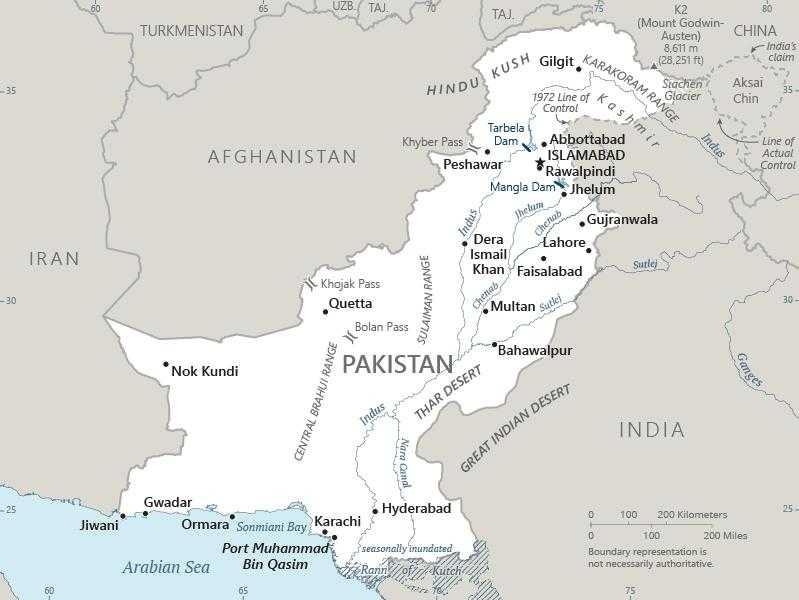
Border countries (4): Afghanistan 2,670 km; China 438 km; India 3,190 km; Iran 959 km
Land use
Arable land: 39.3% (2023 est.)
Permanent crops: 1% (2023 est.)
Permanent pasture: 6.5% (2023 est.)
Forest: 4.1% (2023 est.)
Other: 49.2% (2023 est.)
Maritime claims
Contiguous zone: 24 nm
Exclusive economic zone: 200 nm
Continental shelf: 200 nm or to the edge of the continental margin
Natural resources
Geography - note
Terrain
Location
Map references
Irrigated land
Total renewable water resources
Population distribution
Elevation
Lowest point: Arabian Sea 0 m
Mean elevation: 900 m
Major aquifers
Major watersheds (area sq km)
Internal (endorheic basin) drainage: Tarim Basin (1,152,448 sq km), (Aral Sea basin) Amu Darya (534,739 sq km)
Major rivers (by length in km)
Note: [s] after country name indicates river source; [m] after country name indicates river mouth
Area
Land: 770,875 sq km
Water: 25,220 sq km
Age structure
15-64 years: 60.7% (male 78,321,834/female 74,833,003)
65 years and over: 4.9% (2024 est.) (male 5,735,294/female 6,613,764)
Sex ratio
0-14 years: 1.04 male(s)/female
15-64 years: 1.05 male(s)/female
65 years and over: 0.87 male(s)/female
Total population: 1.04 male(s)/female (2024 est.)
Literacy
Male: 69.1% (2021 est.)
Female: 48.5% (2021 est.)
Nationality
Adjective: Pakistani
School life expectancy (primary to tertiary education)
Male: 8 years (2022 est.)
Female: 7 years (2022 est.)
Urbanization
Rate of urbanization: 2.1% annual rate of change (2020-25 est.)
Drinking water source
Urban: 92.9% of population (2022 est.)
Rural: 89.3% of population (2022 est.)
Total: 90.6% of population (2022 est.)
Unimproved:
Urban: 7.1% of population (2022 est.)
Rural: 10.7% of population (2022 est.)
Total: 9.4% of population (2022 est.)
Major urban areas - population
Physician density
Hospital bed density
Mother's mean age at first birth
Note: Data represents median age at first birth among women 25-49
Dependency ratios
Youth dependency ratio: 56.7 (2024 est.)
Elderly dependency ratio: 8.1 (2024 est.)
Potential support ratio: 12.4 (2024 est.)
Sanitation facility access
Urban: 90.5% of population (2022 est.)
Rural: 76.1% of population (2022 est.)
Total: 81.5% of population (2022 est.)
Unimproved:
Urban: 9.5% of population (2022 est.)
Rural: 23.9% of population (2022 est.)
Total: 18.5% of population (2022 est.)
Ethnic groups
Languages
Major-language sample(s):
دنیا کا قاموس، ایک لازمی زریہ بنیادی معلومات کا (Urdu)
The World Factbook, the indispensable source for basic information.
Note: Data represent population by mother tongue; English (official; lingua franca of Pakistani elite and most government ministries)
Health expenditure
5.6% of national budget (2022 est.)
Child marriage
Women married by age 18: 18.3% (2018)
Men married by age 18: 4.7% (2018)
Gross reproduction rate
Currently married women (ages 15-49)
Youth unemployment rate (ages 15-24)
Male: 9.8% (2024 est.)
Female: 10.1% (2024 est.)
note: % of labor force ages 15-24 seeking employment
Net migration rate
Median age
Male: 22.8 years
Female: 23 years
Maternal mortality ratio
Total fertility rate
Population
Male: 128,387,797
Female: 123,975,774
Infant mortality rate
Male: 56 deaths/1,000 live births
Female: 46.8 deaths/1,000 live births
Tobacco use
Male: 25.7% (2025 est.)
Female: 5.4% (2025 est.)
Obesity - adult prevalence rate
Death rate
Birth rate
Children under the age of 5 years underweight
Alcohol consumption per capita
Beer: 0 liters of pure alcohol (2019 est.)
Wine: 0 liters of pure alcohol (2019 est.)
Spirits: 0.04 liters of pure alcohol (2019 est.)
Other alcohols: 0 liters of pure alcohol (2019 est.)
Life expectancy at birth
Male: 68.2 years
Female: 72.5 years
Education expenditure
9.8% national budget (2023 est.)
Population growth rate
Religions
Total water withdrawal
Industrial: 1.4 billion cubic meters (2022 est.)
Agricultural: 172.4 billion cubic meters (2022 est.)
Waste and recycling
Percent of municipal solid waste recycled: 13.8% (2022 est.)
Particulate matter emissions
Carbon dioxide emissions
From coal and metallurgical coke: 59.937 million metric tonnes of CO2 (2023 est.)
From petroleum and other liquids: 93.713 million metric tonnes of CO2 (2023 est.)
From consumed natural gas: 59.006 million metric tonnes of CO2 (2023 est.)
Energy consumption per capita
Diplomatic representation from the US
Embassy: Diplomatic Enclave, Ramna 5, Islamabad
Mailing address: 8100 Islamabad Place, Washington, DC 20521-8100
Telephone: [92] 051-201-4000
FAX: [92] 51-2338071
Email address and website:
ACSIslamabad@state.gov
https://pk.usembassy.gov/
Consulate(s) general: Karachi, Lahore, Peshawar
Administrative divisions
Capital
Geographic coordinates: 33 41 N, 73 03 E
Time difference: UTC+5 (10 hours ahead of Washington, DC, during Standard Time)
Etymology: The name means "city of Islam" and derives from the Arabic islam, referring to the Islamic faith, and the Persian suffix -abad, meaning "inhabited place" or "city"
Constitution
Amendment process: Proposed by the Senate or by the National Assembly; passage requires at least two-thirds majority vote of both houses
Executive branch
Head of government: Prime Minister Muhammad Shehbaz SHARIF (since 3 March 2024)
Cabinet: Cabinet appointed by the president on the advice of the prime minister
Election/appointment process: President indirectly elected for a 5-year term (limited to 2 consecutive terms) by the Electoral College, which consists of members of the Senate, National Assembly, and provincial assemblies; prime minister elected for a 5-year term by the National Assembly
Most recent election date: 9 March 2024
Election results:
2024: Asif Ali ZARDARI elected president; National Assembly vote - Asif Ali ZARDARI (PPP) 411 votes, Mehmood Khan ACHAKZALI (PMAP) 181 votes; Shehbaz SHARIF elected prime minister; National Assembly vote - Shehbaz SHARIF (PML-N) 201, Omar AYUB (PTI) 92
2018: Arif ALVI elected president; Electoral College vote - Arif ALVI (PTI) 352, Fazl-ur-REHMAN (MMA) 184, Aitzaz AHSAN (PPP) 124; Imran KHAN elected prime minister; National Assembly vote - Imran KHAN (PTI) 176, Shehbaz SHARIF (PML-N) 96
Expected date of next election: 2029
Flag
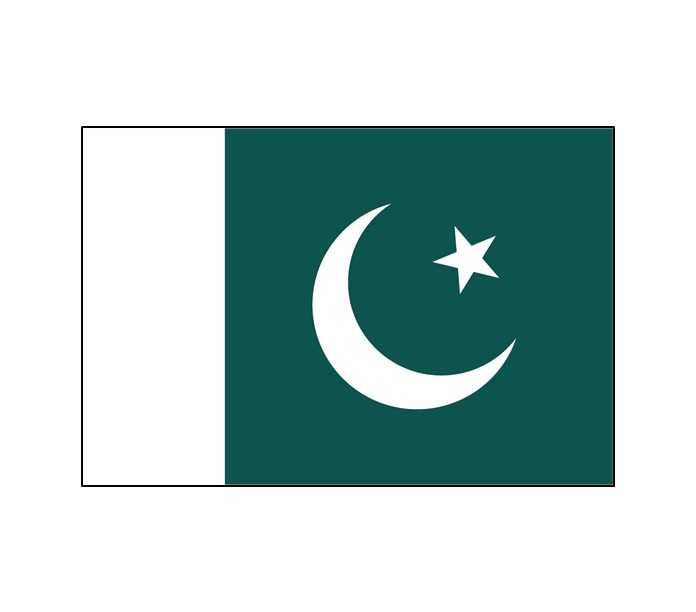
Meaning: The crescent, star, and color green are all traditional Islamic symbols; the white band symbolizes the role of religious minorities
Independence
Judicial branch
Judge selection and term of office: Justices nominated by an 8-member parliamentary committee on the recommendation of the Judicial Commission, a 9-member body of judges and other judicial professionals, and appointed by the president; justices can serve until age 65
Subordinate courts: High Courts; Federal Shariat Court; provincial and district civil and criminal courts; specialized courts for issues, such as taxation, banking, and customs
Legal system
Legislative branch
Legislative structure: Bicameral
Note: in May 2018, the Parliament of Pakistan and the Khyber Pakhtunkhwa Assembly passed a constitutional amendment to merge the Federally Administrated Tribal Areas and Provincially Administered Tribal Areas with the province of Khyber Pakhtunkhwa; the amendment reduces the Senate from 104 to 96 members - 4 in the 2024 election and 4 in the 2027 election
International organization participation
National holiday
Note: Commemorates the adoption of the Lahore Resolution on 23 March 1940, which called for the creation of independent Muslim states, and also the adoption of Pakistan's first constitution on 23 March 1956, during the transition to the Islamic Republic of Pakistan
Political parties
Awami Muslim League or AML
Balochistan Awami Party or BAP
Balochistan National Party-Awami or BNP-A
Balochistan National Party-Mengal or BNP-M
Grand Democratic Alliance or GDA (alliance of several parties)
Hazara Democratic Party or HDP
Istehkam-e-Pakistan Party
Jamaat-e-Islami or JI
Jamhoori Wattan Party or JWP
Jamiat Ulema-e-Islam-Fazl or JUI-F
Majlis Wahdat-e-Muslimeen Pakistan or MWM
Muttahida Majlis-e-Amal or MMA (alliance of several parties)
Muttahida Qaumi Movement-Pakistan or MQM-P
National Party or NP
Pakistan Muslim League or PML-Z
Pakistan Muslim League-Functional or PML-F
Pakistan Muslim League-Nawaz or PML-N
Pakistan Muslim League-Quaid-e-Azam or PML-Q
Pakistan Peoples Party or PPP
Pakistan Rah-e-Haq Party or PRHP
Pakistan Tehrik-e Insaaf or PTI (Pakistan Movement for Justice)
Pashtoonkhwa Milli Awami Party or PMAP or PKMAP
Tehreek-e-Labbaik Pakistan or TLP
Suffrage
Note: Women and non-Muslims have joint electorates and reserved parliamentary seats
Government type
Country name
Conventional short form: Pakistan
Local long form: Jamhuryat Islami Pakistan
Local short form: Pakistan
Former: West Pakistan
Etymology: The name is said to have been proposed in the early 1930s by Muslim students at Cambridge University, created from the initials of Punjab, Afghanistan, and Kashmir; the word pak also means "pure" in Persian or Pashto, and the Persian suffix -stan means "place of" or "country," so Pakistan literally means "Land of the Pure"
Diplomatic representation in the US
Chancery: 3517 International Court NW, Washington, DC 20008
Telephone: [1] (202) 243-6500
FAX: [1] (202) 686-1534
Email address and website:
Consularsection@embassyofpakistanusa.org
https://embassyofpakistanusa.org/
Consulate(s) general: Chicago, Houston, Los Angeles, New York
National anthem(s)
Lyrics/music: Abu-Al-Asar Hafeez JULLANDHURI/Ahmed Ghulamali CHAGLA
History: Adopted 1954; also known as "Pak sarzamin shad bad" (Blessed Be the Sacred Land)
International law organization participation
National symbol(s)
Citizenship
Citizenship by descent only: At least one parent must be a citizen of Pakistan
Dual citizenship recognized: Yes, but limited to select countries
Residency requirement for naturalization: 4 out of the previous 7 years and including the 12 months preceding application
National heritage
Selected World Heritage Site locales: Archaeological Ruins at Moenjodaro; Buddhist Ruins of Takht-i-Bahi; Taxila; Fort and Shalamar Gardens in Lahore; Historical Monuments at Makli, Thatta; Rohtas Fort
National color(s)
Population below poverty line
note: % of population with income below national poverty line
Household income or consumption by percentage share
Highest 10%: 25.5% (2018 est.)
note: % share of income accruing to lowest and highest 10% of population
Exports - commodities
note: top five export commodities based on value in dollars
Exports - partners
note: top five export partners based on percentage share of exports
Agricultural products
note: top ten agricultural products based on tonnage
Budget
Expenditures: $49.558 billion (2015 est.)
note: central government revenues and expenses (excluding grants/extrabudgetary units/social security funds) converted to US dollars at average official exchange rate for year indicated
Imports - commodities
note: top five import commodities based on value in dollars
Exchange rates
Exchange rates:
278.581 (2024 est.)
280.356 (2023 est.)
204.867 (2022 est.)
162.906 (2021 est.)
161.838 (2020 est.)
Industries
Economic overview
GDP (official exchange rate)
note: data in current dollars at official exchange rate
GDP - composition, by end use
Government consumption: 8.5% (2024 est.)
Investment in fixed capital: 11.2% (2024 est.)
Investment in inventories: 1.7% (2024 est.)
Exports of goods and services: 10.4% (2024 est.)
Imports of goods and services: -17.1% (2024 est.)
note: figures may not total 100% due to rounding or gaps in data collection
Imports - partners
note: top five import partners based on percentage share of imports
Average household expenditures
On alcohol and tobacco: 1.3% of household expenditures (2023 est.)
Remittances
7.9% of GDP (2023 est.)
8% of GDP (2022 est.)
note: personal transfers and compensation between resident and non-resident individuals/households/entities
Labor force
note: number of people ages 15 or older who are employed or seeking work
Debt - external
note: present value of external debt in current US dollars
Reserves of foreign exchange and gold
$13.73 billion (2023 est.)
$9.927 billion (2022 est.)
note: holdings of gold (year-end prices)/foreign exchange/special drawing rights in current dollars
Unemployment rate
5.5% (2023 est.)
5.5% (2022 est.)
note: % of labor force seeking employment
Real GDP (purchasing power parity)
$1.346 trillion (2023 est.)
$1.347 trillion (2022 est.)
note: data in 2021 dollars
Inflation rate (consumer prices)
30.8% (2023 est.)
19.9% (2022 est.)
note: annual % change based on consumer prices
Current account balance
-$1.039 billion (2023 est.)
-$12.216 billion (2022 est.)
note: balance of payments - net trade and primary/secondary income in current dollars
Real GDP per capita
$5,400 (2023 est.)
$5,500 (2022 est.)
note: data in 2021 dollars
Imports
$58.069 billion (2023 est.)
$76.594 billion (2022 est.)
note: balance of payments - imports of goods and services in current dollars
Exports
$36.215 billion (2023 est.)
$38.967 billion (2022 est.)
note: balance of payments - exports of goods and services in current dollars
Real GDP growth rate
0% (2023 est.)
4.8% (2022 est.)
note: annual GDP % growth based on constant local currency
Industrial production growth rate
note: annual % change in industrial value added based on constant local currency
GDP - composition, by sector of origin
Industry: 20% (2024 est.)
Services: 50.5% (2024 est.)
note: figures may not total 100% due to non-allocated consumption not captured in sector-reported data
Electricity access
Electrification - urban areas: 100%
Electrification - rural areas: 93%
Coal
Consumption: 30.191 million metric tons (2023 est.)
Exports: 900 metric tons (2023 est.)
Imports: 16.185 million metric tons (2023 est.)
Proven reserves: 2.857 billion metric tons (2023 est.)
Electricity generation sources
Nuclear: 14.1% of total installed capacity (2023 est.)
Solar: 0.7% of total installed capacity (2023 est.)
Wind: 3.7% of total installed capacity (2023 est.)
Hydroelectricity: 19.9% of total installed capacity (2023 est.)
Biomass and waste: 1.1% of total installed capacity (2023 est.)
Natural gas
Consumption: 36.323 billion cubic meters (2023 est.)
Imports: 8.847 billion cubic meters (2023 est.)
Proven reserves: 592.219 billion cubic meters (2021 est.)
Petroleum
Refined petroleum consumption: 645,000 bbl/day (2023 est.)
Crude oil estimated reserves: 540 million barrels (2021 est.)
Electricity
Consumption: 145.357 billion kWh (2023 est.)
Imports: 481.25 million kWh (2023 est.)
Transmission/distribution losses: 25.811 billion kWh (2023 est.)
Internet users
Internet country code
Broadcast media
Telephones - mobile cellular
Subscriptions per 100 inhabitants: 82 (2022 est.)
Broadband - fixed subscriptions
Subscriptions per 100 inhabitants: 1 (2023 est.)
Telephones - fixed lines
Subscriptions per 100 inhabitants: 1 (2023 est.)
Railways
Narrow gauge: 389 km (2021) 1.000-m gauge
Broad gauge: 11,492 km (2021) 1.676-m gauge (286 km electrified)
Civil aircraft registration country code prefix
Airports
Merchant marine
By type: Bulk carrier 5, oil tanker 9, other 46
Heliports
Military service age and obligation
Military expenditures
3% of GDP (2023 est.)
4% of GDP (2022 est.)
4% of GDP (2021 est.)
4% of GDP (2020 est.)
Military and security forces
Ministry of Interior: Frontier Constabulary, Frontier Corps, National Police, Pakistan Coast Guard, Punjab (Pakistan) Rangers, Sindh (Pakistan) Rangers (2025)
Note: The National Guard is a paramilitary force and one of the Army's reserve forces; other Army reserves include the Pakistan Army Reserve, the Frontier Corps, and the Pakistan Rangers
Military - note
The military operates largely independently and without effective civilian oversight; it has ruled the country for more than 30 years since independence in 1947 and continues to play a significant role in Pakistan's political arena; it also has a large stake in the country’s economic sector and is involved in a diverse array of commercial activities, including banking, construction of public projects, employment services, energy and power generation, fertilizer, food, housing, real estate, and security services
Pakistan has fought four wars and several skirmishes with India; three of the wars have been over the disputed region of Jammu and Kashmir, the status of which has been unsettled since the UK's 1947 withdrawal and the partition and independence of India and Pakistan; a fragile cease-fire was reached in 2003, revised in 2018, and reaffirmed in 2021, although the militarized Line of Control which serves as the border remains contested, and India has accused Pakistan of backing armed separatists and terrorist organizations in the territory New Delhi controls; in the Spring of 2025, Indian held Pakistan responsible for a terrorist attack in India-controlled Kashmir and retaliated, sparking a brief cross-border conflict involving aircraft, artillery, drone, and missile strikes
The Kashmir dispute also includes the Siachen Glacier, located in the Karakoram Mountain Range, which was seized by India in 1984 with Pakistan attempting to retake the area several times between 1985 and 1995; despite the 2003 cease-fire, both sides continue to maintain a permanent military presence there with outposts at altitudes above 20,000 feet (over 6,000 meters) where most casualties are due to extreme weather and the hazards of operating in the high mountain terrain of the world’s highest conflict, including avalanches, exposure, and altitude sickness (2025)
Military and security service personnel strengths
Military deployments
Military equipment inventories and acquisitions
Illicit drugs
Major illicit drug-producing and/or drug-transit country
Major precursor-chemical producer (2025)
Refugees and internally displaced persons
IDPs: 224,813 (2024 est.)
Stateless persons: 60 (2024 est.)
Terrorist group(s)
Note 1: Details about the history, aims, leadership, organization, areas of operation, tactics, targets, weapons, size, and sources of support of the group(s) appear(s) in the Terrorism reference guide
Note 2: The Balochistan Liberation Army (BLA), an armed separatist group that targets security forces and civilians, has been active in Pakistan since the 2000s, mainly in ethnic Baloch areas of the country; in 2019, the US designated BLA as Specially Designated Global Terrorists
Nuclear energy
Number of nuclear reactors under construction: 1 (2025)
Net capacity of operational nuclear reactors: 3.26GW (2025 est.)
Percent of total electricity production: 17.4% (2023 est.)
Number of nuclear reactors permanently shut down: 1 (2025)
Space agency/agencies
Space launch site(s)
Space program overview
Ports
Large: 0
Medium: 2
Small: 1
Very small: 0
Ports with oil terminals: 2
Key ports: Gwadar, Karachi, Muhamamad Bin Qasim
Legislative branch - lower chamber
Number of seats: 336 (all directly elected)
Electoral system: Plurality/majority
Scope of elections: Full renewal
Term in office: 5 years
Most recent election date: 2/8/2024
Parties elected and seats per party: Pakistan Muslim League-Nawaz (PML-N) (75); Pakistan People's Party Parliamentarians (PPPP) (54); Muttahida Quami Movement Pakistan (MQMP) (17); Independents (101); Other (16)
Percentage of women in chamber: 17%
Expected date of next election: February 2029
Legislative branch - upper chamber
Number of seats: 96 (all indirectly elected)
Scope of elections: Partial renewal
Term in office: 6 years
Most recent election date: 4/2/2024
Percentage of women in chamber: 18.8%
Expected date of next election: March 2027
Note: In 2018, the Parliament of Pakistan and the Khyber Pakhtunkhwa Assembly passed a constitutional amendment to merge the Federally Administrated Tribal Areas and Provincially Administered Tribal Areas with the province of Khyber Pakhtunkhwa; the amendment reduces the Senate from 104 to 96 members -- by 4 in the 2024 election and another 4 in the 2027 election
Key space-program milestones
1990 - first domestically built experimental satellite (Badr-1) launched by China
2001 - first remote sensing (RS) satellite (Badr-2) built jointly with the UK and launched by Russia
2011 - first digital communications satellite (PakSat-1R) launched by China
2017 - successfully test-launched ballistic missile system (Shaheed-III)
2023 - joined China’s International Lunar Research Station program
2024 - first lunar orbiter/satellite (iCube Qamar) launched by China and deployed from China's Chang'e-6 spacecraft
2025 - first fully domestic RS satellite (PRSC-EO1) launched by China; selected country's first astronauts to be trained by China for mission to China's space station
Methane emissions
Agriculture: 5,381.3 kt (2019-2021 est.)
Waste: 700.4 kt (2019-2021 est.)
Other: 128.7 kt (2019-2021 est.)
Gini Index coefficient - distribution of family income
note: index (0-100) of income distribution; higher values represent greater inequality