Maldives
Background
A sultanate since the 12th century, the Maldives became a British protectorate in 1887 and a republic in 1968, three years after independence. President Maumoon Abdul GAYOOM dominated Maldives' political scene for 30 years, elected to six successive terms by single-party referendums. After political demonstrations in the capital Male in 2003, GAYOOM and his government pledged to embark upon a process of liberalization and democratic reforms, including a more representative political system and expanded political freedoms. Political parties were legalized in 2005.
In 2008, a constituent assembly -- termed the "Special Majlis" -- finalized a new constitution ratified by GAYOOM. The first-ever presidential elections under a multi-candidate, multi-party system were held later that year. GAYOOM was defeated in a runoff by Mohamed NASHEED, a political activist whom the regime had jailed several years earlier. In 2012, after several weeks of street protests in response to a top judge's arrest, NASHEED resigned the presidency and handed over power to Vice President Mohammed WAHEED Hassan Maniku. A government-appointed Commission of National Inquiry concluded that there was no evidence of a coup, but NASHEED contended that police and military personnel forced him to resign. NASHEED, WAHEED, and Abdulla YAMEEN Abdul Gayoom ran in the 2013 elections with YAMEEN ultimately winning the presidency after three rounds of voting. In 2018, YAMEEN lost his reelection bid to parliamentarian Ibrahim Mohamed SOLIH. YAMEEN was arrested and jailed in 2022 on corruption charges. Maldives' fourth democratic election was held in September 2023. The winner, Male City Mayor Dr. Mohamed MUIZZU, campaigned on a platform of Maldivian sovereignty, vowing to remove Indian military personnel from the country. MUIZZU represents a joint Progressive Pary of Maldives and People's National Congress (PPM/PNC) coalition.
Geographic coordinates
Natural hazards
Area - comparative
Environmental issues
International environmental agreements
Signed, but not ratified: None of the selected agreements
Climate
Coastline
Land boundaries
Land use
Arable land: 13.4% (2023 est.)
Permanent crops: 3% (2023 est.)
Permanent pasture: 3.4% (2023 est.)
Forest: 12.5% (2023 est.)
Other: 67.7% (2023 est.)
Maritime claims
Contiguous zone: 24 nm
Exclusive economic zone: 200 nm
Note: Measured from claimed archipelagic straight baselines
Natural resources
Geography - note
Terrain
Location
Map references
Irrigated land
Total renewable water resources
Population distribution
Elevation
Lowest point: Indian Ocean 0 m
Mean elevation: 2 m
Area
Land: 298 sq km
Water: 0 sq km
Age structure
15-64 years: 71.5% (male 143,021/female 135,044)
65 years and over: 6.1% (2024 est.) (male 10,397/female 13,449)
Sex ratio
0-14 years: 1.04 male(s)/female
15-64 years: 1.06 male(s)/female
65 years and over: 0.77 male(s)/female
Total population: 1.04 male(s)/female (2024 est.)
Literacy
Male: 98.2% (2019 est.)
Female: 98.3% (2019 est.)
Nationality
Adjective: Maldivian
Urbanization
Rate of urbanization: 2.34% annual rate of change (2020-25 est.)
Drinking water source
Urban: 99.1% of population (2022 est.)
Rural: 99.9% of population (2022 est.)
Total: 99.6% of population (2022 est.)
Unimproved:
Urban: 0.9% of population (2022 est.)
Rural: 0.1% of population (2022 est.)
Total: 0.4% of population (2022 est.)
Major urban areas - population
Physician density
Hospital bed density
Mother's mean age at first birth
Note: Data represents median age at first birth among women 25-49
Dependency ratios
Youth dependency ratio: 31.3 (2024 est.)
Elderly dependency ratio: 8.6 (2024 est.)
Potential support ratio: 11.7 (2024 est.)
Sanitation facility access
Urban: 100% of population (2022 est.)
Rural: 100% of population (2022 est.)
Total: 100% of population (2022 est.)
Unimproved:
Urban: 0% of population (2022 est.)
Rural: 0% of population (2022 est.)
Total: 0% of population (2022 est.)
Ethnic groups
Religions
Languages
Health expenditure
18.2% of national budget (2022 est.)
School life expectancy (primary to tertiary education)
Male: 11 years (2022 est.)
Female: 15 years (2022 est.)
Child marriage
Women married by age 18: 2.2% (2017)
Men married by age 18: 2.2% (2017)
Gross reproduction rate
Currently married women (ages 15-49)
Youth unemployment rate (ages 15-24)
Male: 20% (2024 est.)
Female: 9.5% (2024 est.)
note: % of labor force ages 15-24 seeking employment
Net migration rate
Median age
Male: 31.3 years
Female: 32.4 years
Maternal mortality ratio
Total fertility rate
Population
Male: 197,739
Female: 191,119
Infant mortality rate
Male: 27.3 deaths/1,000 live births
Female: 21.3 deaths/1,000 live births
Tobacco use
Male: 41.5% (2025 est.)
Female: 9.2% (2025 est.)
Obesity - adult prevalence rate
Death rate
Birth rate
Children under the age of 5 years underweight
Alcohol consumption per capita
Beer: 0.33 liters of pure alcohol (2019 est.)
Wine: 0.59 liters of pure alcohol (2019 est.)
Spirits: 0.45 liters of pure alcohol (2019 est.)
Other alcohols: 0 liters of pure alcohol (2019 est.)
Life expectancy at birth
Male: 75.1 years
Female: 79.9 years
Education expenditure
9.6% national budget (2025 est.)
Population growth rate
Total water withdrawal
Industrial: 300,000 cubic meters (2022 est.)
Agricultural: 268,194 cubic meters (2022 est.)
Waste and recycling
Percent of municipal solid waste recycled: 20.9% (2022 est.)
Particulate matter emissions
Carbon dioxide emissions
From petroleum and other liquids: 1.908 million metric tonnes of CO2 (2023 est.)
Energy consumption per capita
Diplomatic representation from the US
Embassy: 210 Galle Road, Colombo 03, Sri Lanka; note - as of early November 2023, the US has no consular or diplomatic offices in Maldives; the US Mission to Maldives operates from US Embassy Colombo, Sri Lanka
Telephone: [94] (11) 249-8500
FAX: [94] (11) 243-7345
Email address and website:
Homepage - U.S. Embassy in Maldives
Administrative divisions
Capital
Geographic coordinates: 4 10 N, 73 30 E
Time difference: UTC+5 (10 hours ahead of Washington, DC, during Standard Time)
Etymology: The name may come from the Sanskrit word mala, or "garland"
Constitution
Amendment process: Proposed by Parliament; passage requires at least three-quarters majority vote by its membership and the signature of the president of the republic; passage of amendments to constitutional articles on rights and freedoms and the terms of office of Parliament and of the president also requires a majority vote in a referendum
Executive branch
Head of government: President Mohamed MUIZZU (since 17 November 2023)
Cabinet: Cabinet of Ministers appointed by the president, approved by People's Majlis
Election/appointment process: President directly elected by absolute-majority popular vote in 2 rounds, if needed, for a 5-year term (eligible for a second term)
Most recent election date: 9 September 2023, with runoff on 30 September 2023
Election results:
2023: Mohamed MUIZZU elected president in the second round; percent of vote in first round - Mohamed MUIZZU (PNC) 46.1%, Ibrahim Mohamed SOLIH (MDP) 39.1%, Ilyas LABEEB (DEMS) 7.1%, other 7.7%; percent of vote in the second round - Mohamed MUIZZU 54%, Ibrahim Mohamed SOLIH 46%
2018: Ibrahim Mohamed SOLIH elected president in first round; Ibrahim Mohamed SOLIH (MDP) 58.3%, Abdulla YAMEEN Abdul Gayoom (PPM) 41.7%
Expected date of next election: 2028
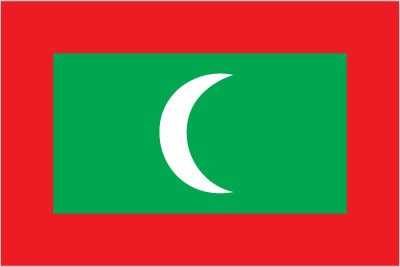
Flag
Meaning: Red stands for those who have sacrificed their lives to defend the country, green for peace and prosperity, and the white crescent is a symbol of Islam
Independence
Judicial branch
Judge selection and term of office: Supreme Court judges appointed by the president in consultation with the Judicial Service Commission -- a 10-member body of selected senior government officials and the public -- and on confirmation by voting members of the People's Majlis; judges serve until mandatory retirement at age 70
Subordinate courts: High Court; Criminal, Civil, Family, Juvenile, and Drug Courts; Magistrate Courts (on each of the inhabited islands)
Legal system
Legislative branch
Legislative structure: Unicameral
Number of seats: 93 (all directly elected)
Electoral system: Plurality/majority
Scope of elections: Full renewal
Term in office: 5 years
Most recent election date: 4/21/2024
Parties elected and seats per party: People's National Congress (PNC) (66); Maldivian Democratic Party (MDP) (12); Independents (11); Other (4)
Percentage of women in chamber: 3.2%
Expected date of next election: April 2029
International organization participation
National holiday
Political parties
Dhivehi Rayyithunge Party or DRP
Maldives Development Alliance or MDA
Maldivian Democratic Party or MDP
Maldives Third Way Democrats or MTD
People's National Congress or PNC
People's National Front
Republican (Jumhooree) Party or JP
Suffrage
Government type
Country name
Conventional short form: Maldives
Local long form: Dhivehi Raajjeyge Jumhooriyyaa
Local short form: Dhivehi Raajje
Etymology: The origin of the name is obscure but may derive from the Sanskrit word maladvipa, meaning "garland of islands;" the local name, Dhivehi Raajje, means "land of the Dhivehi people" in the local language
Diplomatic representation in the US
Chancery: 1100 H Street NW, Suite 250, Washington, D.C. 20005
Telephone: [1] (202) 516-5458
Email address and website:
WashingtonInfo@foreign.gov.mv
The Embassy (mdvmission.gov.mv)
National anthem(s)
Lyrics/music: Mohamed Jameel DIDI/Wannakuwattawaduge DON AMARADEVA
History: Lyrics adopted 1948, music adopted 1972; the anthem has seven verses, but only the first two are commonly used
International law organization participation
National symbol(s)
Citizenship
Citizenship by descent only: At least one parent must be a citizen of Maldives
Dual citizenship recognized: Yes
Residency requirement for naturalization: Unknown
National color(s)
Population below poverty line
note: % of population with income below national poverty line
Household income or consumption by percentage share
Highest 10%: 23.3% (2019 est.)
note: % share of income accruing to lowest and highest 10% of population
Exports - commodities
note: top five export commodities based on value in dollars
Exports - partners
note: top five export partners based on percentage share of exports
Agricultural products
note: top ten agricultural products based on tonnage
Budget
Expenditures: $1.939 billion (2021 est.)
note: central government revenues and expenses (excluding grants/extrabudgetary units/social security funds) converted to US dollars at average official exchange rate for year indicated
Imports - commodities
note: top five import commodities based on value in dollars
Exchange rates
Exchange rates:
15.389 (2024 est.)
15.387 (2023 est.)
15.387 (2022 est.)
15.373 (2021 est.)
15.381 (2020 est.)
Industries
Economic overview
GDP (official exchange rate)
note: data in current dollars at official exchange rate
GDP - composition, by end use
Government consumption: 17.1% (2023 est.)
Investment in fixed capital: 35% (2023 est.)
Investment in inventories: -2% (2023 est.)
Exports of goods and services: 74.4% (2023 est.)
Imports of goods and services: -75.7% (2023 est.)
Imports - partners
note: top five import partners based on percentage share of imports
Remittances
0.1% of GDP (2023 est.)
0.1% of GDP (2022 est.)
note: personal transfers and compensation between resident and non-resident individuals/households/entities
Labor force
note: number of people ages 15 or older who are employed or seeking work
Debt - external
Note: Present value of external debt in current US dollars
Reserves of foreign exchange and gold
$590.523 million (2023 est.)
$832.094 million (2022 est.)
note: holdings of gold (year-end prices)/foreign exchange/special drawing rights in current dollars
Unemployment rate
4.3% (2023 est.)
4.5% (2022 est.)
note: % of labor force seeking employment
Taxes and other revenues
Note: Central government tax revenue as a % of GDP
Real GDP (purchasing power parity)
$11.723 billion (2023 est.)
$11.194 billion (2022 est.)
note: data in 2021 dollars
Inflation rate (consumer prices)
2.9% (2023 est.)
2.3% (2022 est.)
note: annual % change based on consumer prices
Current account balance
-$1.4 billion (2023 est.)
-$1.042 billion (2022 est.)
note: balance of payments - net trade and primary/secondary income in current dollars
Real GDP per capita
$22,300 (2023 est.)
$21,400 (2022 est.)
note: data in 2021 dollars
Imports
$4.984 billion (2023 est.)
$4.939 billion (2022 est.)
note: balance of payments - imports of goods and services in current dollars
Exports
$4.88 billion (2023 est.)
$5.096 billion (2022 est.)
note: balance of payments - exports of goods and services in current dollars
Real GDP growth rate
4.7% (2023 est.)
13.8% (2022 est.)
note: annual GDP % growth based on constant local currency
Industrial production growth rate
note: annual % change in industrial value added based on constant local currency
GDP - composition, by sector of origin
Industry: 9% (2024 est.)
Services: 73.8% (2024 est.)
note: figures may not total 100% due to non-allocated consumption not captured in sector-reported data
Electricity access
Coal
Electricity generation sources
Solar: 6.6% of total installed capacity (2023 est.)
Wind: 0.2% of total installed capacity (2023 est.)
Petroleum
Electricity
Consumption: 821.397 million kWh (2023 est.)
Transmission/distribution losses: 25.867 million kWh (2023 est.)
Internet users
Internet country code
Broadcast media
Telephones - mobile cellular
Subscriptions per 100 inhabitants: 137 (2022 est.)
Broadband - fixed subscriptions
Subscriptions per 100 inhabitants: 19 (2023 est.)
Telephones - fixed lines
Subscriptions per 100 inhabitants: 2 (2023 est.)
Civil aircraft registration country code prefix
Airports
Merchant marine
By type: General cargo 30, oil tanker 20, other 32
Military service age and obligation
Military and security forces
Ministry of Homeland Security and Technology (MOHST): Maldives Police Service (2025)
Note: In addition to the MNDF, the Maldives Ministry of Defense controls the Aviation Security Command, which provides security for the civil aviation industry, and the National Counter Terrorism Center
Military - note
Military expenditures
Military and security service personnel strengths
Military equipment inventories and acquisitions
Trafficking in persons
Refugees and internally displaced persons
Terrorist group(s)
Note: Details about the history, aims, leadership, organization, areas of operation, tactics, targets, weapons, size, and sources of support of the group(s) appear(s) in the Terrorism reference guide
Ports
Large: 0
Medium: 0
Small: 0
Very small: 1
Ports with oil terminals: 1
Key ports: Male
Gini Index coefficient - distribution of family income
note: index (0-100) of income distribution; higher values represent greater inequality