Uruguay
Background
The Spanish founded the city of Montevideo in modern-day Uruguay in 1726 as a military stronghold, and it soon became an important commercial center due to its natural harbor. Argentina initially claimed Uruguay, but Brazil annexed the country in 1821. Uruguay declared its independence in 1825 and secured its freedom in 1828 after a three-year struggle. The administrations of President Jose BATLLE in the early 20th century launched widespread political, social, and economic reforms that established a statist tradition. A violent Marxist urban guerrilla movement named the Tupamaros (or Movimiento de Liberación Nacional-Tupamaros) launched in the late 1960s and pushed Uruguay's president to cede control of the government to the military in 1973. By year-end, the rebels had been crushed, but the military continued to expand its hold over the government. Civilian rule was restored in 1985. In 2004, the left-of-center Frente Amplio (FA) Coalition won national elections that effectively ended 170 years of political control by the Colorado and National (Blanco) parties. The left-of-center coalition retained the presidency and control of both chambers of congress until 2019. Uruguay's political and labor conditions are among the freest on the South American continent.
Geographic coordinates
Natural hazards
Area - comparative
Environmental issues
International environmental agreements
Signed, but not ratified: Marine Dumping-London Convention, Marine Life Conservation
Climate
Coastline
Land boundaries
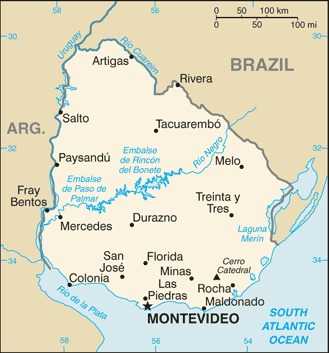
Border countries (2): Argentina 541 km; Brazil 1,050 km
Land use
Arable land: 12.6% (2023 est.)
Permanent crops: 0.2% (2023 est.)
Permanent pasture: 68.6% (2023 est.)
Forest: 11.4% (2023 est.)
Other: 7.3% (2023 est.)
Maritime claims
Contiguous zone: 24 nm
Exclusive economic zone: 200 nm
Continental shelf: 200 nm or the edge of continental margin
Natural resources
Geography - note
Terrain
Location
Map references
Irrigated land
Total renewable water resources
Population distribution
Elevation
Lowest point: Atlantic Ocean 0 m
Mean elevation: 109 m
Major aquifers
Major lakes (area sq km)
Major rivers (by length in km)
Note: [s] after country name indicates river source; [m] after country name indicates river mouth
Area
Land: 175,015 sq km
Water: 1,200 sq km
Age structure
15-64 years: 65.4% (male 1,112,622/female 1,128,418)
65 years and over: 15.7% (2024 est.) (male 218,242/female 318,855)
Sex ratio
0-14 years: 1.04 male(s)/female
15-64 years: 0.99 male(s)/female
65 years and over: 0.68 male(s)/female
Total population: 0.94 male(s)/female (2024 est.)
Literacy
Male: 98.6% (2024 est.)
Female: 99.2% (2024 est.)
Nationality
Adjective: Uruguayan
School life expectancy (primary to tertiary education)
Male: 16 years (2022 est.)
Female: 19 years (2022 est.)
Urbanization
Rate of urbanization: 0.4% annual rate of change (2020-25 est.)
Drinking water source
Urban: 99.7% of population (2022 est.)
Rural: 95.3% of population (2022 est.)
Total: 99.5% of population (2022 est.)
Unimproved:
Urban: 0.3% of population (2022 est.)
Rural: 4.7% of population (2022 est.)
Total: 0.5% of population (2022 est.)
Major urban areas - population
Physician density
Hospital bed density
Dependency ratios
Youth dependency ratio: 26.9 (2024 est.)
Elderly dependency ratio: 22.2 (2024 est.)
Potential support ratio: 4.5 (2024 est.)
Sanitation facility access
Urban: 99.3% of population (2022 est.)
Rural: 100% of population (2022 est.)
Total: 99.3% of population (2022 est.)
Unimproved:
Urban: 0.7% of population (2022 est.)
Rural: 0% of population (2022 est.)
Total: 0.7% of population (2022 est.)
Ethnic groups
Note: Data represent primary ethnic identity
Religions
Roman Catholic 42%, Protestant 15%, other 6%, agnostic 3%, atheist 10%, unspecified 24% (2023 est.)
Languages
Major-language sample(s):
La Libreta Informativa del Mundo, la fuente indispensable de información básica. (Spanish)
The World Factbook, the indispensable source for basic information.
Health expenditure
20.9% of national budget (2022 est.)
Gross reproduction rate
Currently married women (ages 15-49)
Youth unemployment rate (ages 15-24)
Male: 23.5% (2024 est.)
Female: 29.8% (2024 est.)
note: % of labor force ages 15-24 seeking employment
Net migration rate
Median age
Male: 34.9 years
Female: 38.2 years
Maternal mortality ratio
Total fertility rate
Population
Male: 1,660,132
Female: 1,765,198
Infant mortality rate
Male: 9.1 deaths/1,000 live births
Female: 6.8 deaths/1,000 live births
Tobacco use
Male: 21.3% (2025 est.)
Female: 14.9% (2025 est.)
Obesity - adult prevalence rate
Death rate
Birth rate
Children under the age of 5 years underweight
Alcohol consumption per capita
Beer: 1.86 liters of pure alcohol (2019 est.)
Wine: 2.86 liters of pure alcohol (2019 est.)
Spirits: 0.71 liters of pure alcohol (2019 est.)
Other alcohols: 0 liters of pure alcohol (2019 est.)
Life expectancy at birth
Male: 75.8 years
Female: 82.1 years
Education expenditure
15.6% national budget (2023 est.)
Population growth rate
Total water withdrawal
Industrial: 603.701 million cubic meters (2022)
Agricultural: 3.479 billion cubic meters (2022)
Waste and recycling
Percent of municipal solid waste recycled: 24.8% (2022 est.)
Particulate matter emissions
Carbon dioxide emissions
From coal and metallurgical coke: 39,000 metric tonnes of CO2 (2023 est.)
From petroleum and other liquids: 6.681 million metric tonnes of CO2 (2023 est.)
From consumed natural gas: 177,000 metric tonnes of CO2 (2023 est.)
Energy consumption per capita
Diplomatic representation from the US
Embassy: Lauro Muller 1776, Montevideo 11200
Mailing address: 3360 Montevideo Place, Washington DC 20521-3360
Telephone: (+598) 1770-2000
FAX: [+598] 1770-2128
Email address and website:
MontevideoACS@state.gov
https://uy.usembassy.gov/
Administrative divisions
Capital
Geographic coordinates: 34 51 S, 56 10 W
Time difference: UTC-3 (2 hours ahead of Washington, DC, during Standard Time)
Etymology: The origin of the name is disputed but refers to a hill or mountain (monte); one theory combines the Spanish word monte (mountain) with the Latin video (I see)
Constitution
Amendment process: Initiated by public petition of at least 10% of qualified voters, proposed by agreement of at least two fifths of the General Assembly membership, or by existing "constitutional laws" sanctioned by at least two thirds of the membership in both houses of the Assembly; proposals can also be submitted by senators, representatives, or by the executive power and require the formation of and approval in a national constituent convention; final passage by either method requires approval by absolute majority of votes cast in a referendum
Executive branch
Head of government: President Yamandú ORSI Martínez (since 1 March 2025)
Cabinet: Council of Ministers appointed by the president with approval of the General Assembly
Election/appointment process: President and vice president directly elected on the same ballot by absolute-majority vote in 2 rounds, if needed, for a 5-year term (eligible for nonconsecutive terms)
Most recent election date: 27 October 2024, with a runoff on 24 November 2024
Election results:
2024: Yamandú ORSI Martínez elected president in second round; percent of vote in first round - Yamandú ORSI Martínez (FA) 46.2%, Álvaro Luis DELGADO Ceretta (PN) 28.2%, Andrés OJEDA Ojeda Spitz (PC) 16.9%, other 8.7%; percent of vote in second round - Yamandú ORSI Martínez 52.1%, Álvaro Luis DELGADO Ceretta 47.9%
2019: Luis Alberto LACALLE POU elected president in second round; percent of vote in first round - Daniel MARTINEZ (FA) 40.7%, Luis Alberto LACALLE POU (PN) 29.7%, Ernesto TALVI (Colorado Party) 12.8%, Guido MANINI RIOS (Open Cabildo) 11.3%, other 5.5%; percent of vote in second round - Luis Alberto LACALLE POU 50.6%, Daniel MARTINEZ 49.4%
Expected date of next election: 28 October 2029, with a runoff, if needed, on 25 November 2029
Note: The president is both chief of state and head of government
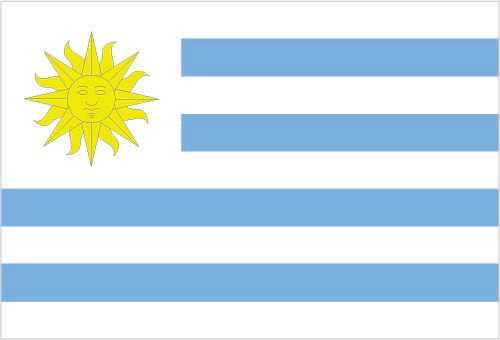
Flag
Meaning: The stripes represent the country's nine original departments; the sun refers to the legend of the sun breaking through the clouds on 25 May 1810 as independence was declared from Spain; the sun is said to be Inti, the Inca god of the sun
Note: The banner was inspired by the national colors of Argentina and the design of the US flag
Independence
Judicial branch
Judge selection and term of office: Judges nominated by the president and appointed by two-thirds vote in joint conference of the General Assembly; judges serve 10-year terms, with reelection possible after a lapse of 5 years following the previous term
Subordinate courts: Courts of Appeal; District Courts (Juzgados Letrados); Peace Courts (Juzgados de Paz); Rural Courts (Juzgados Rurales)
Legal system
Legislative branch
Legislative structure: Bicameral
International organization participation
National holiday
Political parties
Colorado Party or PC (including Batllistas and Ciudadanos)
Intransigent Radical Ecologist Party (Partido Ecologista Radical Intransigente) or PERI
Independent Party
National Party or PN (including Todos (Everyone) and National Alliance)
Open Cabildo
Popular Unity
Suffrage
Government type
Country name
Conventional short form: Uruguay
Local long form: República Oriental del Uruguay
Local short form: Uruguay
Former: Banda Oriental, Cisplatine Province
Etymology: Name derives from the Uruguay River, which makes up the western border of the country; the river's name comes from the Guarani words uru (bird) and guay (tail)
Diplomatic representation in the US
Chancery: 1913 I Street NW, Washington, DC 20006
Telephone: [1] (202) 331-1313
FAX: [1] (202) 331-8142
Email address and website:
Urueeuu@mrree.gub.uy
https://embassyofuruguay.us/
Consulate(s) general: Miami, New York, San Francisco
National anthem(s)
Lyrics/music: Francisco Esteban ACUNA de Figueroa/Francisco Jose DEBALI
History: Adopted 1848; the anthem is also known as "Orientales, la Patria o la tumba!" ("Uruguayans, the Fatherland or Death!"); it is the world's longest national anthem in terms of music (105 bars; almost five minutes); usually only the first verse and chorus are sung
International law organization participation
National symbol(s)
Citizenship
Citizenship by descent only: Yes
Dual citizenship recognized: Yes
Residency requirement for naturalization: 3-5 years
National heritage
Selected World Heritage Site locales: Historic City of Colonia del Sacramento; Fray Bentos Industrial Landscape; The work of engineer Eladio Dieste: Church of Atlántida
National color(s)
Population below poverty line
note: % of population with income below national poverty line
Household income or consumption by percentage share
Highest 10%: 30.8% (2023 est.)
note: % share of income accruing to lowest and highest 10% of population
Exports - commodities
note: top five export commodities based on value in dollars
Exports - partners
note: top five export partners based on percentage share of exports
Agricultural products
note: top ten agricultural products based on tonnage
Budget
Expenditures: $17.808 billion (2023 est.)
note: central government revenues (excluding grants) and expenditures converted to US dollars at average official exchange rate for year indicated
Imports - commodities
note: top five import commodities based on value in dollars
Exchange rates
Exchange rates:
40.213 (2024 est.)
38.824 (2023 est.)
41.171 (2022 est.)
43.555 (2021 est.)
42.013 (2020 est.)
Industries
Economic overview
GDP (official exchange rate)
note: data in current dollars at official exchange rate
GDP - composition, by end use
Government consumption: 13.8% (2015 est.)
Investment in fixed capital: 19.8% (2015 est.)
Investment in inventories: -0.1% (2015 est.)
Exports of goods and services: 22.5% (2015 est.)
Imports of goods and services: -22.9% (2015 est.)
note: figures may not total 100% due to rounding or gaps in data collection
Imports - partners
note: top five import partners based on percentage share of imports
Average household expenditures
On alcohol and tobacco: 1.2% of household expenditures (2023 est.)
Remittances
0.2% of GDP (2023 est.)
0.2% of GDP (2022 est.)
note: personal transfers and compensation between resident and non-resident individuals/households/entities
Labor force
note: number of people ages 15 or older who are employed or seeking work
Reserves of foreign exchange and gold
$16.257 billion (2023 est.)
$15.127 billion (2022 est.)
note: holdings of gold (year-end prices)/foreign exchange/special drawing rights in current dollars
Public debt
note: central government debt as a % of GDP
Unemployment rate
8.4% (2023 est.)
7.9% (2022 est.)
note: % of labor force seeking employment
Taxes and other revenues
note: central government tax revenue as a % of GDP
Real GDP (purchasing power parity)
$105.231 billion (2023 est.)
$104.456 billion (2022 est.)
note: data in 2021 dollars
Inflation rate (consumer prices)
5.9% (2023 est.)
9.1% (2022 est.)
note: annual % change based on consumer prices
Current account balance
-$2.64 billion (2023 est.)
-$2.675 billion (2022 est.)
note: balance of payments - net trade and primary/secondary income in current dollars
Real GDP per capita
$31,100 (2023 est.)
$30,800 (2022 est.)
note: data in 2021 dollars
Imports
$19.259 billion (2023 est.)
$19.639 billion (2022 est.)
note: balance of payments - imports of goods and services in current dollars
Exports
$21.946 billion (2023 est.)
$23.56 billion (2022 est.)
note: balance of payments - exports of goods and services in current dollars
Real GDP growth rate
0.7% (2023 est.)
4.5% (2022 est.)
note: annual GDP % growth based on constant local currency
Industrial production growth rate
note: annual % change in industrial value added based on constant local currency
GDP - composition, by sector of origin
Industry: 16.8% (2024 est.)
Services: 65.3% (2024 est.)
note: figures may not total 100% due to non-allocated consumption not captured in sector-reported data
Electricity access
Coal
Imports: 13,000 metric tons (2023 est.)
Electricity generation sources
Solar: 3.8% of total installed capacity (2023 est.)
Wind: 37% of total installed capacity (2023 est.)
Hydroelectricity: 27.3% of total installed capacity (2023 est.)
Biomass and waste: 23.9% of total installed capacity (2023 est.)
Natural gas
Imports: 90.871 million cubic meters (2023 est.)
Petroleum
Refined petroleum consumption: 50,000 bbl/day (2023 est.)
Electricity
Consumption: 9.826 billion kWh (2023 est.)
Exports: 2 billion kWh (2023 est.)
Imports: 84 million kWh (2023 est.)
Transmission/distribution losses: 1.136 billion kWh (2023 est.)
Internet users
Internet country code
Broadcast media
Telephones - mobile cellular
Subscriptions per 100 inhabitants: 139 (2022 est.)
Broadband - fixed subscriptions
Subscriptions per 100 inhabitants: 32 (2023 est.)
Telephones - fixed lines
Subscriptions per 100 inhabitants: 36 (2023 est.)
Railways
Standard gauge: 1,673 km (2016) 1.435-m gauge
Civil aircraft registration country code prefix
Airports
Merchant marine
By type: Container ship 1, general cargo 4, oil tanker 3, other 50
Heliports
Military service age and obligation
Note: As of 2023, women comprised nearly 20% of the active military
Military expenditures
2% of GDP (2023 est.)
2% of GDP (2022 est.)
2.3% of GDP (2021 est.)
2% of GDP (2020 est.)
Military and security forces
Ministry of Interior: National Police (2025)
Note: The National Police includes the paramilitary National Republican Guard (Guardia Nacional Republicana)
Military - note
Military and security service personnel strengths
Military deployments
Military equipment inventories and acquisitions
Refugees and internally displaced persons
IDPs: 33 (2024 est.)
Stateless persons: 5 (2024 est.)
Geoparks
Global geoparks and regional networks: Grutas del Palacio (2023)
Ports
Large: 0
Medium: 1
Small: 1
Very small: 6
Ports with oil terminals: 2
Key ports: Colonia, Fray Bentos, Jose Ignacio, La Paloma, Montevideo, Nueva Palmira, Paysandu, Puerto Sauce
Legislative branch - lower chamber
Number of seats: 99 (all directly elected)
Electoral system: Proportional representation
Scope of elections: Full renewal
Term in office: 5 years
Most recent election date: 10/27/2024
Parties elected and seats per party: Broad Front (FA) (48); National Party (PN) (29); Colorado Party (PC) (17); Other (5)
Percentage of women in chamber: 31.3%
Expected date of next election: October 2029
Legislative branch - upper chamber
Number of seats: 31 (all directly elected)
Electoral system: Proportional representation
Scope of elections: Full renewal
Term in office: 5 years
Most recent election date: 10/27/2024
Parties elected and seats per party: Broad Front (FA) (16); National Party (PN) (9); Colorado Party (PC) (5)
Percentage of women in chamber: 32.3%
Expected date of next election: October 2029
Methane emissions
Agriculture: 730.6 kt (2019-2021 est.)
Waste: 115.4 kt (2019-2021 est.)
Other: 2.8 kt (2019-2021 est.)
Gini Index coefficient - distribution of family income
note: index (0-100) of income distribution; higher values represent greater inequality