Turks and Caicos Islands
Central America and the CaribbeanTK September 03, 2025
Background
The islands were part of the UK's Jamaican colony until 1962, when they assumed the status of a separate Crown colony upon Jamaica's independence. The governor of The Bahamas oversaw affairs from 1965 to 1973. With Bahamian independence, the islands received a separate governor in 1973. Although independence was agreed upon for 1982, the policy was reversed, and the islands remain a British overseas territory. Grand Turk Island suffered extensive damage from Hurricane Maria in 2017.
Geographic coordinates
21 45 N, 71 35 W
Natural hazards
frequent hurricanes
Area - comparative
2.5 times the size of Washington, D.C.
Environmental issues
limited natural freshwater resources
Climate
tropical; marine; moderated by trade winds; sunny and relatively dry
Coastline
389 km
Land boundaries
Total: 0 km
Land use
Agricultural land: 1.1% (2022 est.)
Arable land: 1.1% (2022 est.)
Permanent crops: 0% (2022 est.)
Permanent pasture: 0% (2022 est.)
Forest: 11.1% (2022 est.)
Other: 87.9% (2022 est.)
Arable land: 1.1% (2022 est.)
Permanent crops: 0% (2022 est.)
Permanent pasture: 0% (2022 est.)
Forest: 11.1% (2022 est.)
Other: 87.9% (2022 est.)
Maritime claims
Territorial sea: 12 nm
Exclusive fishing zone: 200 nm
Exclusive fishing zone: 200 nm
Natural resources
spiny lobster, conch
Geography - note
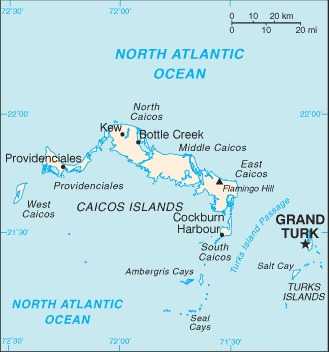
include eight large islands and numerous smaller cays, islets, and reefs; only two of the Caicos Islands and six of the Turks group are inhabited
Terrain
low, flat limestone; extensive marshes and mangrove swamps
Location
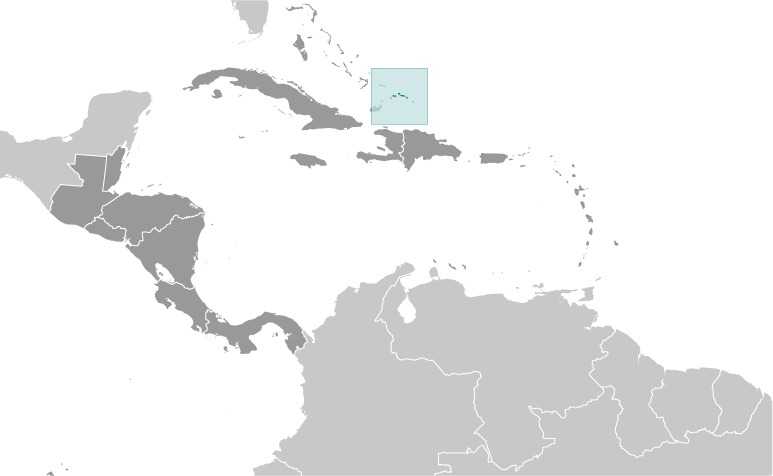
two island groups in the North Atlantic Ocean, southeast of The Bahamas, north of Haiti; note - although the Turks and Caicos Islands do not border the Caribbean Sea, geopolitically they are often designated as being Caribbean
Map references
Central America and the Caribbean
Irrigated land
0 sq km (2022)
Population distribution
eight of the thirty islands are inhabited; the island of Providenciales is the most populated, but the most densely populated is Grand Turk
Elevation
Highest point: Blue Hill on Providenciales and Flamingo Hill on East Caicos 48 m
Lowest point: Atlantic Ocean 0 m
Lowest point: Atlantic Ocean 0 m
Area
Total : 948 sq km
Land: 948 sq km
Water: 0 sq km
Land: 948 sq km
Water: 0 sq km
Age structure
0-14 years: 20.4% (male 6,288/female 6,056)
15-64 years: 73.2% (male 22,232/female 22,011)
65 years and over: 6.4% (2024 est.) (male 1,869/female 1,983)
15-64 years: 73.2% (male 22,232/female 22,011)
65 years and over: 6.4% (2024 est.) (male 1,869/female 1,983)
Sex ratio
At birth: 1.05 male(s)/female
0-14 years: 1.04 male(s)/female
15-64 years: 1.01 male(s)/female
65 years and over: 0.94 male(s)/female
Total population: 1.01 male(s)/female (2024 est.)
0-14 years: 1.04 male(s)/female
15-64 years: 1.01 male(s)/female
65 years and over: 0.94 male(s)/female
Total population: 1.01 male(s)/female (2024 est.)
Nationality
Noun: None
Adjective: None
Adjective: None
Urbanization
Urban population: 94.2% of total population (2023)
Rate of urbanization: 1.46% annual rate of change (2020-25 est.)
Rate of urbanization: 1.46% annual rate of change (2020-25 est.)
Major urban areas - population
5,000 GRAND TURK (capital) (2018)
Ethnic groups
Black 87.6%, White 7.9%, mixed 2.5%, East Indian 1.3%, other 0.7% (2006 est.)
Religions
Protestant 72.8% (Baptist 35.8%, Church of God 11.7%, Anglican 10%, Methodist 9.3%, Seventh Day Adventist 6%), Roman Catholic 11.4%, Jehovah's Witness 1.8%, other 14% (2006 est.)
Languages
English (official)
Dependency ratios
Total dependency ratio: 36.6 (2024 est.)
Youth dependency ratio: 27.9 (2024 est.)
Elderly dependency ratio: 8.7 (2024 est.)
Potential support ratio: 11.5 (2024 est.)
Youth dependency ratio: 27.9 (2024 est.)
Elderly dependency ratio: 8.7 (2024 est.)
Potential support ratio: 11.5 (2024 est.)
Drinking water source
Improved:
Urban: 99.2% of population (2022 est.)
Rural: 91.8% of population (2022 est.)
Total: 98.8% of population (2022 est.)
Unimproved:
Urban: 0.8% of population (2022 est.)
Rural: 8.2% of population (2022 est.)
Total: 1.2% of population (2022 est.)
Urban: 99.2% of population (2022 est.)
Rural: 91.8% of population (2022 est.)
Total: 98.8% of population (2022 est.)
Unimproved:
Urban: 0.8% of population (2022 est.)
Rural: 8.2% of population (2022 est.)
Total: 1.2% of population (2022 est.)
Sanitation facility access
Improved:
Urban: 98.8% of population (2022 est.)
Rural: 97.7% of population (2022 est.)
Total: 98.7% of population (2022 est.)
Unimproved:
Urban: 1.2% of population (2022 est.)
Rural: 2.3% of population (2022 est.)
Total: 1.3% of population (2022 est.)
Urban: 98.8% of population (2022 est.)
Rural: 97.7% of population (2022 est.)
Total: 98.7% of population (2022 est.)
Unimproved:
Urban: 1.2% of population (2022 est.)
Rural: 2.3% of population (2022 est.)
Total: 1.3% of population (2022 est.)
School life expectancy (primary to tertiary education)
Total: 14 years (2023 est.)
Male: 15 years (2023 est.)
Female: 14 years (2023 est.)
Male: 15 years (2023 est.)
Female: 14 years (2023 est.)
Gross reproduction rate
0.83 (2024 est.)
Currently married women (ages 15-49)
59.1% (2023 est.)
Child marriage
Women married by age 15: 0% (2020)
Women married by age 18: 23.3% (2020)
Men married by age 18: 5.1% (2020)
Women married by age 18: 23.3% (2020)
Men married by age 18: 5.1% (2020)
Net migration rate
8.3 migrant(s)/1,000 population (2024 est.)
Median age
Total: 36.3 years (2024 est.)
Male: 36.5 years
Female: 36.1 years
Male: 36.5 years
Female: 36.1 years
Total fertility rate
1.7 children born/woman (2024 est.)
Population
Total: 60,439 (2024 est.)
Male: 30,389
Female: 30,050
Male: 30,389
Female: 30,050
Infant mortality rate
Total: 11.1 deaths/1,000 live births (2024 est.)
Male: 13.9 deaths/1,000 live births
Female: 8.1 deaths/1,000 live births
Male: 13.9 deaths/1,000 live births
Female: 8.1 deaths/1,000 live births
Death rate
3.6 deaths/1,000 population (2024 est.)
Birth rate
13 births/1,000 population (2024 est.)
Children under the age of 5 years underweight
0.4% (2019/20)
Life expectancy at birth
Total population: 81.3 years (2024 est.)
Male: 78.5 years
Female: 84.1 years
Male: 78.5 years
Female: 84.1 years
Education expenditure
3.1% of GDP (2023 est.)
8.7% national budget (2023 est.)
8.7% national budget (2023 est.)
Population growth rate
1.77% (2024 est.)
Carbon dioxide emissions
447,000 metric tonnes of CO2 (2023 est.)
From petroleum and other liquids: 447,000 metric tonnes of CO2 (2023 est.)
From petroleum and other liquids: 447,000 metric tonnes of CO2 (2023 est.)
Diplomatic representation from the US
Embassy: None (overseas territory of the UK)
Administrative divisions
none (overseas territory of the UK)
Capital
Name: Grand Turk (Cockburn Town)
Geographic coordinates: 21 28 N, 71 08 W
Time difference: UTC-5 (same time as Washington, DC, during Standard Time)
Daylight saving time: +1hr, begins second Sunday in March; ends first Sunday in November
Etymology: Named after Sir Francis COCKBURN, who served as governor of the Bahamas from 1837 to 1844
Geographic coordinates: 21 28 N, 71 08 W
Time difference: UTC-5 (same time as Washington, DC, during Standard Time)
Daylight saving time: +1hr, begins second Sunday in March; ends first Sunday in November
Etymology: Named after Sir Francis COCKBURN, who served as governor of the Bahamas from 1837 to 1844
Constitution
History: Several previous; latest signed 7 August 2012, effective 15 October 2012 (The Turks and Caicos Constitution Order 2011)
Executive branch
Chief of state: King CHARLES III (since 8 September 2022); represented by Governor Dileeni Daniel-SELVARATNAM (since 29 June 2023)
Head of government: Premier Washington MISICK (since 19 February 2021)
Cabinet: Cabinet appointed by the governor from among members of the House of Assembly
Election/appointment process: The monarch is hereditary; governor appointed by the monarch; following legislative elections, the governor appoints the leader of the majority party as the premier
Head of government: Premier Washington MISICK (since 19 February 2021)
Cabinet: Cabinet appointed by the governor from among members of the House of Assembly
Election/appointment process: The monarch is hereditary; governor appointed by the monarch; following legislative elections, the governor appoints the leader of the majority party as the premier
Flag
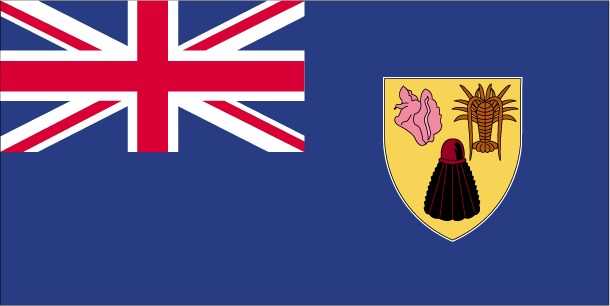
Description: Blue with the UK flag in the upper-left quadrant and the colonial shield centered on the right half of the flag; the shield is yellow and displays a conch shell, a spiny lobster, and Turk's cap cactus
Independence
none (overseas territory of the UK)
Judicial branch
Highest court(s): Supreme Court (consists of the chief justice and other judges, as determined by the governor); Court of Appeal (consists of the court president and 2 justices)
Judge selection and term of office: Supreme Court and Appeals Court judges appointed by the governor in accordance with the Judicial Service Commission, a 3-member body of high-level judicial officials; Supreme Court judges serve until mandatory retirement at age 65, but terms can be extended to age 70; Appeals Court judge tenure determined by individual terms of appointment
Subordinate courts: Magistrates' courts
Note: Appeals beyond the Supreme Court are referred to the Judicial Committee of the Privy Council (in London)
Judge selection and term of office: Supreme Court and Appeals Court judges appointed by the governor in accordance with the Judicial Service Commission, a 3-member body of high-level judicial officials; Supreme Court judges serve until mandatory retirement at age 65, but terms can be extended to age 70; Appeals Court judge tenure determined by individual terms of appointment
Subordinate courts: Magistrates' courts
Note: Appeals beyond the Supreme Court are referred to the Judicial Committee of the Privy Council (in London)
Legal system
mixed system of English common law and civil law
Legislative branch
Legislature name: House of Assembly
Legislative structure: Unicameral
Number of seats: 21 (directly elected or appointed)
Electoral system: Mixed
Scope of elections: Full renewal
Term in office: 4 years
Most recent election date: 2/07/2025
Parties elected and seats per party: PNP (16); PDM (2); independents (1)
Percentage of women in chamber: 27.3%
Expected date of next election: 2029
Legislative structure: Unicameral
Number of seats: 21 (directly elected or appointed)
Electoral system: Mixed
Scope of elections: Full renewal
Term in office: 4 years
Most recent election date: 2/07/2025
Parties elected and seats per party: PNP (16); PDM (2); independents (1)
Percentage of women in chamber: 27.3%
Expected date of next election: 2029
International organization participation
Caricom (associate), CDB, Interpol (subbureau), UPU
Political parties
People's Democratic Movement or PDM
Progressive National Party or PNP
Progressive National Party or PNP
Suffrage
18 years of age; universal
Government type
parliamentary democracy
Country name
Conventional long form: None
Conventional short form: Turks and Caicos Islands
Abbreviation: TCA
Etymology: The Turks Islands are named after the Turk's cap cactus, which is native to the islands and appears on the flag and coat of arms; the name Caicos may derive from caya hico, a phrase meaning “string of islands” in the Lucayan (Arawak) language, or from the Spanish word cayo, meaning "rock"
Conventional short form: Turks and Caicos Islands
Abbreviation: TCA
Etymology: The Turks Islands are named after the Turk's cap cactus, which is native to the islands and appears on the flag and coat of arms; the name Caicos may derive from caya hico, a phrase meaning “string of islands” in the Lucayan (Arawak) language, or from the Spanish word cayo, meaning "rock"
Diplomatic representation in the US
none (overseas territory of the UK)
National anthem(s)
Title: "This Land of Ours"
Lyrics/music: Conrad HOWELL
History: Serves as a local anthem
_____
Title: "God Save the King"
Lyrics/music: Unknown
History: Official anthem, as a UK overseas territory
Lyrics/music: Conrad HOWELL
History: Serves as a local anthem
_____
Title: "God Save the King"
Lyrics/music: Unknown
History: Official anthem, as a UK overseas territory
National symbol(s)
conch shell, Turk's cap cactus
Citizenship
see United Kingdom
Exports - commodities
plastics, shellfish, carbonates, tobacco, garments (2023)
note: top five export commodities based on value in dollars
note: top five export commodities based on value in dollars
Agricultural products
corn, beans, cassava (manioc, tapioca), citrus fruits; fish
Budget
Revenues: $247.3 million (2017 est.)
Expenditures: $224.3 million (2017 est.)
Expenditures: $224.3 million (2017 est.)
Imports - commodities
refined petroleum, cars, aluminum structures, furniture, plastic products (2023)
note: top five import commodities based on value in dollars
note: top five import commodities based on value in dollars
Exchange rates
the US dollar is used
Industries
tourism, offshore financial services
Economic overview
British Caribbean island territorial economy; GDP and its tourism industry hit hard by COVID-19 disruptions; major biodiversity locale; US dollar user; fossil fuel dependent; negative trade balance; increasing unemployment
GDP (official exchange rate)
$1.745 billion (2024 est.)
note: data in current dollars at official exchange rate
note: data in current dollars at official exchange rate
Imports - partners
USA 73%, Dominican Republic 4%, Italy 3%, Japan 3%, China 2% (2023)
note: top five import partners based on percentage share of imports
note: top five import partners based on percentage share of imports
Exports - partners
Gabon 27%, USA 25%, Zimbabwe 17%, Czechia 8%, UAE 3% (2023)
note: top five export partners based on percentage share of exports
note: top five export partners based on percentage share of exports
Remittances
0% of GDP (2023 est.)
0% of GDP (2022 est.)
0% of GDP (2021 est.)
note: personal transfers and compensation between resident and non-resident individuals/households/entities
0% of GDP (2022 est.)
0% of GDP (2021 est.)
note: personal transfers and compensation between resident and non-resident individuals/households/entities
Real GDP (purchasing power parity)
$1.554 billion (2024 est.)
$1.471 billion (2023 est.)
$1.293 billion (2022 est.)
note: data in 2021 dollars
$1.471 billion (2023 est.)
$1.293 billion (2022 est.)
note: data in 2021 dollars
Inflation rate (consumer prices)
8.5% (2022 est.)
5% (2021 est.)
2.3% (2020 est.)
Note: Annual % change based on consumer prices
5% (2021 est.)
2.3% (2020 est.)
Note: Annual % change based on consumer prices
Current account balance
$172.709 million (2018 est.)
$35.016 million (2017 est.)
$247.081 million (2016 est.)
note: balance of payments - net trade and primary/secondary income in current dollars
$35.016 million (2017 est.)
$247.081 million (2016 est.)
note: balance of payments - net trade and primary/secondary income in current dollars
Real GDP per capita
$33,400 (2024 est.)
$31,800 (2023 est.)
$28,200 (2022 est.)
note: data in 2021 dollars
$31,800 (2023 est.)
$28,200 (2022 est.)
note: data in 2021 dollars
Imports
$544.219 million (2018 est.)
$484.842 million (2017 est.)
$438.041 million (2016 est.)
note: balance of payments - imports of goods and services in current dollars
$484.842 million (2017 est.)
$438.041 million (2016 est.)
note: balance of payments - imports of goods and services in current dollars
Exports
$826.824 million (2018 est.)
$602.581 million (2017 est.)
$741.173 million (2016 est.)
note: balance of payments - exports of goods and services in current dollars
$602.581 million (2017 est.)
$741.173 million (2016 est.)
note: balance of payments - exports of goods and services in current dollars
Real GDP growth rate
5.6% (2024 est.)
13.7% (2023 est.)
14.1% (2022 est.)
note: annual GDP % growth based on constant local currency
13.7% (2023 est.)
14.1% (2022 est.)
note: annual GDP % growth based on constant local currency
Industrial production growth rate
9% (2024 est.)
note: annual % change in industrial value added based on constant local currency
note: annual % change in industrial value added based on constant local currency
GDP - composition, by sector of origin
Agriculture: 0.4% (2024 est.)
Industry: 9.3% (2024 est.)
Services: 72.6% (2024 est.)
note: figures may not total 100% due to non-allocated consumption not captured in sector-reported data
Industry: 9.3% (2024 est.)
Services: 72.6% (2024 est.)
note: figures may not total 100% due to non-allocated consumption not captured in sector-reported data
Electricity access
Electrification - total population: 99.9% (2022 est.)
Electrification - urban areas: 100%
Electrification - rural areas: 100%
Electrification - urban areas: 100%
Electrification - rural areas: 100%
Electricity generation sources
Fossil fuels: 98.1% of total installed capacity (2023 est.)
Solar: 1.9% of total installed capacity (2023 est.)
Solar: 1.9% of total installed capacity (2023 est.)
Petroleum
Refined petroleum consumption: 3,000 bbl/day (2023 est.)
Electricity
Installed generating capacity: 94,000 kW (2023 est.)
Consumption: 252.088 million kWh (2023 est.)
Transmission/distribution losses: 12.912 million kWh (2023 est.)
Consumption: 252.088 million kWh (2023 est.)
Transmission/distribution losses: 12.912 million kWh (2023 est.)
Internet country code
.tc
Broadcast media
no local terrestrial TV stations; broadcasts from the Bahamas, multi-channel cable, and satellite TV available; state-run radio network operates alongside private broadcasters, with a total of about 15 stations
Internet users
Percent of population: 93.5% (2022)
Telephones - mobile cellular
Total subscriptions: 25,085 (2004 est.)
Subscriptions per 100 inhabitants: 110 (2004 est.)
Subscriptions per 100 inhabitants: 110 (2004 est.)
Telephones - fixed lines
Total subscriptions: 4,000 (2021 est.)
Subscriptions per 100 inhabitants: 9 (2022 est.)
Subscriptions per 100 inhabitants: 9 (2022 est.)
Civil aircraft registration country code prefix
VQ-T
Airports
9 (2025)
Merchant marine
Total: 3 (2023)
By type: General cargo 1, other 2
By type: General cargo 1, other 2
Military - note
defense is the responsibility of the UK
Refugees and internally displaced persons
Refugees: 8 (2024 est.)
Dependency status
overseas territory of the UK
People - note
destination and transit point for illegal Haitian immigrants bound for the Bahamas and the US
Ports
Total ports: 3 (2024)
Large: 0
Medium: 0
Small: 0
Very small: 2
Size unknown: 1
Ports with oil terminals: 1
Key ports: Cockburn Harbor, Grand Turk, Providenciales
Large: 0
Medium: 0
Small: 0
Very small: 2
Size unknown: 1
Ports with oil terminals: 1
Key ports: Cockburn Harbor, Grand Turk, Providenciales
Quick Facts
Also in Central America and the Caribbean
AnguillaAntigua and BarbudaArubaBahamas, TheBarbadosBelizeBritish Virgin IslandsCayman IslandsCosta RicaCuba
View all →