
Trinidad and Tobago
Central America and the CaribbeanTD December 10, 2025
Background
First colonized by the Spanish, Trinidad and Tobago came under British control in the early 19th century. The emancipation of enslaved people in 1834 disrupted the twin islands' sugar industry. Contract workers arriving from India between 1845 and 1917 augmented the labor force, which boosted sugar production as well as the cocoa industry. The discovery of oil on Trinidad in 1910 added another important export that remains the country's dominant industry. Trinidad and Tobago attained independence in 1962. The country is one of the most prosperous in the Caribbean, thanks largely to petroleum and natural gas production and processing. The government is struggling to reverse a surge in violent crime.
Geographic coordinates
11 00 N, 61 00 W
Natural hazards
outside usual path of hurricanes and other tropical storms
Area - comparative
slightly smaller than Delaware
Environmental issues
water pollution from agricultural chemicals, industrial wastes, and raw sewage; widespread pollution of waterways and coastal areas; illegal dumping; deforestation; soil erosion; fisheries and wildlife depletion
International environmental agreements
Party to: Biodiversity, Climate Change, Climate Change-Kyoto Protocol, Climate Change-Paris Agreement, Comprehensive Nuclear Test Ban, Desertification, Endangered Species, Hazardous Wastes, Law of the Sea, Marine Dumping-London Protocol, Marine Life Conservation, Nuclear Test Ban, Ozone Layer Protection, Ship Pollution, Tropical Timber 2006, Wetlands
Signed, but not ratified: None of the selected agreements
Signed, but not ratified: None of the selected agreements
Climate
tropical; rainy season (June to December)
Coastline
362 km
Land boundaries
Total: 0 km
Maritime claims
Territorial sea: 12 nm
Contiguous zone: 24 nm
Exclusive economic zone: 200 nm
Continental shelf: 200 nm or to the outer edge of the continental margin
Note: Measured from claimed archipelagic baselines
Contiguous zone: 24 nm
Exclusive economic zone: 200 nm
Continental shelf: 200 nm or to the outer edge of the continental margin
Note: Measured from claimed archipelagic baselines
Natural resources
petroleum, natural gas, asphalt
Geography - note
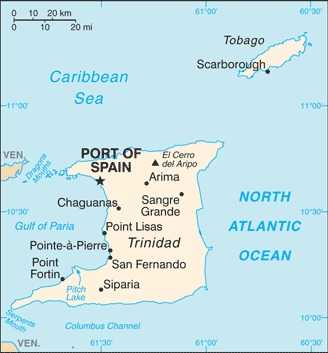
Pitch Lake, on Trinidad's southwestern coast, is the world's largest natural reservoir of asphalt
Terrain
mostly plains with some hills and low mountains
Location
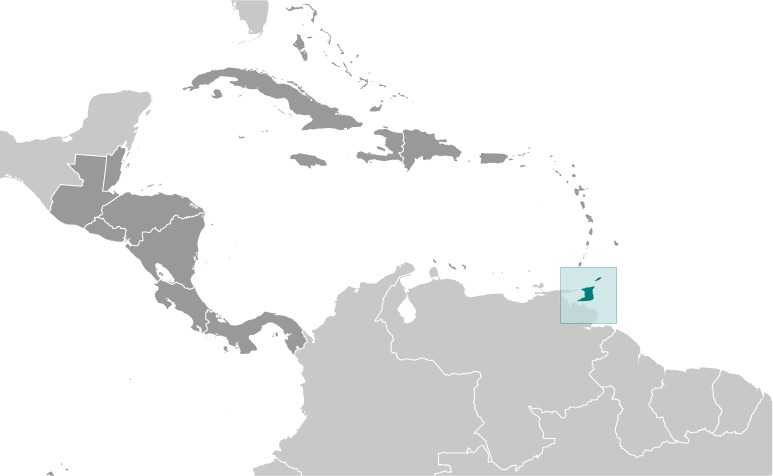
Caribbean, islands between the Caribbean Sea and the North Atlantic Ocean, northeast of Venezuela
Map references
Central America and the Caribbean
Irrigated land
70 sq km (2012)
Total renewable water resources
3.84 billion cubic meters (2022 est.)
Population distribution
population on Trinidad is concentrated in the western half of the island, on Tobago in the southern half
Elevation
Highest point: El Cerro del Aripo 940 m
Lowest point: Caribbean Sea 0 m
Mean elevation: 83 m
Lowest point: Caribbean Sea 0 m
Mean elevation: 83 m
Area
Total : 5,128 sq km
Land: 5,128 sq km
Water: 0 sq km
Land: 5,128 sq km
Water: 0 sq km
Land use
Agricultural land: 10.5% (2023 est.)
Arable land: 4.9% (2023 est.)
Permanent crops: 4.3% (2023 est.)
Permanent pasture: 1.4% (2023 est.)
Forest: 44.2% (2023 est.)
Other: 45.2% (2023 est.)
Arable land: 4.9% (2023 est.)
Permanent crops: 4.3% (2023 est.)
Permanent pasture: 1.4% (2023 est.)
Forest: 44.2% (2023 est.)
Other: 45.2% (2023 est.)
Age structure
0-14 years: 18.7% (male 134,508/female 129,180)
15-64 years: 67.2% (male 481,606/female 465,150)
65 years and over: 14.1% (2024 est.) (male 92,146/female 106,376)
15-64 years: 67.2% (male 481,606/female 465,150)
65 years and over: 14.1% (2024 est.) (male 92,146/female 106,376)
Sex ratio
At birth: 1.04 male(s)/female
0-14 years: 1.04 male(s)/female
15-64 years: 1.04 male(s)/female
65 years and over: 0.87 male(s)/female
Total population: 1.01 male(s)/female (2024 est.)
0-14 years: 1.04 male(s)/female
15-64 years: 1.04 male(s)/female
65 years and over: 0.87 male(s)/female
Total population: 1.01 male(s)/female (2024 est.)
Literacy
Female: 93.8% (2022 est.)
Nationality
Noun: Trinidadian(s), Tobagonian(s)
Adjective: Trinidadian, Tobagonian
Note: Trinbagonian is used on occasion to describe a citizen of the country without specifying the island of origin
Adjective: Trinidadian, Tobagonian
Note: Trinbagonian is used on occasion to describe a citizen of the country without specifying the island of origin
Urbanization
Urban population: 53.4% of total population (2023)
Rate of urbanization: 0.23% annual rate of change (2020-25 est.)
Rate of urbanization: 0.23% annual rate of change (2020-25 est.)
Drinking water source
Improved:
Total: 98.9% of population (2022 est.)
Unimproved:
Total: 1.1% of population (2022 est.)
Total: 98.9% of population (2022 est.)
Unimproved:
Total: 1.1% of population (2022 est.)
Major urban areas - population
545,000 PORT-OF-SPAIN (capital) (2023)
Physician density
4.16 physicians/1,000 population (2021)
Hospital bed density
1.6 beds/1,000 population (2021 est.)
Dependency ratios
Total dependency ratio: 48.8 (2024 est.)
Youth dependency ratio: 27.9 (2024 est.)
Elderly dependency ratio: 21 (2024 est.)
Potential support ratio: 4.8 (2024 est.)
Youth dependency ratio: 27.9 (2024 est.)
Elderly dependency ratio: 21 (2024 est.)
Potential support ratio: 4.8 (2024 est.)
Sanitation facility access
Improved:
Total: 99.9% of population (2022 est.)
Unimproved:
Total: 0.1% of population (2022 est.)
Total: 99.9% of population (2022 est.)
Unimproved:
Total: 0.1% of population (2022 est.)
Ethnic groups
East Indian 35.4%, African descent 34.2%, mixed - other 15.3%, mixed - African/East Indian 7.7%, other 1.3%, unspecified 6.2% (2011 est.)
Religions
Protestant 32.1% (Pentecostal/Evangelical/Full Gospel 12%, Baptist 6.9%, Anglican 5.7%, Seventh Day Adventist 4.1%, Presbyterian/Congregational 2.5%, other Protestant 0.9%), Roman Catholic 21.6%, Hindu 18.2%, Muslim 5%, Jehovah's Witness 1.5%, other 8.4%, none 2.2%, unspecified 11.1% (2011 est.)
Languages
English (official), Trinidadian Creole English, Tobagonian Creole English, Caribbean Hindustani (a dialect of Hindi), Trinidadian Creole French, Spanish, Chinese
Health expenditure
7% of GDP (2021)
10.9% of national budget (2022 est.)
10.9% of national budget (2022 est.)
Gross reproduction rate
0.8 (2024 est.)
Child marriage
Women married by age 15: 0.7% (2022)
Women married by age 18: 4.2% (2022)
Women married by age 18: 4.2% (2022)
Youth unemployment rate (ages 15-24)
Total: 11.1% (2024 est.)
Male: 10.3% (2024 est.)
Female: 12% (2024 est.)
note: % of labor force ages 15-24 seeking employment
Male: 10.3% (2024 est.)
Female: 12% (2024 est.)
note: % of labor force ages 15-24 seeking employment
Net migration rate
-0.9 migrant(s)/1,000 population (2024 est.)
Median age
Total: 38.5 years (2024 est.)
Male: 38 years
Female: 39 years
Male: 38 years
Female: 39 years
Maternal mortality ratio
54 deaths/100,000 live births (2023 est.)
Total fertility rate
1.63 children born/woman (2024 est.)
Population
Total: 1,408,966 (2024 est.)
Male: 708,260
Female: 700,706
Male: 708,260
Female: 700,706
Infant mortality rate
Total: 15.1 deaths/1,000 live births (2024 est.)
Male: 17.1 deaths/1,000 live births
Female: 13 deaths/1,000 live births
Male: 17.1 deaths/1,000 live births
Female: 13 deaths/1,000 live births
Obesity - adult prevalence rate
18.6% (2016)
Death rate
8.6 deaths/1,000 population (2024 est.)
Birth rate
10.5 births/1,000 population (2024 est.)
Alcohol consumption per capita
Total: 5.81 liters of pure alcohol (2019 est.)
Beer: 2.92 liters of pure alcohol (2019 est.)
Wine: 0.16 liters of pure alcohol (2019 est.)
Spirits: 2.65 liters of pure alcohol (2019 est.)
Other alcohols: 0.09 liters of pure alcohol (2019 est.)
Beer: 2.92 liters of pure alcohol (2019 est.)
Wine: 0.16 liters of pure alcohol (2019 est.)
Spirits: 2.65 liters of pure alcohol (2019 est.)
Other alcohols: 0.09 liters of pure alcohol (2019 est.)
Life expectancy at birth
Total population: 76.5 years (2024 est.)
Male: 74.6 years
Female: 78.4 years
Male: 74.6 years
Female: 78.4 years
Population growth rate
0.1% (2024 est.)
Currently married women (ages 15-49)
42.7% (2022 est.)
Education expenditure
3% of GDP (2023 est.)
12.6% national budget (2025 est.)
12.6% national budget (2025 est.)
Total water withdrawal
Municipal: 237.6 million cubic meters (2022 est.)
Industrial: 128.9 million cubic meters (2022 est.)
Agricultural: 16.7 million cubic meters (2022 est.)
Industrial: 128.9 million cubic meters (2022 est.)
Agricultural: 16.7 million cubic meters (2022 est.)
Waste and recycling
Municipal solid waste generated annually: 727,900 tons (2024 est.)
Percent of municipal solid waste recycled: 16.2% (2022 est.)
Percent of municipal solid waste recycled: 16.2% (2022 est.)
Particulate matter emissions
10.4 micrograms per cubic meter (2019 est.)
Carbon dioxide emissions
33.629 million metric tonnes of CO2 (2023 est.)
From coal and metallurgical coke: 6,000 metric tonnes of CO2 (2023 est.)
From petroleum and other liquids: 3.634 million metric tonnes of CO2 (2023 est.)
From consumed natural gas: 29.989 million metric tonnes of CO2 (2023 est.)
From coal and metallurgical coke: 6,000 metric tonnes of CO2 (2023 est.)
From petroleum and other liquids: 3.634 million metric tonnes of CO2 (2023 est.)
From consumed natural gas: 29.989 million metric tonnes of CO2 (2023 est.)
Diplomatic representation from the US
Chief of mission: Ambassador (vacant); Chargé d’Affaires Jenifer NEIDHART de ORTIZ (since January 2025)
Embassy: 15 Queen's Park West, Port of Spain
Mailing address: 3410 Port of Spain Place, Washington DC 20521-3410
Telephone: (868) 622-6371
FAX: (868) 822-5905
Email address and website:
Ptspas@state.gov
https://tt.usembassy.gov/
Embassy: 15 Queen's Park West, Port of Spain
Mailing address: 3410 Port of Spain Place, Washington DC 20521-3410
Telephone: (868) 622-6371
FAX: (868) 822-5905
Email address and website:
Ptspas@state.gov
https://tt.usembassy.gov/
Administrative divisions
9 regions, 3 boroughs, 2 cities, 1 ward
Regions: Couva/Tabaquite/Talparo, Diego Martin, Mayaro/Rio Claro, Penal/Debe, Princes Town, Sangre Grande, San Juan/Laventille, Siparia, Tunapuna/Piarco
Borough: Arima, Chaguanas, Point Fortin
Cities: Port of Spain, San Fernando
Ward: Tobago
Regions: Couva/Tabaquite/Talparo, Diego Martin, Mayaro/Rio Claro, Penal/Debe, Princes Town, Sangre Grande, San Juan/Laventille, Siparia, Tunapuna/Piarco
Borough: Arima, Chaguanas, Point Fortin
Cities: Port of Spain, San Fernando
Ward: Tobago
Capital
Name: Port of Spain
Geographic coordinates: 10 39 N, 61 31 W
Time difference: UTC-4 (1 hour ahead of Washington, DC, during Standard Time)
Etymology: Translation of the name the Spanish gave the town in 1595, Puerto de España; the name was anglicized after the British captured Trinidad in 1797
Geographic coordinates: 10 39 N, 61 31 W
Time difference: UTC-4 (1 hour ahead of Washington, DC, during Standard Time)
Etymology: Translation of the name the Spanish gave the town in 1595, Puerto de España; the name was anglicized after the British captured Trinidad in 1797
Constitution
History: Previous 1962; latest 1976
Amendment process: Proposed by Parliament; passage of amendments affecting constitutional provisions, such as human rights and freedoms or citizenship, requires at least two-thirds majority vote by the membership of both houses and assent of the president; passage of amendments, such as the powers and authorities of the executive, legislative, and judicial branches of government, and the procedure for amending the constitution, requires at least three-quarters majority vote by the House membership, two-thirds majority vote by the Senate membership, and assent of the president
Amendment process: Proposed by Parliament; passage of amendments affecting constitutional provisions, such as human rights and freedoms or citizenship, requires at least two-thirds majority vote by the membership of both houses and assent of the president; passage of amendments, such as the powers and authorities of the executive, legislative, and judicial branches of government, and the procedure for amending the constitution, requires at least three-quarters majority vote by the House membership, two-thirds majority vote by the Senate membership, and assent of the president
Executive branch
Chief of state: President Christine KANGALOO (since 20 March 2023)
Head of government: Prime Minister Kamla Susheila PERSAD-BISSESSAR (since 1 May 2025)
Cabinet: Cabinet appointed from among members of Parliament
Election/appointment process: President indirectly elected by an electoral college of selected Senate and House of Representatives members for a 5-year term (eligible for a second term); the president usually appoints the leader of the majority party in the House of Representatives as prime minister
Most recent election date: 20 January 2023
Election results:
2023: Christine KANGALOO elected president by the electoral college on 20 January 2023; electoral college vote Christine KANGALOO (PNM) 48, Israel KHAN (UNC) 22
2018: Paula-Mae WEEKES (independent) elected president; ran unopposed and was elected without a vote; she was Trinidad and Tabago's first female head of state
Expected date of next election: By February 2028
Head of government: Prime Minister Kamla Susheila PERSAD-BISSESSAR (since 1 May 2025)
Cabinet: Cabinet appointed from among members of Parliament
Election/appointment process: President indirectly elected by an electoral college of selected Senate and House of Representatives members for a 5-year term (eligible for a second term); the president usually appoints the leader of the majority party in the House of Representatives as prime minister
Most recent election date: 20 January 2023
Election results:
2023: Christine KANGALOO elected president by the electoral college on 20 January 2023; electoral college vote Christine KANGALOO (PNM) 48, Israel KHAN (UNC) 22
2018: Paula-Mae WEEKES (independent) elected president; ran unopposed and was elected without a vote; she was Trinidad and Tabago's first female head of state
Expected date of next election: By February 2028
Flag
Description: Red with a white-edged black diagonal band from the upper left to the lower right
Meaning: The colors represent the elements of earth, water, and fire; black also stands for the wealth of the land and the dedication of the people; white for the sea, the purity of the country's aspirations, and equality; red for the sun, the vitality of the land, and the people's courage and friendliness
Meaning: The colors represent the elements of earth, water, and fire; black also stands for the wealth of the land and the dedication of the people; white for the sea, the purity of the country's aspirations, and equality; red for the sun, the vitality of the land, and the people's courage and friendliness
Independence
31 August 1962 (from the UK)
Judicial branch
Highest court(s): Supreme Court of the Judicature (consists of a chief justice for both the Court of Appeal with 12 judges and the High Court with 24 judges)
Judge selection and term of office: Supreme Court chief justice appointed by the president after consultation with the prime minister and the parliamentary leader of the opposition; other judges appointed by the Judicial Legal Services Commission, headed by the chief justice and 5 members with judicial experience; all judges serve for life with mandatory retirement normally at age 65
Subordinate courts: Courts of Summary Criminal Jurisdiction; Petty Civil Courts; Family Court
Note: Trinidad and Tobago can file appeals beyond its Supreme Court to the Caribbean Court of Justice, with final appeal to the Judicial Committee of the Privy Council (in London)
Judge selection and term of office: Supreme Court chief justice appointed by the president after consultation with the prime minister and the parliamentary leader of the opposition; other judges appointed by the Judicial Legal Services Commission, headed by the chief justice and 5 members with judicial experience; all judges serve for life with mandatory retirement normally at age 65
Subordinate courts: Courts of Summary Criminal Jurisdiction; Petty Civil Courts; Family Court
Note: Trinidad and Tobago can file appeals beyond its Supreme Court to the Caribbean Court of Justice, with final appeal to the Judicial Committee of the Privy Council (in London)
Legal system
English common law; Supreme Court reviews legislative acts
Legislative branch
Legislature name: Parliament
Legislative structure: Bicameral
Note: Tobago has a unicameral House of Assembly (19 seats; 15 assemblymen directly elected by simple majority vote and 4 appointed councilors - 3 on the advice of the chief secretary and 1 on the advice of the minority leader; members serve 4-year terms)
Legislative structure: Bicameral
Note: Tobago has a unicameral House of Assembly (19 seats; 15 assemblymen directly elected by simple majority vote and 4 appointed councilors - 3 on the advice of the chief secretary and 1 on the advice of the minority leader; members serve 4-year terms)
International organization participation
ACP, ACS, AOSIS, C, Caricom, CDB, CELAC, EITI (compliant country), FAO, G-24, G-77, IADB, IAEA, IBRD, ICAO, ICC (NGOs), ICCt, ICRM, IDA, IFAD, IFC, IFRCS, IHO, ILO, IMF, IMO, Interpol, IOC, IOM, IPU, ISO, ITSO, ITU, ITUC (NGOs), LAES, MIGA, NAM, OAS, OPANAL, OPCW, Pacific Alliance (observer), Paris Club (associate), UN, UNCTAD, UNESCO, UNIDO, UPU, WCO, WFTU (NGOs), WHO, WIPO, WMO, WTO
National holiday
Independence Day, 31 August (1962)
Political parties
People's National Movement or PNM
United National Congress or UNC
Tobago People’s Party or Tobago
United National Congress or UNC
Tobago People’s Party or Tobago
Suffrage
18 years of age; universal
Government type
parliamentary republic
Country name
Conventional long form: Republic of Trinidad and Tobago
Conventional short form: Trinidad and Tobago
Etymology: Explorer Christopher COLUMBUS named the larger island "La Isla de la Trinidad" (The Island of the Trinity) in 1498, possibly because of the three mountain peaks on the island; COLUMBUS may have gotten the name Tobago, spelled "tobaco" in Spanish, from the tobacco grown and smoked locally, or from its elongated cigar shape
Conventional short form: Trinidad and Tobago
Etymology: Explorer Christopher COLUMBUS named the larger island "La Isla de la Trinidad" (The Island of the Trinity) in 1498, possibly because of the three mountain peaks on the island; COLUMBUS may have gotten the name Tobago, spelled "tobaco" in Spanish, from the tobacco grown and smoked locally, or from its elongated cigar shape
Diplomatic representation in the US
Chief of mission: Ambassador (vacant); Chargé d'Affaires Venessa RAMHIT-RAMROOP (since 4 June 2025)
Chancery: 1708 Massachusetts Avenue NW, Washington, DC 20036-1975
Telephone: [1] (202) 467-6490
FAX: [1] (202) 785-3130
Email address and website:
Embdcinfo@foreign.gov.tt
https://foreign.gov.tt/missions-consuls/tt-missions-abroad/diplomatic-missions/embassy-washington-dc-us/
Consulate(s) general: Miami, New York
Chancery: 1708 Massachusetts Avenue NW, Washington, DC 20036-1975
Telephone: [1] (202) 467-6490
FAX: [1] (202) 785-3130
Email address and website:
Embdcinfo@foreign.gov.tt
https://foreign.gov.tt/missions-consuls/tt-missions-abroad/diplomatic-missions/embassy-washington-dc-us/
Consulate(s) general: Miami, New York
National anthem(s)
Title: "Forged From the Love of Liberty"
Lyrics/music: Patrick Stanislaus CASTAGNE
History: Adopted 1962; song originally written as an anthem for the West Indies Federation; Trinidad and Tobago adopted it when the Federation dissolved
Lyrics/music: Patrick Stanislaus CASTAGNE
History: Adopted 1962; song originally written as an anthem for the West Indies Federation; Trinidad and Tobago adopted it when the Federation dissolved
International law organization participation
has not submitted an ICJ jurisdiction declaration; accepts ICCt jurisdiction
National symbol(s)
scarlet ibis (bird of Trinidad), cocrico (bird of Tobago), chaconia flower
Citizenship
Citizenship by birth: Yes
Citizenship by descent only: Yes
Dual citizenship recognized: Yes
Residency requirement for naturalization: 8 years
Citizenship by descent only: Yes
Dual citizenship recognized: Yes
Residency requirement for naturalization: 8 years
National color(s)
red, white, black
Exports - commodities
natural gas, alcohols, ammonia, crude petroleum, iron reductions (2023)
note: top five export commodities based on value in dollars
note: top five export commodities based on value in dollars
Exports - partners
USA 28%, China 7%, Guyana 5%, Chile 5%, Netherlands 5% (2023)
note: top five export partners based on percentage share of exports
note: top five export partners based on percentage share of exports
Agricultural products
chicken, fruits, coconuts, citrus fruits, maize, oranges, plantains, eggs, taro, mangoes/guavas (2023)
note: top ten agricultural products based on tonnage
note: top ten agricultural products based on tonnage
Budget
Revenues: $5.698 billion (2019 est.)
Expenditures: $7.822 billion (2019 est.)
note: central government revenues (excluding grants) and expenses converted to US dollars at average official exchange rate for year indicated
Expenditures: $7.822 billion (2019 est.)
note: central government revenues (excluding grants) and expenses converted to US dollars at average official exchange rate for year indicated
Imports - commodities
railway cargo containers, refined petroleum, cars, iron ore, excavation machinery (2023)
note: top five import commodities based on value in dollars
note: top five import commodities based on value in dollars
Exchange rates
Trinidad and Tobago dollars (TTD) per US dollar -
Exchange rates:
6.75 (2024 est.)
6.75 (2023 est.)
6.754 (2022 est.)
6.759 (2021 est.)
6.751 (2020 est.)
Exchange rates:
6.75 (2024 est.)
6.75 (2023 est.)
6.754 (2022 est.)
6.759 (2021 est.)
6.751 (2020 est.)
Industries
petroleum and petroleum products, liquefied natural gas, methanol, ammonia, urea, steel products, beverages, food processing, cement, cotton textiles
Economic overview
high-income Caribbean economy; major hydrocarbon exporter; key tourism and finance sectors; high inflation and growing public debt; long foreign currency access delays; large foreign reserves and sovereign wealth fund
GDP (official exchange rate)
$26.429 billion (2024 est.)
note: data in current dollars at official exchange rate
note: data in current dollars at official exchange rate
GDP - composition, by end use
Household consumption: 78.9% (2017 est.)
Government consumption: 16.4% (2017 est.)
Investment in fixed capital: 19.8% (2021 est.)
Investment in inventories: 0% (2021 est.)
Exports of goods and services: 45.4% (2017 est.)
Imports of goods and services: -48.7% (2017 est.)
Government consumption: 16.4% (2017 est.)
Investment in fixed capital: 19.8% (2021 est.)
Investment in inventories: 0% (2021 est.)
Exports of goods and services: 45.4% (2017 est.)
Imports of goods and services: -48.7% (2017 est.)
Imports - partners
USA 29%, Guyana 27%, China 8%, Brazil 4%, Canada 3% (2023)
note: top five import partners based on percentage share of imports
note: top five import partners based on percentage share of imports
Remittances
0.8% of GDP (2024 est.)
0.8% of GDP (2023 est.)
0.7% of GDP (2022 est.)
note: personal transfers and compensation between resident and non-resident individuals/households/entities
0.8% of GDP (2023 est.)
0.7% of GDP (2022 est.)
note: personal transfers and compensation between resident and non-resident individuals/households/entities
Labor force
649,900 (2024 est.)
note: number of people ages 15 or older who are employed or seeking work
note: number of people ages 15 or older who are employed or seeking work
Reserves of foreign exchange and gold
$5.601 billion (2024 est.)
$6.256 billion (2023 est.)
$6.832 billion (2022 est.)
note: holdings of gold (year-end prices)/foreign exchange/special drawing rights in current dollars
$6.256 billion (2023 est.)
$6.832 billion (2022 est.)
note: holdings of gold (year-end prices)/foreign exchange/special drawing rights in current dollars
Unemployment rate
4.6% (2024 est.)
4.3% (2023 est.)
4.4% (2022 est.)
note: % of labor force seeking employment
4.3% (2023 est.)
4.4% (2022 est.)
note: % of labor force seeking employment
Taxes and other revenues
16.7% (of GDP) (2019 est.)
note: central government tax revenue as a % of GDP
note: central government tax revenue as a % of GDP
Real GDP (purchasing power parity)
$43.362 billion (2024 est.)
$42.658 billion (2023 est.)
$42.058 billion (2022 est.)
note: data in 2021 dollars
$42.658 billion (2023 est.)
$42.058 billion (2022 est.)
note: data in 2021 dollars
Inflation rate (consumer prices)
0.5% (2024 est.)
4.6% (2023 est.)
5.8% (2022 est.)
note: annual % change based on consumer prices
4.6% (2023 est.)
5.8% (2022 est.)
note: annual % change based on consumer prices
Current account balance
$1.117 billion (2024 est.)
$2.948 billion (2023 est.)
$4.967 billion (2022 est.)
note: balance of payments - net trade and primary/secondary income in current dollars
$2.948 billion (2023 est.)
$4.967 billion (2022 est.)
note: balance of payments - net trade and primary/secondary income in current dollars
Real GDP per capita
$31,700 (2024 est.)
$31,200 (2023 est.)
$30,800 (2022 est.)
note: data in 2021 dollars
$31,200 (2023 est.)
$30,800 (2022 est.)
note: data in 2021 dollars
Imports
$10.19 billion (2024 est.)
$9.219 billion (2023 est.)
$10.968 billion (2022 est.)
note: balance of payments - imports of goods and services in current dollars
$9.219 billion (2023 est.)
$10.968 billion (2022 est.)
note: balance of payments - imports of goods and services in current dollars
Exports
$11.087 billion (2024 est.)
$11.545 billion (2023 est.)
$17.584 billion (2022 est.)
note: balance of payments - exports of goods and services in current dollars
$11.545 billion (2023 est.)
$17.584 billion (2022 est.)
note: balance of payments - exports of goods and services in current dollars
Real GDP growth rate
1.7% (2024 est.)
1.4% (2023 est.)
1.1% (2022 est.)
note: annual GDP % growth based on constant local currency
1.4% (2023 est.)
1.1% (2022 est.)
note: annual GDP % growth based on constant local currency
Industrial production growth rate
-4.7% (2023 est.)
note: annual % change in industrial value added based on constant local currency
note: annual % change in industrial value added based on constant local currency
GDP - composition, by sector of origin
Agriculture: 0.8% (2023 est.)
Industry: 35% (2023 est.)
Services: 59.9% (2023 est.)
note: figures may not total 100% due to non-allocated consumption not captured in sector-reported data
Industry: 35% (2023 est.)
Services: 59.9% (2023 est.)
note: figures may not total 100% due to non-allocated consumption not captured in sector-reported data
Electricity access
Electrification - total population: 100% (2022 est.)
Coal
Consumption: 6 metric tons (2022 est.)
Imports: 2,000 metric tons (2023 est.)
Imports: 2,000 metric tons (2023 est.)
Electricity generation sources
Fossil fuels: 99.9% of total installed capacity (2023 est.)
Solar: 0.1% of total installed capacity (2023 est.)
Solar: 0.1% of total installed capacity (2023 est.)
Natural gas
Production: 25.994 billion cubic meters (2023 est.)
Consumption: 15.316 billion cubic meters (2023 est.)
Exports: 10.737 billion cubic meters (2023 est.)
Proven reserves: 298.063 billion cubic meters (2021 est.)
Consumption: 15.316 billion cubic meters (2023 est.)
Exports: 10.737 billion cubic meters (2023 est.)
Proven reserves: 298.063 billion cubic meters (2021 est.)
Petroleum
Total petroleum production: 72,000 bbl/day (2023 est.)
Refined petroleum consumption: 26,000 bbl/day (2023 est.)
Crude oil estimated reserves: 242.982 million barrels (2021 est.)
Refined petroleum consumption: 26,000 bbl/day (2023 est.)
Crude oil estimated reserves: 242.982 million barrels (2021 est.)
Electricity
Installed generating capacity: 2.139 million kW (2023 est.)
Consumption: 9.001 billion kWh (2023 est.)
Transmission/distribution losses: 492 million kWh (2023 est.)
Consumption: 9.001 billion kWh (2023 est.)
Transmission/distribution losses: 492 million kWh (2023 est.)
Internet users
Percent of population: 85% (2023 est.)
Internet country code
.tt
Broadcast media
6 free-to-air TV networks, 2 of which are state-owned; 24 subscription providers (cable and satellite); over 36 radio frequencies (2019)
Telephones - mobile cellular
Total subscriptions: 2.02 million (2023 est.)
Subscriptions per 100 inhabitants: 131 (2022 est.)
Subscriptions per 100 inhabitants: 131 (2022 est.)
Broadband - fixed subscriptions
Total: 404,000 (2023 est.)
Subscriptions per 100 inhabitants: 27 (2023 est.)
Subscriptions per 100 inhabitants: 27 (2023 est.)
Telephones - fixed lines
Total subscriptions: 311,000 (2023 est.)
Subscriptions per 100 inhabitants: 21 (2023 est.)
Subscriptions per 100 inhabitants: 21 (2023 est.)
Civil aircraft registration country code prefix
9Y
Airports
3 (2025)
Merchant marine
Total: 102 (2023)
By type: General cargo 1, other 101
By type: General cargo 1, other 101
Military service age and obligation
18-25 years of age for voluntary military service for men and women (some age variations between services, reserves); no conscription (2024)
Military expenditures
0.9% of GDP (2024 est.)
1% of GDP (2023 est.)
1% of GDP (2022 est.)
1% of GDP (2021 est.)
1% of GDP (2020 est.)
1% of GDP (2023 est.)
1% of GDP (2022 est.)
1% of GDP (2021 est.)
1% of GDP (2020 est.)
Military and security forces
Trinidad and Tobago Defense Force (TTDF): Trinidad and Tobago Regiment (Army/Land Forces), Trinidad and Tobago Coast Guard, Trinidad and Tobago Air Guard, Trinidad and Tobago Defense Force Reserves
Trinidad and Tobago Police Service (TTPS) (2025)
Note: The Ministry of National Security oversees both the TTDF and the TTPS
Trinidad and Tobago Police Service (TTPS) (2025)
Note: The Ministry of National Security oversees both the TTDF and the TTPS
Military - note
the primary responsibilities of the Trinidad and Tobago Defense Force (TTDF) are conducting border and maritime security, assisting civil authorities in times of crisis or disaster, providing search and rescue services, port security, and supporting civil law enforcement, particularly in countering gang-related crime and trafficking of narcotics and other illicit goods; the Police Service maintains internal security (2025)
Military and security service personnel strengths
approximately 5,000 Defense Forces (2025)
Military equipment inventories and acquisitions
the TTDF's ground force inventory consists of light weapons, while the Coast Guard and Air Guard field mostly secondhand equipment from a mix of countries, including Australia, China, Italy, the Netherlands, the UK, and the US (2024)
Refugees and internally displaced persons
Refugees: 24,134 (2024 est.)
Ports
Total ports: 10 (2024)
Large: 0
Medium: 1
Small: 4
Very small: 5
Ports with oil terminals: 8
Key ports: Galeota Point Terminal, Point Lisas Industrial Port, Point Lisas Port, Pointe-a-Pierre, Port of Spain
Large: 0
Medium: 1
Small: 4
Very small: 5
Ports with oil terminals: 8
Key ports: Galeota Point Terminal, Point Lisas Industrial Port, Point Lisas Port, Pointe-a-Pierre, Port of Spain
Terrorist group(s)
Terrorist group(s): Tren de Aragua (TdA)
Legislative branch - lower chamber
Chamber name: House of Representatives
Number of seats: 42 (all directly elected)
Electoral system: Plurality/majority
Scope of elections: Full renewal
Term in office: 5 years
Most recent election date: 4/28/2025
Parties elected and seats per party: United National Congress (UNC) (26); People's National Movement (PNM) (13); Other (2)
Percentage of women in chamber: 23.8%
Expected date of next election: April 2030
Number of seats: 42 (all directly elected)
Electoral system: Plurality/majority
Scope of elections: Full renewal
Term in office: 5 years
Most recent election date: 4/28/2025
Parties elected and seats per party: United National Congress (UNC) (26); People's National Movement (PNM) (13); Other (2)
Percentage of women in chamber: 23.8%
Expected date of next election: April 2030
Legislative branch - upper chamber
Chamber name: Senate
Number of seats: 31 (all appointed)
Scope of elections: Full renewal
Term in office: 5 years
Most recent election date: 5/23/2025
Percentage of women in chamber: 25.8%
Expected date of next election: May 2030
Number of seats: 31 (all appointed)
Scope of elections: Full renewal
Term in office: 5 years
Most recent election date: 5/23/2025
Percentage of women in chamber: 25.8%
Expected date of next election: May 2030
National coat of arms
designed in 1962, the coat of arms shows the scarlet ibis (national bird of Trinidad) and the cocrico (national bird of Tobago); they support a shield displaying two hummingbirds, because Trinidad is home to 18 species of the bird and is called the “Land of Hummingbirds;” three gold ships on a backdrop of national colors represent Christopher Columbus, who visited the islands; the three peaks in the lower left refer to Trinidad being named after the Holy Trinity and also represent a famous mountain; the image of a gold ship's wheel in front of a coconut palm was also used on the Great Seals of British Colonial Tobago; the gold helmet represents Queen Elizabeth II of England (ruler of the country at the time), and the national motto promotes harmony in diversity
Methane emissions
Energy: 160.3 kt (2022-2024 est.)
Agriculture: 4.1 kt (2019-2021 est.)
Waste: 59.1 kt (2019-2021 est.)
Other: 6 kt (2019-2021 est.)
Agriculture: 4.1 kt (2019-2021 est.)
Waste: 59.1 kt (2019-2021 est.)
Other: 6 kt (2019-2021 est.)
Quick Facts
Also in Central America and the Caribbean
AnguillaAntigua and BarbudaArubaBahamas, TheBarbadosBelizeBritish Virgin IslandsCayman IslandsCosta RicaCuba
View all →