Togo
Background
From the 11th to the 16th centuries, various ethnic groups settled the Togo region. From the 16th to the 18th centuries, the coastal region became a major trading center for enslaved people, and the surrounding region took on the name of "The Slave Coast." In 1884, Germany declared the area a protectorate called Togoland, which included present-day Togo. After World War I, colonial rule over Togo was transferred to France. French Togoland became Togo upon independence in 1960.
Gen. Gnassingbe EYADEMA, installed as military ruler in 1967, ruled Togo with a heavy hand for almost four decades. Despite the facade of multi-party elections instituted in the early 1990s, EYADEMA largely dominated the government. His Rally of the Togolese People (RPT) party has been in power almost continually since 1967, with its successor, the Union for the Republic, maintaining a majority of seats in today's legislature. Upon EYADEMA's death in 2005, the military installed his son, Faure GNASSINGBE, as president and then engineered his formal election two months later. Togo held its first relatively free and fair legislative elections in 2007. Since then, GNASSINGBE has started the country along a gradual path to democratic reform. Togo has held multiple presidential and legislative elections, and in 2019, the country held its first local elections in 32 years.
Despite those positive moves, political reconciliation has moved slowly, and the country experiences periodic outbursts of protests from frustrated citizens, leading to violence between security forces and protesters. Constitutional changes in 2019 to institute a runoff system in presidential elections and to establish term limits have done little to reduce the resentment many Togolese feel after more than 50 years of one-family rule. GNASSINGBE became eligible for his current fourth term and one additional fifth term under the new rules. The next presidential election is set for 2025.
Geographic coordinates
Natural hazards
Area - comparative
Environmental issues
International environmental agreements
Signed, but not ratified: None of the selected agreements
Climate
Coastline
Land boundaries
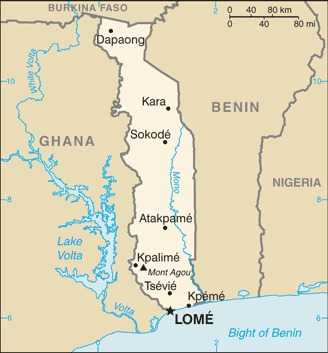
Border countries (3): Benin 651 km; Burkina Faso 131 km; Ghana 1,098 km
Land use
Arable land: 48.7% (2023 est.)
Permanent crops: 3.1% (2023 est.)
Permanent pasture: 18.4% (2023 est.)
Forest: 22.4% (2023 est.)
Other: 7.4% (2023 est.)
Maritime claims
Exclusive economic zone: 200 nm
Note: The US does not recognize the territorial sea claim
Natural resources
Geography - note
Terrain
Location
Map references
Irrigated land
Total renewable water resources
Population distribution
Elevation
Lowest point: Atlantic Ocean 0 m
Mean elevation: 236 m
Major watersheds (area sq km)
Area
Land: 54,385 sq km
Water: 2,400 sq km
Age structure
15-64 years: 57% (male 2,486,142/female 2,597,914)
65 years and over: 4.3% (2024 est.) (male 159,596/female 225,725)
Sex ratio
0-14 years: 1.03 male(s)/female
15-64 years: 0.96 male(s)/female
65 years and over: 0.71 male(s)/female
Total population: 0.97 male(s)/female (2024 est.)
Literacy
Male: 82.8% (2022 est.)
Female: 63.7% (2022 est.)
Nationality
Adjective: Togolese
School life expectancy (primary to tertiary education)
Male: 13 years (2017 est.)
Female: 11 years (2017 est.)
Urbanization
Rate of urbanization: 3.6% annual rate of change (2020-25 est.)
Drinking water source
Urban: 87% of population (2022 est.)
Rural: 58.5% of population (2022 est.)
Total: 71% of population (2022 est.)
Unimproved:
Urban: 13% of population (2022 est.)
Rural: 41.5% of population (2022 est.)
Total: 29% of population (2022 est.)
Major urban areas - population
Physician density
Hospital bed density
Mother's mean age at first birth
Note: Data represents median age at first birth among women 25-29
Dependency ratios
Youth dependency ratio: 67.8 (2024 est.)
Elderly dependency ratio: 7.6 (2024 est.)
Potential support ratio: 13.2 (2024 est.)
Sanitation facility access
Urban: 82% of population (2022 est.)
Rural: 19.2% of population (2022 est.)
Total: 46.7% of population (2022 est.)
Unimproved:
Urban: 18% of population (2022 est.)
Rural: 80.8% of population (2022 est.)
Total: 53.3% of population (2022 est.)
Ethnic groups
Note: Togo has an estimated 37 ethnic groups
Religions
Languages
Health expenditure
2.6% of national budget (2022 est.)
Child marriage
Women married by age 18: 24.8% (2017)
Men married by age 18: 2.6% (2017)
Gross reproduction rate
Currently married women (ages 15-49)
Youth unemployment rate (ages 15-24)
Male: 3.3% (2024 est.)
Female: 3.5% (2024 est.)
note: % of labor force ages 15-24 seeking employment
Net migration rate
Median age
Male: 19.9 years
Female: 21.4 years
Maternal mortality ratio
Total fertility rate
Population
Male: 4,395,271
Female: 4,522,723
Infant mortality rate
Male: 43 deaths/1,000 live births
Female: 33.7 deaths/1,000 live births
Tobacco use
Male: 9.3% (2025 est.)
Female: 0.7% (2025 est.)
Obesity - adult prevalence rate
Death rate
Birth rate
Children under the age of 5 years underweight
Alcohol consumption per capita
Beer: 0.78 liters of pure alcohol (2019 est.)
Wine: 0.09 liters of pure alcohol (2019 est.)
Spirits: 0.2 liters of pure alcohol (2019 est.)
Other alcohols: 0.33 liters of pure alcohol (2019 est.)
Life expectancy at birth
Male: 69.5 years
Female: 74.7 years
Education expenditure
11.6% national budget (2024 est.)
Population growth rate
Total water withdrawal
Industrial: 6.3 million cubic meters (2022 est.)
Agricultural: 76 million cubic meters (2022 est.)
Waste and recycling
Percent of municipal solid waste recycled: 3.5% (2022 est.)
Particulate matter emissions
Carbon dioxide emissions
From coal and metallurgical coke: 372,000 metric tonnes of CO2 (2023 est.)
From petroleum and other liquids: 1.941 million metric tonnes of CO2 (2023 est.)
From consumed natural gas: 343,000 metric tonnes of CO2 (2023 est.)
Energy consumption per capita
Diplomatic representation from the US
Embassy: Boulevard Eyadema
B.P. 852, Lomé
Mailing address: 2300 Lome Place, Washington, DC 20521-2300
Telephone: [228] 2261-5470
FAX: [228] 2261-5501
Email address and website:
ConsularLome@state.gov
https://tg.usembassy.gov/
Administrative divisions
Capital
Geographic coordinates: 6 07 N, 1 13 E
Time difference: UTC 0 (5 hours ahead of Washington, DC, during Standard Time)
Etymology: The name comes from a local word meaning "little market"
Constitution
Amendment process: Proposed by the president of the republic or supported by at least one fifth of the National Assembly membership; passage requires four-fifths majority vote by the Assembly; a referendum is required if approved by only two-thirds majority of the Assembly or if requested by the president; constitutional articles on the republican and secular form of government cannot be amended
Executive branch
Head of government: President of Council of Ministers Faure GNASSINGBE (since 3 May 2025)
Cabinet: Council of Ministers appointed by the president on the advice of the president of the council of ministers
Election/appointment process: President is appointed by the national assembly for one six-year term; the president of the council of ministers is the leader of the majority party in the national assembly and is confirmed by the Constitutional Court with no term limits
Election results:
2020: Faure GNASSINGBE reelected president; percent of vote - Faure GNASSINGBE (UNIR) 70.8%, Agbeyome KODJO (MPDD) 19.5%, Jean-Pierre FABRE (ANC) 4.7%, other 5%
2015: Faure GNASSINGBE reelected president; percent of vote - Faure GNASSINGBE (UNIR) 58.8%, Jean-Pierre FABRE (ANC) 35.2%, Tchaboure GOGUE (ADDI) 4%, other 2%
Note: In May 2024, the President signed into law changes to the constitution that converted the presidential system to a parliamentary republic and created the President of Council of Ministers position
Flag
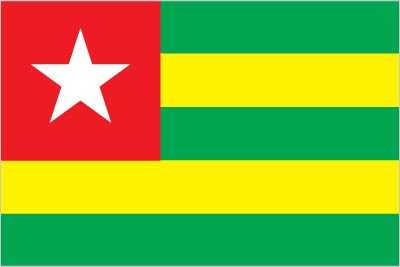
Meaning: The five horizontal stripes stand for the country's regions; red stands for the people's loyalty and patriotism; green for hope, fertility, and agriculture; yellow for mineral wealth and faith that hard work and strength will bring prosperity; the star symbolizes life, purity, peace, dignity, and national independence
History: Uses the colors of the Pan-African movement
Independence
Judicial branch
Judge selection and term of office: Supreme Court president appointed by decree of the president of the republic on the proposal of the Supreme Council of the Magistracy, a 9-member judicial, advisory, and disciplinary body; other judicial appointments and judge tenure NA; Constitutional Court judges appointed by the National Assembly; judge tenure NA
Subordinate courts: Court of Assizes (sessions court); Appeal Court; tribunals of first instance (divided into civil, commercial, and correctional chambers; Court of State Security; military tribunal
Legal system
Legislative branch
Legislative structure: Bicameral
Note: Party lists are required to contain equal numbers of men and women
International organization participation
National holiday
Political parties
Alliance of Democrats for Integral Development or ADDI
Democratic Convention of African Peoples or CDPA
Democratic Forces for the Republic or FDR
National Alliance for Change or ANC
New Togolese Commitment
Pan-African National Party or PNP
Pan-African Patriotic Convergence or CPP
Patriotic Movement for Democracy and Development or MPDD
Socialist Pact for Renewal or PSR
The Togolese Party
Union of Forces for Change or UFC
Union for the Republic or UNIR
Suffrage
Government type
Country name
Conventional short form: Togo
Local long form: République Togolaise
Local short form: None
Former: French Togoland
Etymology: The name derives from the town of Togodo (now Togoville) on the northern shore of Lake Togo; the town's name probably comes from the lake's name, which is composed of the Ewe words to ("water") and go ("shore")
Diplomatic representation in the US
Chancery: 2208 Massachusetts Avenue NW, Washington, DC 20008
Telephone: [1] (202) 234-4212
FAX: [1] (202) 232-3190
Email address and website:
Embassyoftogo@hotmail.com
https://embassyoftogousa.com/
National anthem(s)
Lyrics/music: Alex CASIMIR-DOSSEH
History: Adopted 1960, restored 1992; anthem was replaced during one-party rule between 1979 and 1992
International law organization participation
National symbol(s)
Citizenship
Citizenship by descent only: At least one parent must be a citizen of Togo
Dual citizenship recognized: Yes
Residency requirement for naturalization: 5 years
National heritage
Selected World Heritage Site locales: Koutammakou; the Land of the Batammariba
National color(s)
Population below poverty line
note: % of population with income below national poverty line
Household income or consumption by percentage share
Highest 10%: 29.6% (2021 est.)
note: % share of income accruing to lowest and highest 10% of population
Exports - commodities
note: top five export commodities based on value in dollars
Exports - partners
note: top five export partners based on percentage share of exports
Agricultural products
note: top ten agricultural products based on tonnage
Budget
Expenditures: $2.407 billion (2023 est.)
note: central government revenues and expenses (excluding grants/extrabudgetary units/social security funds) converted to US dollars at average official exchange rate for year indicated
Imports - commodities
note: top five import commodities based on value in dollars
Exchange rates
Exchange rates:
606.345 (2024 est.)
606.57 (2023 est.)
623.76 (2022 est.)
554.531 (2021 est.)
575.586 (2020 est.)
Industries
Economic overview
GDP (official exchange rate)
note: data in current dollars at official exchange rate
GDP - composition, by end use
Government consumption: 13.1% (2024 est.)
Investment in fixed capital: 22.3% (2024 est.)
Investment in inventories: 0% (2024 est.)
Exports of goods and services: 24.4% (2024 est.)
Imports of goods and services: -38.1% (2024 est.)
Note: Figures may not total 100% due to rounding or gaps in data collection
Imports - partners
note: top five import partners based on percentage share of imports
Remittances
8% of GDP (2022 est.)
7.8% of GDP (2021 est.)
note: personal transfers and compensation between resident and non-resident individuals/households/entities
Labor force
note: number of people ages 15 or older who are employed or seeking work
Debt - external
note: present value of external debt in current US dollars
Unemployment rate
2% (2023 est.)
2% (2022 est.)
note: % of labor force seeking employment
Taxes and other revenues
note: central government tax revenue as a % of GDP
Real GDP (purchasing power parity)
$25.75 billion (2023 est.)
$24.199 billion (2022 est.)
note: data in 2021 dollars
Inflation rate (consumer prices)
5.3% (2023 est.)
7.6% (2022 est.)
note: annual % change based on consumer prices
Current account balance
-$55.444 million (2019 est.)
-$184.852 million (2018 est.)
note: balance of payments - net trade and primary/secondary income in current dollars
Real GDP per capita
$2,800 (2023 est.)
$2,700 (2022 est.)
note: data in 2021 dollars
Imports
$2.261 billion (2019 est.)
$2.329 billion (2018 est.)
note: balance of payments - imports of goods and services in current dollars
Exports
$1.665 billion (2019 est.)
$1.703 billion (2018 est.)
note: balance of payments - exports of goods and services in current dollars
Real GDP growth rate
6.4% (2023 est.)
5.8% (2022 est.)
note: annual GDP % growth based on constant local currency
Industrial production growth rate
note: annual % change in industrial value added based on constant local currency
GDP - composition, by sector of origin
Industry: 20% (2024 est.)
Services: 52% (2024 est.)
note: figures may not total 100% due to non-allocated consumption not captured in sector-reported data
Electricity access
Electrification - urban areas: 96.5%
Electrification - rural areas: 25%
Coal
Exports: 10 metric tons (2023 est.)
Imports: 163,000 metric tons (2023 est.)
Electricity generation sources
Solar: 11.9% of total installed capacity (2023 est.)
Hydroelectricity: 8.7% of total installed capacity (2023 est.)
Biomass and waste: 0.1% of total installed capacity (2023 est.)
Natural gas
Imports: 176.16 million cubic meters (2023 est.)
Petroleum
Electricity
Consumption: 1.815 billion kWh (2023 est.)
Imports: 1.1 billion kWh (2023 est.)
Transmission/distribution losses: 206.938 million kWh (2023 est.)
Internet users
Internet country code
Broadcast media
Telephones - mobile cellular
Subscriptions per 100 inhabitants: 74 (2022 est.)
Broadband - fixed subscriptions
Subscriptions per 100 inhabitants: 1 (2023 est.)
Telephones - fixed lines
Subscriptions per 100 inhabitants: 1 (2023 est.) less than 1
Railways
Narrow gauge: 568 km (2014) 1.000-m gauge
Civil aircraft registration country code prefix
Airports
Merchant marine
By type: Bulk carrier 1, container ship 10, general cargo 250, oil tanker 56, other 80
Military service age and obligation
Note: As of 2022, about 7% of the military's personnel were women
Military expenditures
3% of GDP (2023 est.)
4% of GDP (2022 est.)
2.8% of GDP (2021 est.)
2.8% of GDP (2020 est.)
Military and security forces
Ministry of Security and Civil Protection: Togolese Police (2025)
Note: The Police and GNT are responsible for law enforcement and maintenance of order within the country; the GNT is also responsible for migration and border enforcement; the GNT falls under the Ministry of the Armed Forces but also reports to the Ministry of Security and Civil Protection on many matters involving law enforcement and internal security; in 2022, the Ministry of the Armed Forces was made part of the Office of the Presidency
Military and security service personnel strengths
Military - note
Since its creation in 1963, the Togolese military has had a history of involvement in the country’s politics, including assassinations, coups, and a crackdown in 2005 that killed hundreds of civilians; over the past decade, it has made efforts to reform and professionalize, which have included increasing its role in UN peacekeeping activities, participating in multinational exercises, and receiving training from foreign partners, particularly France and the US; in addition, Togo has established a regional peacekeeping training center for military and police in Lome (2025)
Military equipment inventories and acquisitions
Refugees and internally displaced persons
IDPs: 18,429 (2024 est.)
Terrorist group(s)
Note: Details about the history, aims, leadership, organization, areas of operation, tactics, targets, weapons, size, and sources of support of the group(s) appear(s) in the Terrorism reference guide
Ports
Large: 0
Medium: 1
Small: 0
Very small: 1
Ports with oil terminals: 2
Key ports: Kpeme, Lome
Legislative branch - lower chamber
Number of seats: 113 (all directly elected)
Electoral system: Proportional representation
Scope of elections: Full renewal
Term in office: 6 years
Most recent election date: 4/29/2024
Parties elected and seats per party: Union for the Republic (UNIR) (108); Other (5)
Percentage of women in chamber: 15%
Expected date of next election: April 2030
Legislative branch - upper chamber
Number of seats: 61 (41 directly elected; 20 appointed)
Scope of elections: Full renewal
Term in office: 6 years
Most recent election date: 2/15/2025
Parties elected and seats per party: Union for the Republic (UNIR) (34); Independents (3); Other (4)
Percentage of women in chamber: 24.6%
Expected date of next election: February 2031
Methane emissions
Agriculture: 51.8 kt (2019-2021 est.)
Waste: 31.3 kt (2019-2021 est.)
Other: 10.4 kt (2019-2021 est.)
Gini Index coefficient - distribution of family income
note: index (0-100) of income distribution; higher values represent greater inequality