Saudi Arabia
Background
Saudi Arabia is the birthplace of Islam and home to Islam's two holiest shrines in Mecca and Medina. The king's official title is the Custodian of the Two Holy Mosques. ABD AL-AZIZ bin Abd al-Rahman AL SAUD (Ibn Saud) founded the modern Saudi state in 1932 after a 30-year campaign to unify most of the Arabian Peninsula. One of his male descendants rules the country today, as required by the country's 1992 Basic Law. After Iraq invaded Kuwait in 1990, Saudi Arabia took in the Kuwaiti royal family and 400,000 refugees, while allowing Western and Arab troops to deploy on its soil and liberate Kuwait the following year. Major terrorist attacks in 2003 spurred a strong ongoing campaign against domestic terrorism and extremism. US troops returned to the Kingdom in 2019 after attacks on Saudi oil infrastructure.
From 2005 to 2015, King ABDALLAH bin Abd al-Aziz Al Saud incrementally modernized the Kingdom through a series of social and economic initiatives that included expanding employment and social opportunities for women, attracting foreign investment, increasing the private sector's role in the economy, and discouraging the hiring of foreign workers. Saudi Arabia saw some protests during the 2011 Arab Spring but not the level of bloodshed seen in protests elsewhere in the region; Riyadh took a cautious but firm approach, arresting and quickly releasing some protesters and using its state-sponsored clerics to counter political and Islamist activism. The government held its first-ever elections in 2005 and 2011, when Saudis voted for municipal councilors. King ABDALLAH's reforms accelerated under King SALMAN bin Abd al-Aziz, who ascended to the throne in 2015 and lifted the Kingdom's ban on women driving, implemented education reforms, funded green initiatives, and allowed cinemas to operate for the first time in decades. In 2015, women were allowed to vote and stand as candidates for the first time in municipal elections, with 19 women winning seats. King SALMAN initially named his nephew, MUHAMMAD BIN NAYIF bin Abd al-Aziz Al Saud, as the Crown Prince, but a palace coup in 2017 resulted in King SALMAN's son, Deputy Crown Prince MUHAMMAD BIN SALMAN bin Abd al-Aziz Al Saud, taking over as Crown Prince. King SALMAN appointed MUHAMMAD BIN SALMAN as prime minister in 2022.
In 2015, Saudi Arabia led a coalition of 10 countries in a military campaign to restore Yemen's legitimate government, which had been ousted by Houthi forces. The war in Yemen has drawn international criticism for civilian casualties and its effect on the country’s dire humanitarian situation. The same year, MUHAMMAD BIN SALMAN announced that Saudi Arabia would lead a multi-nation Islamic Coalition to fight terrorism, and in 2017, Saudi Arabia inaugurated the Global Center for Combatting Extremist Ideology (also known as "Etidal").
The country remains a leading producer of oil and natural gas and holds about 17% of the world's proven oil reserves as of 2020. The government continues to pursue economic reform and diversification -- particularly since Saudi Arabia's accession to the WTO in 2005 -- and promotes foreign investment in the Kingdom. In 2016, the Saudi Government announced broad socio-economic reforms known as Vision 2030. Low global oil prices in 2015 and 2016 significantly lowered Saudi Arabia’s governmental revenue, prompting cuts to subsidies on water, electricity, and gasoline; reduced government-employee compensation; and new land taxes. In coordination with OPEC and some key non-OPEC countries, Saudi Arabia agreed to cut oil output in 2017 to regulate supply and help boost global prices. In 2020, this agreement collapsed, and Saudi Arabia launched a price war by flooding the market with low-priced oil before returning to the negotiating table to agree to a major output cut that helped buoy prices.
Geographic coordinates
Natural hazards
Volcanism: Little activity in the past few centuries, despite many volcanic formations; volcanoes include Harrat Rahat, Harrat Khaybar, Harrat Lunayyir, and Jabal Yar
Area - comparative
Environmental issues
International environmental agreements
Signed, but not ratified: None of the selected agreements
Climate
Coastline
Land boundaries
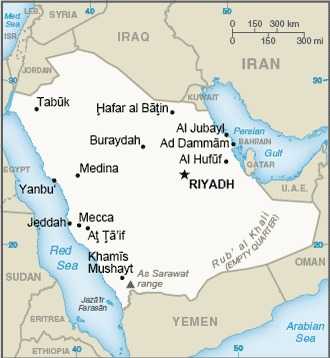
Border countries (7): Iraq 811 km; Jordan 731 km; Kuwait 221 km; Oman 658 km; Qatar 87 km; UAE 457 km; Yemen 1,307 km
Land use
Arable land: 1.6% (2022 est.)
Permanent crops: 0.1% (2022 est.)
Permanent pasture: 79.1% (2022 est.)
Forest: 0.5% (2022 est.)
Other: 18.8% (2022 est.)
Maritime claims
Contiguous zone: 18 nm
Continental shelf: Not specified
Natural resources
Geography - note
Terrain
Location
Map references
Irrigated land
Total renewable water resources
Population distribution
Elevation
Lowest point: Persian Gulf 0 m
Mean elevation: 665 m
Major aquifers
Major watersheds (area sq km)
Area
Land: 2,149,690 sq km
Water: 0 sq km
Age structure
15-64 years: 72.7% (male 15,577,133/female 10,994,061)
65 years and over: 4.4% (2024 est.) (male 856,985/female 752,262)
Sex ratio
0-14 years: 1.04 male(s)/female
15-64 years: 1.42 male(s)/female
65 years and over: 1.14 male(s)/female
Total population: 1.31 male(s)/female (2024 est.)
Literacy
Male: 99% (2020 est.)
Female: 96% (2020 est.)
Nationality
Adjective: Saudi or Saudi Arabian
School life expectancy (primary to tertiary education)
Male: 16 years (2022 est.)
Female: 18 years (2022 est.)
Urbanization
Rate of urbanization: 1.69% annual rate of change (2020-25 est.)
Drinking water source
Urban: 98.4% of population (2022 est.)
Rural: 100% of population (2022 est.)
Total: 98.6% of population (2022 est.)
Unimproved:
Urban: 1.6% of population (2022 est.)
Rural: 0% of population (2022 est.)
Total: 1.4% of population (2022 est.)
Major urban areas - population
Physician density
Hospital bed density
Dependency ratios
Youth dependency ratio: 31.5 (2024 est.)
Elderly dependency ratio: 6.1 (2024 est.)
Potential support ratio: 16.5 (2024 est.)
Sanitation facility access
Urban: 99.7% of population (2022 est.)
Rural: 99.7% of population (2022 est.)
Total: 99.7% of population (2022 est.)
Unimproved:
Urban: 0.3% of population (2022 est.)
Rural: 0.3% of population (2022 est.)
Total: 0.3% of population (2022 est.)
Ethnic groups
Religions
Note: Despite having a large expatriate community of various faiths (more than 30% of the population), most forms of public religious expression inconsistent with the government-sanctioned interpretation of Sunni Islam are restricted; non-Muslims are not allowed to have Saudi citizenship and non-Muslim places of worship are not permitted (2013)
Languages
Major-language sample(s):
كتاب حقائق العالم، المصدر الذي لا يمكن الاستغناء عنه للمعلومات الأساسية (Arabic)
The World Factbook, the indispensable source for basic information.
Health expenditure
12.8% of national budget (2022 est.)
Gross reproduction rate
Currently married women (ages 15-49)
Youth unemployment rate (ages 15-24)
Male: 9.8% (2024 est.)
Female: 23.8% (2024 est.)
note: % of labor force ages 15-24 seeking employment
Net migration rate
Median age
Male: 34.6 years
Female: 29.3 years
Maternal mortality ratio
Total fertility rate
Population
Male: 20,700,838
Female: 15,843,593
Infant mortality rate
Male: 12.8 deaths/1,000 live births
Female: 10.5 deaths/1,000 live births
Tobacco use
Male: 28.3% (2025 est.)
Female: 2% (2025 est.)
Obesity - adult prevalence rate
Death rate
Birth rate
Children under the age of 5 years underweight
Alcohol consumption per capita
Beer: 0 liters of pure alcohol (2019 est.)
Wine: 0 liters of pure alcohol (2019 est.)
Spirits: 0 liters of pure alcohol (2019 est.)
Other alcohols: 0 liters of pure alcohol (2019 est.)
Life expectancy at birth
Male: 75.6 years
Female: 78.8 years
Education expenditure
Population growth rate
Total water withdrawal
Industrial: 1.4 billion cubic meters (2022 est.)
Agricultural: 21.2 billion cubic meters (2022 est.)
Waste and recycling
Percent of municipal solid waste recycled: 18.8% (2022 est.)
Particulate matter emissions
Carbon dioxide emissions
From coal and metallurgical coke: 384,000 metric tonnes of CO2 (2023 est.)
From petroleum and other liquids: 418.326 million metric tonnes of CO2 (2023 est.)
From consumed natural gas: 237.801 million metric tonnes of CO2 (2023 est.)
Energy consumption per capita
Diplomatic representation from the US
Embassy: Riyadh 11564
Mailing address: 6300 Riyadh Place, Washington DC 20521-6300
Telephone: [966] (11) 835-4000
FAX: [966] (11) 488-7360
Email address and website:
RiyadhACS@state.gov
https://sa.usembassy.gov/
Consulate(s) general: Dhahran, Jeddah
Administrative divisions
Capital
Geographic coordinates: 24 39 N, 46 42 E
Time difference: UTC+3 (8 hours ahead of Washington, DC, during Standard Time)
Etymology: The name derives from the Arabic word riyadh, meaning "gardens;" the city was built around a small oasis
Constitution
Amendment process: Proposed by the king directly or proposed to the king by the Consultative Assembly or by the Council of Ministers; passage by the king through royal decree
Executive branch
Head of government: Crown Prince and Prime Minister MUHAMMAD BIN SALMAN bin Abd al-Aziz Al Saud (since 27 September 2022)
Cabinet: Council of Ministers appointed by the monarch every 4 years and includes many royal family members
Election/appointment process: None; the monarchy is hereditary; an Allegiance Council created by royal decree in 2006 established a committee of Saudi princes who have a voice in selecting future Saudi kings
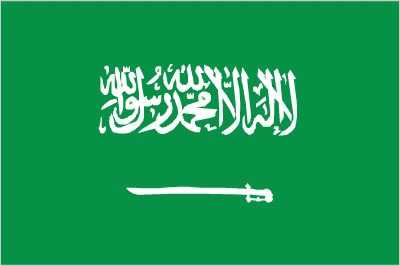
Flag
History: Design dates to the early 20th century and is closely associated with the Al Saud family that established the kingdom in 1932; the flag has different sides so that the text reads correctly from right to left and the saber points in the same direction on both sides
Note 1: The only national flag that has an inscription as its primary design
Note 2: One of three national flags that differ on each side -- the others are Moldova and Paraguay
Independence
Judicial branch
Judge selection and term of office: High Court chief and chiefs of the High Court Circuits appointed by royal decree on the recommendation of the Supreme Judiciary Council, a 10-member body of high-level judges and other judicial heads; new judges and assistant judges serve 1- and 2-year probations, respectively, before permanent assignment
Subordinate courts: Court of Appeals; Specialized Criminal Court, first-degree courts composed of general, criminal, personal status, and commercial courts; Labor Court; a hierarchy of administrative courts
Legal system
Legislative branch
Legislative structure: Unicameral
Number of seats: 151 (all appointed)
Scope of elections: Full renewal
Term in office: 4 years
Most recent election date: 9/2/2024
Percentage of women in chamber: 19.9%
Expected date of next election: August 2028
International organization participation
National holiday
Political parties
Suffrage
Government type
Country name
Conventional short form: Saudi Arabia
Local long form: Al Mamlakah al Arabiyah as Suudiyah
Local short form: Al Arabiyah as Suudiyah
Etymology: Named after the ruling dynasty of the country, the House of Saud; the name Arabia can be traced back at least as far as the ancient Romans, who referred to the peninsula as "Arabia Felix" (Arabia the Fortunate)
Diplomatic representation in the US
Chancery: 601 New Hampshire Avenue NW, Washington, DC 20037
Telephone: [1] (202) 342-3800
FAX: [1] (202) 295-3625
Email address and website:
Saudisusemb@mofa.gov.sa
https://www.saudiembassy.net/
Consulate(s) general: Houston, Los Angeles, New York
National anthem(s)
Lyrics/music: Ibrahim KHAFAJI/Abdul Rahman al-KHATEEB
History: Music adopted 1947, lyrics adopted 1984
International law organization participation
National symbol(s)
Citizenship
Citizenship by descent only: The father must be a citizen of Saudi Arabia; a child born out of wedlock in Saudi Arabia to a Saudi mother and unknown father
Dual citizenship recognized: No
Residency requirement for naturalization: 5 years
National heritage
Selected World Heritage Site locales: Hegra Archaeological Site (al-Hijr / Madā ͐ in Ṣāliḥ) (c); At-Turaif District in ad-Dir'iyah (c); Historic Jeddah, the Gate to Makkah (c); Rock Art in the Hail Region of Saudi Arabia (c); Al-Ahsa Oasis, an Evolving Cultural Landscape (c); Ḥimā Cultural Area (c); ‘Uruq Bani Ma’arid (n);The Cultural Landscape of Al-Faw Archaeological Area (c)
National color(s)
Exports - commodities
Note: Top five export commodities based on value in dollars
Exports - partners
Note: Top five export partners based on percentage share of exports
Agricultural products
note: top ten agricultural products based on tonnage
Budget
Expenditures: $388.489 billion (2023 est.)
note: central government revenues (excluding grants) and expenditures converted to US dollars at average official exchange rate for year indicated
Imports - commodities
Note: Top five import commodities based on value in dollars
Exchange rates
Exchange rates:
3.75 (2024 est.)
3.75 (2023 est.)
3.75 (2022 est.)
3.75 (2021 est.)
3.75 (2020 est.)
Industries
Economic overview
High-income, oil-based Middle Eastern economy; OPEC founding member; Vision 2030 strategy prioritizing economic diversification, increased private sector involvement, and projects funded by sovereign wealth fund and foreign investment; young labor force; falling but significant poverty rate despite lack of official statistics
GDP (official exchange rate)
note: data in current dollars at official exchange rate
GDP - composition, by end use
Government consumption: 21.4% (2024 est.)
Investment in fixed capital: 28.7% (2024 est.)
Investment in inventories: 1.4% (2024 est.)
Exports of goods and services: 29.2% (2024 est.)
Imports of goods and services: -25.6% (2024 est.)
note: figures may not total 100% due to rounding or gaps in data collection
Imports - partners
Note: Top five import partners based on percentage share of imports
Average household expenditures
On alcohol and tobacco: 0.7% of household expenditures (2023 est.)
Remittances
0% of GDP (2023 est.)
0% of GDP (2022 est.)
note: personal transfers and compensation between resident and non-resident individuals/households/entities
Labor force
note: number of people ages 15 or older who are employed or seeking work
Reserves of foreign exchange and gold
$457.949 billion (2023 est.)
$478.232 billion (2022 est.)
note: holdings of gold (year-end prices)/foreign exchange/special drawing rights in current dollars
Unemployment rate
4.1% (2023 est.)
5.6% (2022 est.)
note: % of labor force seeking employment
Taxes and other revenues
note: central government tax revenue as a % of GDP
Real GDP (purchasing power parity)
$2.173 trillion (2023 est.)
$2.161 trillion (2022 est.)
note: data in 2021 dollars
Inflation rate (consumer prices)
2.3% (2023 est.)
2.5% (2022 est.)
note: annual % change based on consumer prices
Current account balance
$35.133 billion (2023 est.)
$150.353 billion (2022 est.)
note: balance of payments - net trade and primary/secondary income in current dollars
Real GDP per capita
$64,500 (2023 est.)
$67,200 (2022 est.)
note: data in 2021 dollars
Imports
$289.91 billion (2023 est.)
$258.371 billion (2022 est.)
note: balance of payments - imports of goods and services in current dollars
Exports
$368.731 billion (2023 est.)
$445.881 billion (2022 est.)
note: balance of payments - exports of goods and services in current dollars
Real GDP growth rate
0.5% (2023 est.)
12% (2022 est.)
note: annual GDP % growth based on constant local currency
Industrial production growth rate
note: annual % change in industrial value added based on constant local currency
GDP - composition, by sector of origin
Industry: 44.8% (2024 est.)
Services: 47.2% (2024 est.)
note: figures may not total 100% due to non-allocated consumption not captured in sector-reported data
Electricity access
Coal
Exports: 500 metric tons (2023 est.)
Imports: 223,000 metric tons (2023 est.)
Electricity generation sources
Solar: 0.3% of total installed capacity (2023 est.)
Wind: 0.4% of total installed capacity (2023 est.)
Natural gas
Consumption: 121.219 billion cubic meters (2023 est.)
Proven reserves: 9.423 trillion cubic meters (2021 est.)
Petroleum
Refined petroleum consumption: 3.524 million bbl/day (2023 est.)
Crude oil estimated reserves: 258.6 billion barrels (2021 est.)
Electricity
Consumption: 383.512 billion kWh (2023 est.)
Exports: 352 million kWh (2023 est.)
Imports: 308 million kWh (2023 est.)
Transmission/distribution losses: 38.23 billion kWh (2023 est.)
Internet users
Internet country code
Broadcast media
Telephones - mobile cellular
Subscriptions per 100 inhabitants: 132 (2022 est.)
Broadband - fixed subscriptions
Subscriptions per 100 inhabitants: 44 (2023 est.)
Telephones - fixed lines
Subscriptions per 100 inhabitants: 20 (2023 est.)
Railways
Standard gauge: 5,410 km (2016) 1.435-m gauge (with branch lines and sidings)
Civil aircraft registration country code prefix
Airports
Merchant marine
By type: Bulk carrier 9, container ship 1, general cargo 20, oil tanker 55, other 348
Heliports
Military service age and obligation
Note: In 2021, women were allowed to serve in the Army, Air Defense, Navy, Strategic Missile Force, medical services, and internal security forces up to the rank of non-commissioned officer
Military expenditures
7% of GDP (2023 est.)
6.5% of GDP (2022 est.)
7% of GDP (2021 est.)
8% of GDP (2020 est.)
Military and security forces
Ministry of Defense: Royal Saudi Land Forces, Royal Saudi Naval Forces (includes marines, special forces, naval aviation), Royal Saudi Air Force, Royal Saudi Air Defense Forces, Royal Saudi Strategic Missiles Force; Ministry of the National Guard: Saudi Arabian National Guard (SANG)
Other security forces include:
Ministry of Interior: Facilities Security Forces, Public Security Forces (police), General Directorate of Border Guard
State Security Presidency (SSP): General Directorate of Investigation (Mabahith), Special Security Forces, Special Emergency Forces (2025)
Note 1: The regular armed forces under the Ministry of Defense are responsible for external defense, although they can be called for domestic security duties if needed
Note 2: the SANG (also known as the White Army) is a land force comprised off tribal elements loyal to the House of Saud; it is responsible for internal security, protecting the royal family, guarding against military coups, defending strategic facilities and resources, and providing security for the cities of Mecca and Medina; it may also assist the regular armed forces in combat operations
Note 3: The SAAF includes the Saudi Royal Guard Command, a unit which provides security and protection to the ruling family and other dignitaries
Military - note
Saudi Arabia has close security ties with the US; the SAAF conducts bilateral exercises with the US military and hosts US forces; the US has participated in a cooperative program to equip and train the SANG since 1973, and much of the equipment for both the regular forces and the SANG has been acquired from the US; Saudi Arabia also has defense relationships with China, France, India, Pakistan, the UK, and fellow Gulf Cooperation Council (GCC) members; it is a member of the Peninsula Shield Forces, a joint military force established by the GCC countries with the aim of maintaining security and stability in the region; the force was established in 1982, and its leadership is based in Saudi Arabia
In 2015, Saudi Arabia led a military intervention into Yemen by a coalition of Arab states in support of the Republic of Yemen Government against the separatist Houthis (Ansarallah); Saudi forces from both the Ministry of Defense and the SANG participated in combat operations in Yemen; Saudi Arabia also raised and equipped paramilitary/militia security forces in Yemen--based largely on tribal or regional affiliation--to deploy along the Saudi-Yemen border (2025)
Military and security service personnel strengths
Military equipment inventories and acquisitions
Note: The Saudi Navy is in the midst of a multi-year and multi-billion-dollar expansion and modernization program to purchase new frigates, corvettes, and other naval craft from such suppliers as Spain and the US
Military deployments
Refugees and internally displaced persons
Stateless persons: 70,000 (2024 est.)
Terrorist group(s)
Note: Details about the history, aims, leadership, organization, areas of operation, tactics, targets, weapons, size, and sources of support of the group(s) appear(s) in the Terrorism reference guide
Space program overview
Note: Further details about the key activities, programs, and milestones of the country’s space program, as well as government spending estimates on the space sector, appear in the Space Programs reference guide
Space agency/agencies
Geoparks
Global geoparks and regional networks: North Riyadh; Salma (2025)
Ports
Large: 0
Medium: 1
Small: 7
Very small: 8
Ports with oil terminals: 10
Key ports: Dammam, Duba, Jiddah, Jizan, Ju Aymah Oil Terminal, Ras Tannurah, Ras Al Khafji, Ras Al Mishab
Methane emissions
Agriculture: 162.9 kt (2019-2021 est.)
Waste: 927.6 kt (2019-2021 est.)
Other: 28.3 kt (2019-2021 est.)