Israel
Middle EastIS December 23, 2025
Background
Israel has become a regional economic and military powerhouse, leveraging its prosperous high-tech sector, large defense industry, and concerns about Iran to foster partnerships around the world. The State of Israel was established in 1948. The UN General Assembly proposed in 1947 partitioning the British Mandate for Palestine into an Arab and Jewish state. The Jews accepted the proposal, but the local Arabs and the Arab states rejected the UN plan and launched a war. The Arabs were subsequently defeated in the 1947-1949 war that followed the UN proposal and the British withdrawal. Israel joined the UN in 1949 and saw rapid population growth, primarily due to Jewish refugee migration from Europe and the Middle East. Israel and its Arab neighbors fought wars in 1956, 1967, and 1973, and Israel signed peace treaties with Egypt in 1979 and Jordan in 1994. Israel took control of the West Bank, the eastern part of Jerusalem, the Gaza Strip, the Sinai Peninsula, and the Golan Heights in the course of the 1967 war. It ceded the Sinai back to Egypt in the 1979-1982 period but has continued to administer the other territories through military authorities. Israel and Palestinian officials signed interim agreements in the 1990s that created a period of Palestinian self-rule in parts of the West Bank and Gaza. Israel withdrew from Gaza in 2005. The most recent formal efforts between Israel and the Palestinian Authority to negotiate final status issues occurred in 2013 and 2014, and the US continues its efforts to advance peace. Israel signed the US-brokered normalization agreements (the Abraham Accords) with Bahrain, the UAE, and Morocco in 2020 and reached an agreement with Sudan in 2021. Immigration to Israel continues, with more than 44,000 estimated new immigrants, mostly Jewish, in the first 11 months of 2023.
Former Prime Minister Benjamin NETANYAHU returned to office in 2022, continuing his dominance of Israel's political landscape at the head of Israel's most rightwing and religious government. NETANYAHU previously served as premier from 1996 to 1999 and from 2009 to 2021, becoming Israel's longest serving prime minister.
On 7 October 2023, HAMAS militantslaunched a combined unguided rocket and ground terrorist attack from Gaza into southern Israel. The same day Israel’s Air Force launched air strikes inside Gaza and initiated a sustained air campaign against HAMAS targets across the Gaza Strip. The following day, NETANYAHU formally declared war on HAMAS, and on 28 October, the Israel Defense Forces launched a large-scale ground assault inside Gaza.
The Israeli economy has undergone a dramatic transformation in the last 30 years, led by cutting-edge high-tech sectors. Offshore gas discoveries in the Mediterranean place Israel at the center of a potential regional natural gas market. In 2022, a US-brokered agreement between Israel and Lebanon established their maritime boundary, allowing Israel to begin production on additional gas fields in the Mediterranean. However, Israel's economic development has been uneven. Structural issues such as low labor-force participation among religious and minority populations,low workforce productivity, high costs for housing and consumer staples, and high income inequality concern both economists and the general population. The current war with Hamas disrupted Israel’s solid economic fundamentals, but it is not likely to have long-term structural implications for the economy.
Former Prime Minister Benjamin NETANYAHU returned to office in 2022, continuing his dominance of Israel's political landscape at the head of Israel's most rightwing and religious government. NETANYAHU previously served as premier from 1996 to 1999 and from 2009 to 2021, becoming Israel's longest serving prime minister.
On 7 October 2023, HAMAS militantslaunched a combined unguided rocket and ground terrorist attack from Gaza into southern Israel. The same day Israel’s Air Force launched air strikes inside Gaza and initiated a sustained air campaign against HAMAS targets across the Gaza Strip. The following day, NETANYAHU formally declared war on HAMAS, and on 28 October, the Israel Defense Forces launched a large-scale ground assault inside Gaza.
The Israeli economy has undergone a dramatic transformation in the last 30 years, led by cutting-edge high-tech sectors. Offshore gas discoveries in the Mediterranean place Israel at the center of a potential regional natural gas market. In 2022, a US-brokered agreement between Israel and Lebanon established their maritime boundary, allowing Israel to begin production on additional gas fields in the Mediterranean. However, Israel's economic development has been uneven. Structural issues such as low labor-force participation among religious and minority populations,low workforce productivity, high costs for housing and consumer staples, and high income inequality concern both economists and the general population. The current war with Hamas disrupted Israel’s solid economic fundamentals, but it is not likely to have long-term structural implications for the economy.
Geographic coordinates
31 30 N, 34 45 E
Natural hazards
sandstorms may occur during spring and summer; droughts; periodic earthquakes
Area - comparative
slightly larger than New Jersey
Environmental issues
limited arable land and restricted natural freshwater resources; desertification; air pollution from industrial and vehicle emissions; groundwater pollution from industrial and domestic waste, chemical fertilizers, and pesticides
International environmental agreements
Party to: Biodiversity, Climate Change, Climate Change-Kyoto Protocol, Climate Change-Paris Agreement, Desertification, Endangered Species, Hazardous Wastes, Nuclear Test Ban, Ozone Layer Protection, Ship Pollution, Wetlands, Whaling
Signed, but not ratified: Comprehensive Nuclear Test Ban, Marine Life Conservation
Signed, but not ratified: Comprehensive Nuclear Test Ban, Marine Life Conservation
Climate
temperate; hot and dry in southern and eastern desert areas
Coastline
273 km
Land boundaries
Total: 1,068 km
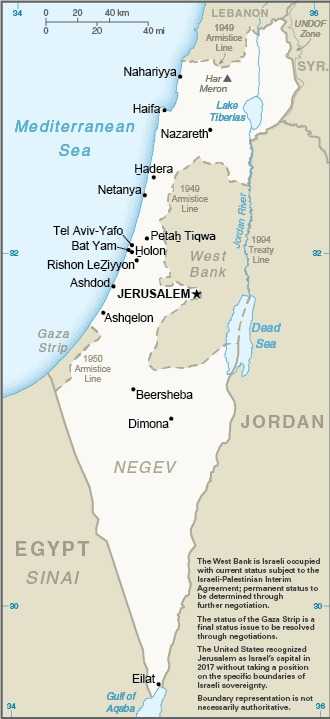
Border countries (6): Egypt 208 km; Gaza Strip 59 km; Jordan 327 km (20 km are within the Dead Sea); Lebanon 81 km; Syria 83 km; West Bank 330 km
Border countries (6): Egypt 208 km; Gaza Strip 59 km; Jordan 327 km (20 km are within the Dead Sea); Lebanon 81 km; Syria 83 km; West Bank 330 km
Land use
Agricultural land: 24.8% (2023 est.)
Arable land: 12.5% (2023 est.)
Permanent crops: 4.7% (2023 est.)
Permanent pasture: 7.6% (2023 est.)
Forest: 6.7% (2023 est.)
Other: 68.5% (2023 est.)
Arable land: 12.5% (2023 est.)
Permanent crops: 4.7% (2023 est.)
Permanent pasture: 7.6% (2023 est.)
Forest: 6.7% (2023 est.)
Other: 68.5% (2023 est.)
Maritime claims
Territorial sea: 12 nm
Continental shelf: To depth of exploitation
Continental shelf: To depth of exploitation
Natural resources
timber, potash, copper ore, natural gas, phosphate rock, magnesium bromide, clays, sand
Geography - note
Note 1: Lake Tiberias (Sea of Galilee) is an important freshwater source; the Dead Sea is the second saltiest body of water in the world (after Lake Assal in Djibouti)
Note 2: The Malham Cave in Mount Sodom is the world's longest salt cave at 10 km (6 mi); Mount Sodom is a hill about 220 m (722 ft) high that is 80% salt, with multiple salt layers covered by a veneer of rock
Note 2: The Malham Cave in Mount Sodom is the world's longest salt cave at 10 km (6 mi); Mount Sodom is a hill about 220 m (722 ft) high that is 80% salt, with multiple salt layers covered by a veneer of rock
Terrain
Negev desert in the south; low coastal plain; central mountains; Jordan Rift Valley
Location
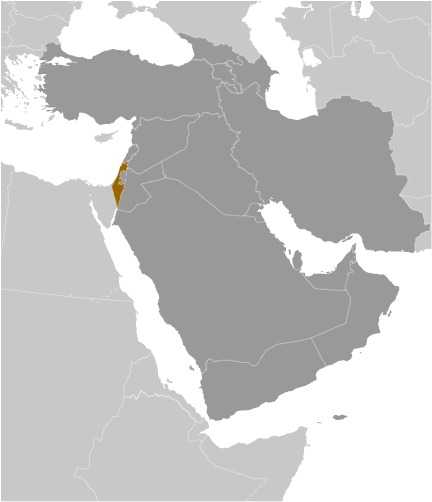
Middle East, bordering the Mediterranean Sea, between Egypt and Lebanon
Map references
Middle East
Irrigated land
1,927 sq km (2022)
Total renewable water resources
1.78 billion cubic meters (2022 est.)
Population distribution
population concentrated in and around Tel-Aviv, as well as around the Sea of Galilee; the south remains sparsely populated, with the exception of the shore of the Gulf of Aqaba
Elevation
Highest point: Mitspe Shlagim 2,224 m; note - this is the highest named point, the actual highest point is an unnamed dome slightly to the west of Mitspe Shlagim at 2,236 m; both points are on the northeastern border of Israel, along the southern end of the Anti-Lebanon mountain range
Lowest point: Dead Sea -431 m
Mean elevation: 508 m
Lowest point: Dead Sea -431 m
Mean elevation: 508 m
Major lakes (area sq km)
Salt water lake(s): Dead Sea (shared with Jordan and West Bank) - 1,020 sq km
Note - endorheic hypersaline lake; 9.6 times saltier than the ocean; lake shore is 431 meters below sea level
Note - endorheic hypersaline lake; 9.6 times saltier than the ocean; lake shore is 431 meters below sea level
Area
Total : 21,937 sq km
Land: 21,497 sq km
Water: 440 sq km
Land: 21,497 sq km
Water: 440 sq km
Age structure
0-14 years: 27.5% (male 1,320,629/female 1,260,977)
15-64 years: 60.3% (male 2,885,485/female 2,781,777)
65 years and over: 12.3% (2024 est.) (male 525,161/female 628,588)
15-64 years: 60.3% (male 2,885,485/female 2,781,777)
65 years and over: 12.3% (2024 est.) (male 525,161/female 628,588)
Sex ratio
At birth: 1.05 male(s)/female
0-14 years: 1.05 male(s)/female
15-64 years: 1.04 male(s)/female
65 years and over: 0.84 male(s)/female
Total population: 1.01 male(s)/female (2024 est.)
0-14 years: 1.05 male(s)/female
15-64 years: 1.04 male(s)/female
65 years and over: 0.84 male(s)/female
Total population: 1.01 male(s)/female (2024 est.)
Nationality
Noun: Israeli(s)
Adjective: Israeli
Adjective: Israeli
School life expectancy (primary to tertiary education)
Total: 15 years (2022 est.)
Male: 14 years (2022 est.)
Female: 16 years (2022 est.)
Male: 14 years (2022 est.)
Female: 16 years (2022 est.)
Urbanization
Urban population: 92.9% of total population (2023)
Rate of urbanization: 1.51% annual rate of change (2020-25 est.)
Rate of urbanization: 1.51% annual rate of change (2020-25 est.)
Drinking water source
Improved:
Urban: 100% of population (2022 est.)
Rural: 100% of population (2022 est.)
Total: 100% of population (2022 est.)
Unimproved:
Urban: 0% of population (2022 est.)
Rural: 0% of population (2022 est.)
Total: 0% of population (2022 est.)
Urban: 100% of population (2022 est.)
Rural: 100% of population (2022 est.)
Total: 100% of population (2022 est.)
Unimproved:
Urban: 0% of population (2022 est.)
Rural: 0% of population (2022 est.)
Total: 0% of population (2022 est.)
Major urban areas - population
4.421 million Tel Aviv-Yafo, 1.174 million Haifa, 970,000 JERUSALEM (capital) (2023)
Physician density
3.8 physicians/1,000 population (2023)
Hospital bed density
3.1 beds/1,000 population (2021 est.)
Mother's mean age at first birth
27.7 years (2019 est.)
Dependency ratios
Total dependency ratio: 65.9 (2024 est.)
Youth dependency ratio: 45.6 (2024 est.)
Elderly dependency ratio: 20.4 (2024 est.)
Potential support ratio: 4.9 (2024 est.)
Youth dependency ratio: 45.6 (2024 est.)
Elderly dependency ratio: 20.4 (2024 est.)
Potential support ratio: 4.9 (2024 est.)
Sanitation facility access
Improved:
Urban: 100% of population (2022 est.)
Rural: 99% of population (2022 est.)
Total: 99.9% of population (2022 est.)
Unimproved:
Urban: 0% of population (2022 est.)
Rural: 1% of population (2022 est.)
Total: 0.1% of population (2022 est.)
Urban: 100% of population (2022 est.)
Rural: 99% of population (2022 est.)
Total: 99.9% of population (2022 est.)
Unimproved:
Urban: 0% of population (2022 est.)
Rural: 1% of population (2022 est.)
Total: 0.1% of population (2022 est.)
Ethnic groups
Jewish 73.5% (of which Israel-born 79.7%, Europe/America/Oceania-born 14.3%, Africa-born 3.9%, Asia-born 2.1%), Arab 21.1%, other 5.4% (2022 est.)
Religions
Jewish 73.5%, Muslim 18.1%, Christian 1.9%, Druze 1.6%, other 4.9% (2022 est.)
Languages
Hebrew (official), Arabic (special status under Israeli law), English (most commonly used foreign language)
Major-language sample(s):
ספר עובדות העולם, המקור החיוני למידע בסיסי (Hebrew)
The World Factbook, the indispensable source for basic information.
Major-language sample(s):
ספר עובדות העולם, המקור החיוני למידע בסיסי (Hebrew)
The World Factbook, the indispensable source for basic information.
Health expenditure
7.9% of GDP (2021)
13% of national budget (2022 est.)
13% of national budget (2022 est.)
Gross reproduction rate
1.42 (2024 est.)
Currently married women (ages 15-49)
50.4% (2021 est.)
Youth unemployment rate (ages 15-24)
Total: 6.1% (2024 est.)
Male: 6.2% (2024 est.)
Female: 6% (2024 est.)
note: % of labor force ages 15-24 seeking employment
Male: 6.2% (2024 est.)
Female: 6% (2024 est.)
note: % of labor force ages 15-24 seeking employment
Net migration rate
1.9 migrant(s)/1,000 population (2024 est.)
Median age
Total: 30.1 years (2024 est.)
Male: 29.6 years
Female: 30.7 years
Male: 29.6 years
Female: 30.7 years
Maternal mortality ratio
2 deaths/100,000 live births (2023 est.)
Total fertility rate
2.92 children born/woman (2024 est.)
Population
Total: 9,402,617 (2024 est.)
Male: 4,731,275
Female: 4,671,342
Note: Approximately 236,600 Israeli settlers live in East Jerusalem (2021); following the March 2019 US recognition of the Golan Heights as being part of Israel, The World Factbook no longer includes Israeli settler population of the Golan Heights (estimated at 23,400 in 2019) in its overall Israeli settler total
Male: 4,731,275
Female: 4,671,342
Note: Approximately 236,600 Israeli settlers live in East Jerusalem (2021); following the March 2019 US recognition of the Golan Heights as being part of Israel, The World Factbook no longer includes Israeli settler population of the Golan Heights (estimated at 23,400 in 2019) in its overall Israeli settler total
Infant mortality rate
Total: 2.8 deaths/1,000 live births (2024 est.)
Male: 3.3 deaths/1,000 live births
Female: 2.3 deaths/1,000 live births
Male: 3.3 deaths/1,000 live births
Female: 2.3 deaths/1,000 live births
Tobacco use
Total: 18.6% (2025 est.)
Male: 24.9% (2025 est.)
Female: 12.4% (2025 est.)
Male: 24.9% (2025 est.)
Female: 12.4% (2025 est.)
Obesity - adult prevalence rate
26.1% (2016)
Death rate
5.2 deaths/1,000 population (2024 est.)
Birth rate
19.1 births/1,000 population (2024 est.)
Alcohol consumption per capita
Total: 3.07 liters of pure alcohol (2019 est.)
Beer: 1.78 liters of pure alcohol (2019 est.)
Wine: 0.08 liters of pure alcohol (2019 est.)
Spirits: 1.16 liters of pure alcohol (2019 est.)
Other alcohols: 0.04 liters of pure alcohol (2019 est.)
Beer: 1.78 liters of pure alcohol (2019 est.)
Wine: 0.08 liters of pure alcohol (2019 est.)
Spirits: 1.16 liters of pure alcohol (2019 est.)
Other alcohols: 0.04 liters of pure alcohol (2019 est.)
Life expectancy at birth
Total population: 83.1 years (2024 est.)
Male: 81.1 years
Female: 85.1 years
Male: 81.1 years
Female: 85.1 years
Education expenditure
5.9% of GDP (2022 est.)
16.1% national budget (2022 est.)
16.1% national budget (2022 est.)
Population growth rate
1.58% (2024 est.)
Total water withdrawal
Municipal: 1 billion cubic meters (2022 est.)
Industrial: 104.834 million cubic meters (2022 est.)
Agricultural: 1.215 billion cubic meters (2022)
Industrial: 104.834 million cubic meters (2022 est.)
Agricultural: 1.215 billion cubic meters (2022)
Waste and recycling
Municipal solid waste generated annually: 5.4 million tons (2024 est.)
Percent of municipal solid waste recycled: 30.4% (2022 est.)
Percent of municipal solid waste recycled: 30.4% (2022 est.)
Particulate matter emissions
20.4 micrograms per cubic meter (2019 est.)
Carbon dioxide emissions
64.401 million metric tonnes of CO2 (2023 est.)
From coal and metallurgical coke: 11.542 million metric tonnes of CO2 (2023 est.)
From petroleum and other liquids: 28.793 million metric tonnes of CO2 (2023 est.)
From consumed natural gas: 24.066 million metric tonnes of CO2 (2023 est.)
From coal and metallurgical coke: 11.542 million metric tonnes of CO2 (2023 est.)
From petroleum and other liquids: 28.793 million metric tonnes of CO2 (2023 est.)
From consumed natural gas: 24.066 million metric tonnes of CO2 (2023 est.)
Energy consumption per capita
112.437 million Btu/person (2023 est.)
Diplomatic representation from the US
Chief of mission: Ambassador Mike HUCKABEE (21 April 2025)
Embassy: 14 David Flusser Street, Jerusalem, 9378322
Mailing address: 6350 Jerusalem Place, Washington DC 20521-6350
Telephone: [972] (2) 630-4000
FAX: [972] (2) 630-4070
Email address and website:
JerusalemACS@state.gov
https://il.usembassy.gov/
Branch office(s): Tel Aviv
Note: On 14 May 2018, the US Embassy relocated to Jerusalem from Tel Aviv; on 4 March 2019, Consulate General Jerusalem merged into US Embassy Jerusalem to form a single diplomatic mission
Embassy: 14 David Flusser Street, Jerusalem, 9378322
Mailing address: 6350 Jerusalem Place, Washington DC 20521-6350
Telephone: [972] (2) 630-4000
FAX: [972] (2) 630-4070
Email address and website:
JerusalemACS@state.gov
https://il.usembassy.gov/
Branch office(s): Tel Aviv
Note: On 14 May 2018, the US Embassy relocated to Jerusalem from Tel Aviv; on 4 March 2019, Consulate General Jerusalem merged into US Embassy Jerusalem to form a single diplomatic mission
Administrative divisions
6 districts (mehozot, singular - mehoz); Central, Haifa, Jerusalem, Northern, Southern, Tel Aviv
Capital
Name: Jerusalem
Geographic coordinates: 31 46 N, 35 14 E
Time difference: UTC+2 (7 hours ahead of Washington, DC, during Standard Time)
Daylight saving time: +1hr, Friday before the last Sunday in March; ends the last Sunday in October
Etymology: The meaning of the ancient name is unclear; the city is called Ursalim or Urusalimmi in Egyptian texts from the 14th century B.C., which may come from the Western Semitic verb yaru, meaning "to establish," and the name Shalim, the Canaanite god of dusk; another theory says the root letters s-l-m in the name refer to shalom, meaning "peace"
Note: The US recognized Jerusalem as Israel’s capital in 2017, without taking a position on the specific boundaries of Israeli sovereignty
Geographic coordinates: 31 46 N, 35 14 E
Time difference: UTC+2 (7 hours ahead of Washington, DC, during Standard Time)
Daylight saving time: +1hr, Friday before the last Sunday in March; ends the last Sunday in October
Etymology: The meaning of the ancient name is unclear; the city is called Ursalim or Urusalimmi in Egyptian texts from the 14th century B.C., which may come from the Western Semitic verb yaru, meaning "to establish," and the name Shalim, the Canaanite god of dusk; another theory says the root letters s-l-m in the name refer to shalom, meaning "peace"
Note: The US recognized Jerusalem as Israel’s capital in 2017, without taking a position on the specific boundaries of Israeli sovereignty
Constitution
History: No formal constitution; some functions of a constitution are filled by the Declaration of Establishment (1948), the Basic Laws, and the Law of Return (as amended)
Amendment process: Proposed by Government of Israel ministers or by the Knesset; passage requires a majority vote of Knesset members and subject to Supreme Court judicial review
Amendment process: Proposed by Government of Israel ministers or by the Knesset; passage requires a majority vote of Knesset members and subject to Supreme Court judicial review
Executive branch
Chief of state: President Isaac HERZOG (since 7 July 2021)
Head of government: Prime Minister Benyamin NETANYAHU (since 29 December 2022)
Cabinet: Cabinet selected by prime minister and approved by the Knesset
Election/appointment process: President indirectly elected by the Knesset for a single 7-year term; following legislative elections, the president, in consultation with party leaders, tasks a Knesset member (usually the member of the largest party) with forming a new government
Most recent election date: 2 June 2021
Election results:
2021: Isaac HERZOG elected president; Knesset vote in first round - Isaac HERZOG (independent) 87, Miriam PERETZ (independent) 26, invalid/blank 7
2014: Reuven RIVLIN elected president in second round; Knesset vote - Reuven RIVLIN (Likud) 63, Meir SHEETRIT (The Movement) 53, other/invalid 4
Expected date of next election: June 2028
Head of government: Prime Minister Benyamin NETANYAHU (since 29 December 2022)
Cabinet: Cabinet selected by prime minister and approved by the Knesset
Election/appointment process: President indirectly elected by the Knesset for a single 7-year term; following legislative elections, the president, in consultation with party leaders, tasks a Knesset member (usually the member of the largest party) with forming a new government
Most recent election date: 2 June 2021
Election results:
2021: Isaac HERZOG elected president; Knesset vote in first round - Isaac HERZOG (independent) 87, Miriam PERETZ (independent) 26, invalid/blank 7
2014: Reuven RIVLIN elected president in second round; Knesset vote - Reuven RIVLIN (Likud) 63, Meir SHEETRIT (The Movement) 53, other/invalid 4
Expected date of next election: June 2028
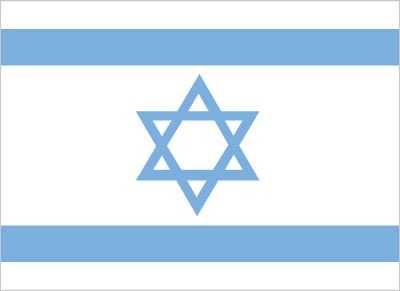
Flag
Description: White with a blue hexagram (six-pointed linear star) known as the Magen David (Star of David or Shield of David) centered between two equal horizontal blue bands near the top and bottom edges of the flag
History: The design resembles a traditional Jewish prayer shawl (tallit), which is white with blue stripes; the hexagram as a Jewish symbol dates back to medieval times
Note: The Israeli flag proclamation states that the flag colors are sky blue and white, but the exact shade of blue has never been set and can vary
History: The design resembles a traditional Jewish prayer shawl (tallit), which is white with blue stripes; the hexagram as a Jewish symbol dates back to medieval times
Note: The Israeli flag proclamation states that the flag colors are sky blue and white, but the exact shade of blue has never been set and can vary
Independence
14 May 1948 (following League of Nations mandate under British administration)
Judicial branch
Highest court(s): Supreme Court (consists of the president, deputy president, 13 justices, and 2 registrars) and normally sits in panels of 3 justices; in special cases, the panel is expanded with an uneven number of justices
Judge selection and term of office: Judges selected by the 9-member Judicial Selection Committee, consisting of the Minister of Justice (chair), the president of the Supreme Court, two other Supreme Court justices, 1 other Cabinet minister, 2 Knesset members, and 2 representatives of the Israel Bar Association; judges can serve up to mandatory retirement at age 70
Subordinate courts: District and magistrate courts; national and regional labor courts; family and juvenile courts; special and Rabbinical courts
Judge selection and term of office: Judges selected by the 9-member Judicial Selection Committee, consisting of the Minister of Justice (chair), the president of the Supreme Court, two other Supreme Court justices, 1 other Cabinet minister, 2 Knesset members, and 2 representatives of the Israel Bar Association; judges can serve up to mandatory retirement at age 70
Subordinate courts: District and magistrate courts; national and regional labor courts; family and juvenile courts; special and Rabbinical courts
Legal system
mixed system of English common law, British Mandate regulations, and Jewish, Christian, and Muslim religious laws
Legislative branch
Legislature name: Parliament (Knesset)
Legislative structure: Unicameral
Number of seats: 120 (all directly elected)
Electoral system: Proportional representation
Scope of elections: Full renewal
Term in office: 4 years
Most recent election date: 11/1/2022
Parties elected and seats per party: Likud (32); Yesh Atid (24); Religious Zionism (14); National Unity (12); Shas (11); United Torah Judaism (Yahadut Hatorah) (7); Yisrael Beiteinu (6); Other (14)
Percentage of women in chamber: 24.2%
Expected date of next election: October 2026
Note 1: A 3.25% vote threshold is required to gain representation
Note 2: Following the 1 November 2022 election, the Religious Zionism Alliance split into its three constituent parties in the Knesset: Religious Zionism 7 seats, Jewish Power (Otzma Yehudit) 6, and Noam 1
Legislative structure: Unicameral
Number of seats: 120 (all directly elected)
Electoral system: Proportional representation
Scope of elections: Full renewal
Term in office: 4 years
Most recent election date: 11/1/2022
Parties elected and seats per party: Likud (32); Yesh Atid (24); Religious Zionism (14); National Unity (12); Shas (11); United Torah Judaism (Yahadut Hatorah) (7); Yisrael Beiteinu (6); Other (14)
Percentage of women in chamber: 24.2%
Expected date of next election: October 2026
Note 1: A 3.25% vote threshold is required to gain representation
Note 2: Following the 1 November 2022 election, the Religious Zionism Alliance split into its three constituent parties in the Knesset: Religious Zionism 7 seats, Jewish Power (Otzma Yehudit) 6, and Noam 1
International organization participation
BIS, BSEC (observer), CE (observer), CERN, CICA, EBRD, FAO, IADB, IAEA, IBRD, ICAO, ICC (national committees), ICRM, IDA, IFAD, IFC, IFRCS, ILO, IMF, IMO, IMSO, Interpol, IOC, IOM, IPU, ISO, ITSO, ITU, ITUC (NGOs), MIGA, OAS (observer), OECD, OPCW (signatory), OSCE (partner), Pacific Alliance (observer), Paris Club, PCA, SELEC (observer), UN, UNCTAD, UNESCO, UNHCR, UNIDO, UNWTO, UPU, WCO, WHO, WIPO, WMO, WTO
National holiday
Independence Day, 14 May (1948)
Note: Israel declared independence on 14 May 1948, but the Jewish calendar is lunar, so the holiday can occur in April or May
Note: Israel declared independence on 14 May 1948, but the Jewish calendar is lunar, so the holiday can occur in April or May
Political parties
Balad
Blue and White
Hadash
Labor Party or HaAvoda
Likud
Meretz
National Unity (alliance includes Blue and White and New Hope)
New Hope
Noam
Otzma Yehudit
Religious Zionist Party
Shas
Ta'al
United Arab List
United Torah Judaism or UTJ (alliance includes Agudat Israel and Degel HaTorah)
Yesh Atid
Yisrael Beiteinu
Blue and White
Hadash
Labor Party or HaAvoda
Likud
Meretz
National Unity (alliance includes Blue and White and New Hope)
New Hope
Noam
Otzma Yehudit
Religious Zionist Party
Shas
Ta'al
United Arab List
United Torah Judaism or UTJ (alliance includes Agudat Israel and Degel HaTorah)
Yesh Atid
Yisrael Beiteinu
Suffrage
18 years of age; universal; 17 years of age for municipal elections
Government type
parliamentary democracy
Country name
Conventional long form: State of Israel
Conventional short form: Israel
Local long form: Medinat Yisra'el
Local short form: Yisra'el
Former: Mandatory Palestine
Etymology: Named after the ancient Kingdom of Israel; according to Biblical tradition, the Jewish patriarch Jacob received the name Israel (meaning "He who struggles with God") after he wrestled with an angel of the Lord
Conventional short form: Israel
Local long form: Medinat Yisra'el
Local short form: Yisra'el
Former: Mandatory Palestine
Etymology: Named after the ancient Kingdom of Israel; according to Biblical tradition, the Jewish patriarch Jacob received the name Israel (meaning "He who struggles with God") after he wrestled with an angel of the Lord
Diplomatic representation in the US
Chief of mission: Ambassador Yechiel (Michael) LEITER (since 4 February 2025)
Chancery: 3514 International Drive NW, Washington, DC 20008
Telephone: [1] (202) 364-5500
FAX: [1] (202) 364-5607
Email address and website:
Consular@washington.mfa.gov.il
https://embassies.gov.il/washington/Pages/default.aspx
Consulate(s) general: Atlanta, Boston, Chicago, Houston, Los Angeles, Miami, New York, San Francisco
Chancery: 3514 International Drive NW, Washington, DC 20008
Telephone: [1] (202) 364-5500
FAX: [1] (202) 364-5607
Email address and website:
Consular@washington.mfa.gov.il
https://embassies.gov.il/washington/Pages/default.aspx
Consulate(s) general: Atlanta, Boston, Chicago, Houston, Los Angeles, Miami, New York, San Francisco
National anthem(s)
Title: "Hatikvah" (The Hope)
Lyrics/music: Naftali Herz IMBER/traditional, arranged by Samuel COHEN
History: Adopted 2004, unofficial since 1948; used as the anthem of the Zionist movement since 1897; the 1888 arrangement by Samuel COHEN is thought to be based on the Romanian folk song "Carul cu boi" (The Ox-Driven Cart)
Lyrics/music: Naftali Herz IMBER/traditional, arranged by Samuel COHEN
History: Adopted 2004, unofficial since 1948; used as the anthem of the Zionist movement since 1897; the 1888 arrangement by Samuel COHEN is thought to be based on the Romanian folk song "Carul cu boi" (The Ox-Driven Cart)
International law organization participation
has not submitted an ICJ jurisdiction declaration; withdrew acceptance of ICCt jurisdiction in 2002
National symbol(s)
Star of David (Magen David), menorah (seven-branched lampstand)
Citizenship
Citizenship by birth: No
Citizenship by descent only: At least one parent must be a citizen of Israel
Dual citizenship recognized: Yes, but naturalized citizens are not allowed to maintain dual citizenship
Residency requirement for naturalization: 3 out of the 5 years preceding the application for naturalization
Note: Israeli law (Law of Return, 5 July 1950) provides for the granting of citizenship to any Jew - defined as a person being born to a Jewish mother or having converted to Judaism while renouncing any other religion - who immigrates to and expresses a desire to settle in Israel on the basis of the Right of aliyah; the 1970 amendment of this act extended the right to family members including the spouse of a Jew, any child or grandchild, and the spouses of children and grandchildren
Citizenship by descent only: At least one parent must be a citizen of Israel
Dual citizenship recognized: Yes, but naturalized citizens are not allowed to maintain dual citizenship
Residency requirement for naturalization: 3 out of the 5 years preceding the application for naturalization
Note: Israeli law (Law of Return, 5 July 1950) provides for the granting of citizenship to any Jew - defined as a person being born to a Jewish mother or having converted to Judaism while renouncing any other religion - who immigrates to and expresses a desire to settle in Israel on the basis of the Right of aliyah; the 1970 amendment of this act extended the right to family members including the spouse of a Jew, any child or grandchild, and the spouses of children and grandchildren
National heritage
Total World Heritage Sites: 9 (all cultural)
Selected World Heritage Site locales: Masada; Old City of Acre; White City of Tel-Aviv - the Modern Movement; Biblical Tels - Megiddo, Hazor, Beer Sheba; Incense Route - Desert Cities in the Negev; Bahá’i Holy Places; Sites of Human Evolution at Mount Carmel; Caves of Maresha and Bet-Guvrin; Necropolis of Bet She’arim
Selected World Heritage Site locales: Masada; Old City of Acre; White City of Tel-Aviv - the Modern Movement; Biblical Tels - Megiddo, Hazor, Beer Sheba; Incense Route - Desert Cities in the Negev; Bahá’i Holy Places; Sites of Human Evolution at Mount Carmel; Caves of Maresha and Bet-Guvrin; Necropolis of Bet She’arim


National color(s)
blue, white
Household income or consumption by percentage share
Lowest 10%: 2% (2021 est.)
Highest 10%: 26.6% (2021 est.)
note: % share of income accruing to lowest and highest 10% of population
Highest 10%: 26.6% (2021 est.)
note: % share of income accruing to lowest and highest 10% of population
Exports - commodities
integrated circuits, diamonds, broadcasting equipment, medical instruments, refined petroleum (2023)
note: top five export commodities based on value in dollars
note: top five export commodities based on value in dollars
Exports - partners
USA 29%, China 10%, Ireland 6%, Germany 4%, Hong Kong 4% (2023)
note: top five export partners based on percentage share of exports
note: top five export partners based on percentage share of exports
Agricultural products
milk, chicken, potatoes, tomatoes, tangerines/mandarins, bananas, eggs, avocados, beef, carrots/turnips (2023)
note: top ten agricultural products based on tonnage
note: top ten agricultural products based on tonnage
Budget
Revenues: $162.524 billion (2023 est.)
Expenditures: $188.905 billion (2023 est.)
note: central government revenues (excluding grants) and expenditures converted to US dollars at average official exchange rate for year indicated
Expenditures: $188.905 billion (2023 est.)
note: central government revenues (excluding grants) and expenditures converted to US dollars at average official exchange rate for year indicated
Imports - commodities
cars, diamonds, crude petroleum, broadcasting equipment, garments (2023)
note: top five import commodities based on value in dollars
note: top five import commodities based on value in dollars
Exchange rates
new Israeli shekels (ILS) per US dollar -
Exchange rates:
3.7 (2024 est.)
3.667 (2023 est.)
3.36 (2022 est.)
3.23 (2021 est.)
3.442 (2020 est.)
Exchange rates:
3.7 (2024 est.)
3.667 (2023 est.)
3.36 (2022 est.)
3.23 (2021 est.)
3.442 (2020 est.)
Industries
high-technology products (including aviation, communications, computer-aided design and manufactures, medical electronics, fiber optics), wood and paper products, potash and phosphates, food, beverages, and tobacco, caustic soda, cement, pharmaceuticals, construction, metal products, chemical products, plastics, cut diamonds, textiles, footwear
Economic overview
high-income, technology- and industrial-based economy; economic contraction and fiscal deficits resulting from war in Gaza; labor force stabilizing following military reservist mobilization; high-tech industry remains resilient while construction and tourism among hardest-hit sectors
GDP (official exchange rate)
$540.38 billion (2024 est.)
note: data in current dollars at official exchange rate
note: data in current dollars at official exchange rate
GDP - composition, by end use
Household consumption: 48% (2023 est.)
Government consumption: 22.3% (2023 est.)
Investment in fixed capital: 24.4% (2023 est.)
Investment in inventories: 1.7% (2023 est.)
Exports of goods and services: 30.4% (2023 est.)
Imports of goods and services: -27.6% (2023 est.)
note: figures may not total 100% due to rounding or gaps in data collection
Government consumption: 22.3% (2023 est.)
Investment in fixed capital: 24.4% (2023 est.)
Investment in inventories: 1.7% (2023 est.)
Exports of goods and services: 30.4% (2023 est.)
Imports of goods and services: -27.6% (2023 est.)
note: figures may not total 100% due to rounding or gaps in data collection
Imports - partners
China 17%, USA 12%, Germany 7%, Turkey 6%, Italy 4% (2023)
note: top five import partners based on percentage share of imports
note: top five import partners based on percentage share of imports
Average household expenditures
On food: 15.8% of household expenditures (2023 est.)
On alcohol and tobacco: 2.6% of household expenditures (2023 est.)
On alcohol and tobacco: 2.6% of household expenditures (2023 est.)
Remittances
0.2% of GDP (2024 est.)
0.2% of GDP (2023 est.)
0.2% of GDP (2022 est.)
note: personal transfers and compensation between resident and non-resident individuals/households/entities
0.2% of GDP (2023 est.)
0.2% of GDP (2022 est.)
note: personal transfers and compensation between resident and non-resident individuals/households/entities
Labor force
4.71 million (2024 est.)
note: number of people ages 15 or older who are employed or seeking work
note: number of people ages 15 or older who are employed or seeking work
Reserves of foreign exchange and gold
$214.544 billion (2024 est.)
$204.661 billion (2023 est.)
$194.231 billion (2022 est.)
note: holdings of gold (year-end prices)/foreign exchange/special drawing rights in current dollars
$204.661 billion (2023 est.)
$194.231 billion (2022 est.)
note: holdings of gold (year-end prices)/foreign exchange/special drawing rights in current dollars
Unemployment rate
3.2% (2024 est.)
3.6% (2023 est.)
3.7% (2022 est.)
note: % of labor force seeking employment
3.6% (2023 est.)
3.7% (2022 est.)
note: % of labor force seeking employment
Taxes and other revenues
22.1% (of GDP) (2023 est.)
note: central government tax revenue as a % of GDP
note: central government tax revenue as a % of GDP
Real GDP (purchasing power parity)
$472.177 billion (2024 est.)
$468.095 billion (2023 est.)
$459.698 billion (2022 est.)
note: data in 2021 dollars
$468.095 billion (2023 est.)
$459.698 billion (2022 est.)
note: data in 2021 dollars
Inflation rate (consumer prices)
3.1% (2024 est.)
4.2% (2023 est.)
4.4% (2022 est.)
note: annual % change based on consumer prices
4.2% (2023 est.)
4.4% (2022 est.)
note: annual % change based on consumer prices
Current account balance
$16.713 billion (2024 est.)
$18.604 billion (2023 est.)
$17.104 billion (2022 est.)
note: balance of payments - net trade and primary/secondary income in current dollars
$18.604 billion (2023 est.)
$17.104 billion (2022 est.)
note: balance of payments - net trade and primary/secondary income in current dollars
Real GDP per capita
$47,300 (2024 est.)
$47,500 (2023 est.)
$48,100 (2022 est.)
note: data in 2021 dollars
$47,500 (2023 est.)
$48,100 (2022 est.)
note: data in 2021 dollars
Imports
$140.438 billion (2024 est.)
$140.432 billion (2023 est.)
$153.388 billion (2022 est.)
note: balance of payments - imports of goods and services in current dollars
$140.432 billion (2023 est.)
$153.388 billion (2022 est.)
note: balance of payments - imports of goods and services in current dollars
Exports
$153.248 billion (2024 est.)
$154.638 billion (2023 est.)
$164.407 billion (2022 est.)
note: balance of payments - exports of goods and services in current dollars
$154.638 billion (2023 est.)
$164.407 billion (2022 est.)
note: balance of payments - exports of goods and services in current dollars
Real GDP growth rate
0.9% (2024 est.)
1.8% (2023 est.)
6.3% (2022 est.)
note: annual GDP % growth based on constant local currency
1.8% (2023 est.)
6.3% (2022 est.)
note: annual GDP % growth based on constant local currency
Industrial production growth rate
-4.2% (2024 est.)
note: annual % change in industrial value added based on constant local currency
note: annual % change in industrial value added based on constant local currency
GDP - composition, by sector of origin
Agriculture: 1.3% (2024 est.)
Industry: 17.3% (2024 est.)
Services: 72.5% (2024 est.)
note: figures may not total 100% due to non-allocated consumption not captured in sector-reported data
Industry: 17.3% (2024 est.)
Services: 72.5% (2024 est.)
note: figures may not total 100% due to non-allocated consumption not captured in sector-reported data
Electricity access
Electrification - total population: 100% (2022 est.)
Coal
Consumption: 5.297 million metric tons (2023 est.)
Exports: 9 metric tons (2022 est.)
Imports: 4.887 million metric tons (2023 est.)
Exports: 9 metric tons (2022 est.)
Imports: 4.887 million metric tons (2023 est.)
Electricity generation sources
Fossil fuels: 89.5% of total installed capacity (2023 est.)
Solar: 9.4% of total installed capacity (2023 est.)
Wind: 1% of total installed capacity (2023 est.)
Biomass and waste: 0.1% of total installed capacity (2023 est.)
Solar: 9.4% of total installed capacity (2023 est.)
Wind: 1% of total installed capacity (2023 est.)
Biomass and waste: 0.1% of total installed capacity (2023 est.)
Natural gas
Production: 24.186 billion cubic meters (2023 est.)
Consumption: 12.608 billion cubic meters (2023 est.)
Exports: 11.505 billion cubic meters (2023 est.)
Imports: 59.369 million cubic meters (2022 est.)
Proven reserves: 176.018 billion cubic meters (2021 est.)
Consumption: 12.608 billion cubic meters (2023 est.)
Exports: 11.505 billion cubic meters (2023 est.)
Imports: 59.369 million cubic meters (2022 est.)
Proven reserves: 176.018 billion cubic meters (2021 est.)
Petroleum
Total petroleum production: 15,000 bbl/day (2023 est.)
Refined petroleum consumption: 219,000 bbl/day (2024 est.)
Crude oil estimated reserves: 12.73 million barrels (2021 est.)
Refined petroleum consumption: 219,000 bbl/day (2024 est.)
Crude oil estimated reserves: 12.73 million barrels (2021 est.)
Electricity
Installed generating capacity: 22.612 million kW (2023 est.)
Consumption: 63.964 billion kWh (2023 est.)
Exports: 6.93 billion kWh (2023 est.)
Transmission/distribution losses: 3.51 billion kWh (2023 est.)
Consumption: 63.964 billion kWh (2023 est.)
Exports: 6.93 billion kWh (2023 est.)
Transmission/distribution losses: 3.51 billion kWh (2023 est.)
Internet users
Percent of population: 87% (2023 est.)
Internet country code
.il
Broadcast media
the Israel Broadcasting Corporation (IBC) has 3 channels, two in Hebrew and one in Arabic; multi-channel satellite and cable TV packages provide access to foreign channels; IBC broadcasts on 8 radio networks with multiple repeaters, and Israel Defense Forces Radio broadcasts over multiple stations; about 15 privately owned radio stations (2019)
Telephones - mobile cellular
Total subscriptions: 13.8 million (2022 est.)
Subscriptions per 100 inhabitants: 152 (2022 est.)
Subscriptions per 100 inhabitants: 152 (2022 est.)
Broadband - fixed subscriptions
Total: 2.76 million (2023 est.)
Subscriptions per 100 inhabitants: 30 (2023 est.)
Subscriptions per 100 inhabitants: 30 (2023 est.)
Telephones - fixed lines
Total subscriptions: 2.905 million (2023 est.)
Subscriptions per 100 inhabitants: 31 (2023 est.)
Subscriptions per 100 inhabitants: 31 (2023 est.)
Railways
Total: 1,497 km (2021) (2019)
Standard gauge: 1,497 km (2021) 1.435-m gauge
Standard gauge: 1,497 km (2021) 1.435-m gauge
Civil aircraft registration country code prefix
4X
Airports
40 (2025)
Merchant marine
Total: 41 (2023)
By type: Container ship 4, general cargo 1, oil tanker 4, other 32
By type: Container ship 4, general cargo 1, oil tanker 4, other 32
Heliports
13 (2025)
Military service age and obligation
18 years of age for compulsory military service; 17 years of age for voluntary military service; Jews and Druze can be conscripted; Christians, Circassians, and Muslims may volunteer; both sexes are obligated to military service; conscript service obligation is 32 months for enlisted men and about 24 months for enlisted women (varies based on military occupation); officers serve 48 months; Air Force pilots commit to 9 years of service; reserve obligation to age 41-51 (men), age 24 (women) (2024)
Note: The IDF recruits foreign Jews and non-Jews with a minimum of one Jewish grandparent, as well as converts to Judaism; each year the IDF brings in about 800-1,000 foreign recruits from around the world
Note: The IDF recruits foreign Jews and non-Jews with a minimum of one Jewish grandparent, as well as converts to Judaism; each year the IDF brings in about 800-1,000 foreign recruits from around the world
Military expenditures
8% of GDP (2024 est.)
5% of GDP (2023 est.)
4.5% of GDP (2022 est.)
5% of GDP (2021 est.)
5% of GDP (2020 est.)
5% of GDP (2023 est.)
4.5% of GDP (2022 est.)
5% of GDP (2021 est.)
5% of GDP (2020 est.)
Military and security forces
Israel Defense Forces (IDF): Ground Forces, Israel Naval Force (IN, includes commandos), Israel Air Force (IAF, includes air defense)
Ministry of National Security: Israeli Police (2025)
Ministry of National Security: Israeli Police (2025)
Military - note
the IDF is responsible for external defense but also has some domestic security responsibilities; its primary operational focuses include the threat posed by Iran, instability in Syria, and terrorist organizations, including HAMAS, Hizballah, and Palestine Islamic Jihad; since its creation from armed Jewish militias during the First Arab-Israeli War in 1948-49, the IDF, particularly the Ground Force, has been guided by a requirement to rapidly mobilize and defend the country’s territory from numerically superior neighboring countries; the active-duty military is backed up by a large force of trained reserves--approximately 300-400,000 personnel--that can be mobilized rapidly
Israel’s primary security partner is the US; consistent with a 10-year (2019-2028) Memorandum of Understanding, the US annually provides over $3 billion in military financing and cooperative military programs, such as missile defense; the US also provides Israel access to US-produced military weapons systems including advanced fighter aircraft; Israel has Major Non-NATO Ally status with the US, a designation under US law that provides foreign partners with certain benefits in the areas of defense trade and security cooperation
The United Nations Disengagement Observer Force (UNDOF) has operated in the Golan between Israel and Syria since 1974 to monitor the ceasefire following the 1973 Arab-Israeli War and supervise the areas of separation between the two countries; UNDOF consists of about 1,300 total personnel (2025)
Israel’s primary security partner is the US; consistent with a 10-year (2019-2028) Memorandum of Understanding, the US annually provides over $3 billion in military financing and cooperative military programs, such as missile defense; the US also provides Israel access to US-produced military weapons systems including advanced fighter aircraft; Israel has Major Non-NATO Ally status with the US, a designation under US law that provides foreign partners with certain benefits in the areas of defense trade and security cooperation
The United Nations Disengagement Observer Force (UNDOF) has operated in the Golan between Israel and Syria since 1974 to monitor the ceasefire following the 1973 Arab-Israeli War and supervise the areas of separation between the two countries; UNDOF consists of about 1,300 total personnel (2025)
Military and security service personnel strengths
approximately 170,000 active-duty Defense Forces (130,000 Ground Forces; 10,000 Naval; 30,000 Air Force); more than 400,000 reserves (2025)
Military equipment inventories and acquisitions
the majority of the IDF's inventory is comprised of weapons that are domestically produced or imported from Europe and the US; the US has been the leading supplier of arms in recent years; Israel's defense industry can develop, produce, support, and sustain a wide variety of weapons systems for both domestic use and export, particularly armored vehicles, unmanned aerial systems, air defense, and guided missiles (2025)
Refugees and internally displaced persons
Refugees: 27,413 (2024 est.)
IDPs: 68,000 (2024 est.)
Stateless persons: 35 (2024 est.)
IDPs: 68,000 (2024 est.)
Stateless persons: 35 (2024 est.)
Terrorist group(s)
Terrorist group(s): Islamic State of Iraq and ash-Sham (ISIS); Popular Front for the Liberation of Palestine (PFLP); Palestinian Islamic Jihad (PIJ); HAMAS
Note: Details about the history, aims, leadership, organization, areas of operation, tactics, targets, weapons, size, and sources of support of the group(s) appear(s) in the Terrorism reference guide
Note: Details about the history, aims, leadership, organization, areas of operation, tactics, targets, weapons, size, and sources of support of the group(s) appear(s) in the Terrorism reference guide
Space program overview
has an ambitious space program that is one of the most advanced in the region; designs, builds, operates, and launches communications, remote sensing (RS), and scientific satellites; designs, builds, and operates orbital satellite/space launch vehicles (SLVs); researches and develops a range of other space-related capabilities, with a focus on lightweight and miniaturized technologies; has relations with a variety of foreign space agencies and industries, including those of Canada, the ESA, individual ESA member states (such as France, Germany, and Italy), India, Japan, Mexico, and the US; has a substantial commercial space sector, as well as state-owned enterprises (2025)
Space launch site(s)
Palmachim Airbase (Central district) (2025)
Space agency/agencies
Israel Space Agency (ISA; established 1983 under the Ministry of Science and Technology; origins go back to the creation of a National Committee for Space Research, established 1960); Ministry of Defense Space Department (2025)
Ports
Total ports: 5 (2024)
Large: 0
Medium: 1
Small: 2
Very small: 2
Ports with oil terminals: 4
Key ports: Ashdod, Ashqelon, Elat, Hadera, Haifa
Large: 0
Medium: 1
Small: 2
Very small: 2
Ports with oil terminals: 4
Key ports: Ashdod, Ashqelon, Elat, Hadera, Haifa
Key space-program milestones
1961 - first sounding rocket launched
1988 - first operational launch of small-lift satellite launch vehicle (SLV) (Shavit) placed first domestically produced technology-demonstrator satellite (Ofeq-1) in orbit
1995 - launched first fully operational remote sensing satellite (Ofeq-3) on Shavit SLV
2007 - unveiled Shavit-2 small-lift 3-stage SLV
2014 - joined ESA’s Jupiter Icy Moons Explorer (JUICE) project; domestically built lunar probe (Beresheet) launched by US (crashed on Moon’s surface)
2022 - joined US Artemis Moon exploration project
1988 - first operational launch of small-lift satellite launch vehicle (SLV) (Shavit) placed first domestically produced technology-demonstrator satellite (Ofeq-1) in orbit
1995 - launched first fully operational remote sensing satellite (Ofeq-3) on Shavit SLV
2007 - unveiled Shavit-2 small-lift 3-stage SLV
2014 - joined ESA’s Jupiter Icy Moons Explorer (JUICE) project; domestically built lunar probe (Beresheet) launched by US (crashed on Moon’s surface)
2022 - joined US Artemis Moon exploration project
Methane emissions
Energy: 29.2 kt (2022-2024 est.)
Agriculture: 40.6 kt (2019-2021 est.)
Waste: 272.7 kt (2019-2021 est.)
Other: 0.7 kt (2019-2021 est.)
Agriculture: 40.6 kt (2019-2021 est.)
Waste: 272.7 kt (2019-2021 est.)
Other: 0.7 kt (2019-2021 est.)
Gini Index coefficient - distribution of family income
37.9 (2021 est.)
note: index (0-100) of income distribution; higher values represent greater inequality
note: index (0-100) of income distribution; higher values represent greater inequality