Puerto Rico
Central America and the CaribbeanRQ June 25, 2025
Background
Populated for centuries by aboriginal peoples, Puerto Rico was claimed by the Spanish Crown in 1493 after Christopher COLUMBUS' second voyage to the Americas. In 1898, after 400 years of colonial rule that saw the indigenous population nearly exterminated and African slave labor introduced, Puerto Rico was ceded to the US as a result of the Spanish-American War. Puerto Ricans were granted US citizenship in 1917. Popularly elected governors have served since 1948. In 1952, a constitution was enacted that provided for internal self-government. In plebiscites held in 1967, 1993, and 1998, voters chose not to alter the existing political status with the US, but the results of a 2012 vote left open the possibility of American statehood. A referendum held in late 2020 showed a narrow preference for statehood.
Economic recession on the island has led to a net population loss since about 2005, as large numbers of residents moved to the US mainland. In 2017, Hurricane Maria was the worst storm to hit the island in eight decades, and damage was estimated in the tens of billions of dollars.
Economic recession on the island has led to a net population loss since about 2005, as large numbers of residents moved to the US mainland. In 2017, Hurricane Maria was the worst storm to hit the island in eight decades, and damage was estimated in the tens of billions of dollars.
Geographic coordinates
18 15 N, 66 30 W
Natural hazards
periodic droughts; hurricanes
Area - comparative
slightly less than three times the size of Rhode Island
Climate
tropical marine, mild; little seasonal temperature variation
Coastline
501 km
Land boundaries
Total: 0 km
Land use
Agricultural land: 19% (2022 est.)
Arable land: 5.7% (2022 est.)
Permanent crops: 1.8% (2022 est.)
Permanent pasture: 11.6% (2022 est.)
Forest: 56.1% (2022 est.)
Other: 24.9% (2022 est.)
Arable land: 5.7% (2022 est.)
Permanent crops: 1.8% (2022 est.)
Permanent pasture: 11.6% (2022 est.)
Forest: 56.1% (2022 est.)
Other: 24.9% (2022 est.)
Maritime claims
Territorial sea: 12 nm
Exclusive economic zone: 200 nm
Exclusive economic zone: 200 nm
Natural resources
some copper and nickel; potential for onshore and offshore oil
Geography - note
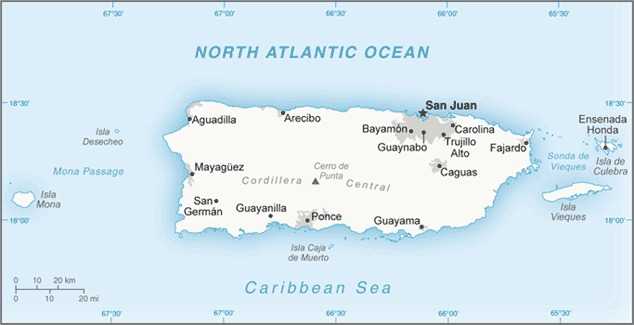
important location along the Mona Passage, a key shipping lane to the Panama Canal; San Juan is one of the biggest and best natural harbors in the Caribbean; many small rivers and high central mountains ensure land is well-watered; south coast relatively dry; fertile coastal plain belt in north
Terrain
mostly mountains with coastal plain in north; precipitous mountains to the sea on west coast; sandy beaches along most coastal areas
Location
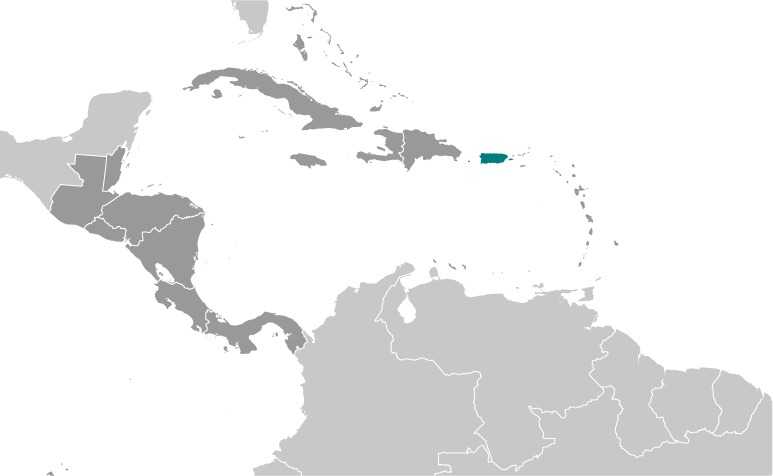
Caribbean, island between the Caribbean Sea and the North Atlantic Ocean, east of the Dominican Republic
Map references
Central America and the Caribbean
Irrigated land
220 sq km (2012)
Elevation
Highest point: Cerro de Punta 1,338 m
Lowest point: Caribbean Sea 0 m
Mean elevation: 261 m
Lowest point: Caribbean Sea 0 m
Mean elevation: 261 m
Total renewable water resources
7.1 billion cubic meters (2020 est.)
Area
Total : 9,104 sq km
Land: 8,959 sq km
Water: 145 sq km
Land: 8,959 sq km
Water: 145 sq km
Population distribution
population clusters tend to be found along the coast, with the largest of these in and around San Juan; an exception is a sizeable population located in the interior of the island immediately south of the capital around Caguas; most of the interior, particularly in the western half of the island, is dominated by the Cordillera Central mountains, where population density is low
Age structure
0-14 years: 12.5% (male 191,649/female 184,597)
15-64 years: 62.6% (male 904,406/female 986,778)
65 years and over: 24.9% (2024 est.) (male 322,698/female 429,322)
15-64 years: 62.6% (male 904,406/female 986,778)
65 years and over: 24.9% (2024 est.) (male 322,698/female 429,322)
Sex ratio
At birth: 1.06 male(s)/female
0-14 years: 1.04 male(s)/female
15-64 years: 0.92 male(s)/female
65 years and over: 0.75 male(s)/female
Total population: 0.89 male(s)/female (2024 est.)
0-14 years: 1.04 male(s)/female
15-64 years: 0.92 male(s)/female
65 years and over: 0.75 male(s)/female
Total population: 0.89 male(s)/female (2024 est.)
Literacy
Total population: 92% (2017 est.)
Male: 92% (2017 est.)
Female: 92% (2017 est.)
Male: 92% (2017 est.)
Female: 92% (2017 est.)
Nationality
Noun: Puerto Rican(s) (US citizens)
Adjective: Puerto Rican
Adjective: Puerto Rican
School life expectancy (primary to tertiary education)
Total: 16 years
Male: 15 years
Female: 18 years (2018)
Male: 15 years
Female: 18 years (2018)
Urbanization
Urban population: 93.6% of total population (2023)
Rate of urbanization: -0.12% annual rate of change (2020-25 est.)
Rate of urbanization: -0.12% annual rate of change (2020-25 est.)
Drinking water source
Improved:
Urban: NA
Rural: NA
Total: 100% of population
Unimproved:
Urban: NA
Rural: NA
Total: 0% of population (2020 est.)
Urban: NA
Rural: NA
Total: 100% of population
Unimproved:
Urban: NA
Rural: NA
Total: 0% of population (2020 est.)
Major urban areas - population
2.440 million SAN JUAN (capital) (2023)
Dependency ratios
Total dependency ratio: 59.7 (2024 est.)
Youth dependency ratio: 19.9 (2024 est.)
Elderly dependency ratio: 39.8 (2024 est.)
Potential support ratio: 2.5 (2024 est.)
Youth dependency ratio: 19.9 (2024 est.)
Elderly dependency ratio: 39.8 (2024 est.)
Potential support ratio: 2.5 (2024 est.)
Sanitation facility access
Improved:
Urban: NA
Rural: NA
Total: 100% of population
Unimproved:
Urban: NA
Rural: NA
Total: 0% of population (2020 est.)
Urban: NA
Rural: NA
Total: 100% of population
Unimproved:
Urban: NA
Rural: NA
Total: 0% of population (2020 est.)
Ethnic groups
White 75.8%, Black/African American 12.4%, other 8.5% (includes American Indian, Alaskan Native, Native Hawaiian, other Pacific Islander, and others), mixed 3.3% (2010 est.)
Note: 99% of the population is Latino
Note: 99% of the population is Latino
Religions
Roman Catholic 56%, Protestant 33% (largely Pentecostal), other 2%, atheist 1%, none 7% (2014 est.)
Languages
Spanish, English
Major-language sample(s):
La Libreta Informativa del Mundo, la fuente indispensable de información básica. (Spanish)
The World Factbook, the indispensable source for basic information.
Major-language sample(s):
La Libreta Informativa del Mundo, la fuente indispensable de información básica. (Spanish)
The World Factbook, the indispensable source for basic information.
Physician density
3.06 physicians/1,000 population (2018)
Contraceptive prevalence rate
NA
Gross reproduction rate
0.61 (2024 est.)
Currently married women (ages 15-49)
37.4% (2023 est.)
Youth unemployment rate (ages 15-24)
Total: 12.5% (2024 est.)
Male: 14% (2024 est.)
Female: 9.8% (2024 est.)
note: % of labor force ages 15-24 seeking employment
Male: 14% (2024 est.)
Female: 9.8% (2024 est.)
note: % of labor force ages 15-24 seeking employment
Net migration rate
-9.6 migrant(s)/1,000 population (2024 est.)
Median age
Total: 46.1 years (2024 est.)
Male: 44.2 years
Female: 47.8 years
Male: 44.2 years
Female: 47.8 years
Maternal mortality ratio
34 deaths/100,000 live births (2020 est.)
Total fertility rate
1.26 children born/woman (2024 est.)
Population
Total: 3,019,450 (2024 est.)
Male: 1,418,753
Female: 1,600,697
Male: 1,418,753
Female: 1,600,697
Infant mortality rate
Total: 5.8 deaths/1,000 live births (2024 est.)
Male: 6.4 deaths/1,000 live births
Female: 5.2 deaths/1,000 live births
Male: 6.4 deaths/1,000 live births
Female: 5.2 deaths/1,000 live births
Death rate
10.2 deaths/1,000 population (2024 est.)
Birth rate
7.8 births/1,000 population (2024 est.)
Life expectancy at birth
Total population: 82.1 years (2024 est.)
Male: 78.9 years
Female: 85.5 years
Male: 78.9 years
Female: 85.5 years
Education expenditure
3.6% of GDP (2021 est.)
Population growth rate
-1.2% (2024 est.)
Environment - current issues
soil erosion; occasional droughts cause water shortages; industrial pollution
Total water withdrawal
Municipal: 800 million cubic meters (2020 est.)
Industrial: 2.37 billion cubic meters (2020 est.)
Agricultural: 110 million cubic meters (2020 est.)
Industrial: 2.37 billion cubic meters (2020 est.)
Agricultural: 110 million cubic meters (2020 est.)
Waste and recycling
Municipal solid waste generated annually: 4,170,953 tons (2015 est.)
Municipal solid waste recycled annually: 583,933 tons (2013 est.)
Percent of municipal solid waste recycled: 14% (2013 est.)
Municipal solid waste recycled annually: 583,933 tons (2013 est.)
Percent of municipal solid waste recycled: 14% (2013 est.)
Carbon dioxide emissions
18.833 million metric tonnes of CO2 (2023 est.)
From coal and metallurgical coke: 2.49 million metric tonnes of CO2 (2023 est.)
From petroleum and other liquids: 11.801 million metric tonnes of CO2 (2023 est.)
From consumed natural gas: 4.542 million metric tonnes of CO2 (2023 est.)
From coal and metallurgical coke: 2.49 million metric tonnes of CO2 (2023 est.)
From petroleum and other liquids: 11.801 million metric tonnes of CO2 (2023 est.)
From consumed natural gas: 4.542 million metric tonnes of CO2 (2023 est.)
Energy consumption per capita
86.286 million Btu/person (2023 est.)
Diplomatic representation from the US
Embassy: None (territory of the US with commonwealth status)
Administrative divisions
none (territory of the US); there are no first-order administrative divisions as defined by the US government, but 78 municipalities (municipios, singular - municipio) are considered second-order: Adjuntas, Aguada, Aguadilla, Aguas Buenas, Aibonito, Anasco, Arecibo, Arroyo, Barceloneta, Barranquitas, Bayamon, Cabo Rojo, Caguas, Camuy, Canovanas, Carolina, Catano, Cayey, Ceiba, Ciales, Cidra, Coamo, Comerio, Corozal, Culebra, Dorado, Fajardo, Florida, Guanica, Guayama, Guayanilla, Guaynabo, Gurabo, Hatillo, Hormigueros, Humacao, Isabela, Jayuya, Juana Diaz, Juncos, Lajas, Lares, Las Marias, Las Piedras, Loiza, Luquillo, Manati, Maricao, Maunabo, Mayaguez, Moca, Morovis, Naguabo, Naranjito, Orocovis, Patillas, Penuelas, Ponce, Quebradillas, Rincon, Rio Grande, Sabana Grande, Salinas, San German, San Juan, San Lorenzo, San Sebastian, Santa Isabel, Toa Alta, Toa Baja, Trujillo Alto, Utuado, Vega Alta, Vega Baja, Vieques, Villalba, Yabucoa, Yauco
Capital
Name: San Juan
Geographic coordinates: 18 28 N, 66 07 W
Time difference: UTC-4 (1 hour ahead of Washington, DC, during Standard Time)
Etymology: Spanish explorer Juan PONCE de Leon named the city in 1511 both for himself and for his name saint, Saint John
Geographic coordinates: 18 28 N, 66 07 W
Time difference: UTC-4 (1 hour ahead of Washington, DC, during Standard Time)
Etymology: Spanish explorer Juan PONCE de Leon named the city in 1511 both for himself and for his name saint, Saint John
Constitution
History: Previous 1900 (Organic Act, or Foraker Act); latest ratified by referendum 3 March 1952, approved 3 July 1952, effective 25 July 1952
Amendment process: Proposed by a concurrent resolution of at least two-thirds majority by the total Legislative Assembly membership; approval requires at least two-thirds majority vote by the membership of both houses and approval by a majority of voters in a special referendum; if passed by at least three-fourths Assembly vote, the referendum can be held concurrently with the next general election; constitutional articles such as the republican form of government or the bill of rights cannot be amended
Amendment process: Proposed by a concurrent resolution of at least two-thirds majority by the total Legislative Assembly membership; approval requires at least two-thirds majority vote by the membership of both houses and approval by a majority of voters in a special referendum; if passed by at least three-fourths Assembly vote, the referendum can be held concurrently with the next general election; constitutional articles such as the republican form of government or the bill of rights cannot be amended
Executive branch
Chief of state: President Donald J. TRUMP (since 20 January 2025)
Head of government: Governor Jenniffer GONZÁLEZ-COLÓN (since 2 January 2025)
Cabinet: Cabinet appointed by governor with the consent of the Legislative Assembly
Elections/appointments: President and vice president indirectly elected on the same ballot by an Electoral College of 'electors' chosen from each state; president and vice president serve a 4-year term (eligible for a second term); under the US Constitution, residents of Puerto Rico do not vote in elections for US president and vice president; however, they may vote in Democratic and Republican party presidential primary elections; governor directly elected by simple majority popular vote for a 4-year term (no term limits); election last held on 5 November 2024 (next to be held on 7 November 2028)
Election results:
Head of government: Governor Jenniffer GONZÁLEZ-COLÓN (since 2 January 2025)
Cabinet: Cabinet appointed by governor with the consent of the Legislative Assembly
Elections/appointments: President and vice president indirectly elected on the same ballot by an Electoral College of 'electors' chosen from each state; president and vice president serve a 4-year term (eligible for a second term); under the US Constitution, residents of Puerto Rico do not vote in elections for US president and vice president; however, they may vote in Democratic and Republican party presidential primary elections; governor directly elected by simple majority popular vote for a 4-year term (no term limits); election last held on 5 November 2024 (next to be held on 7 November 2028)
Election results:
2024: Jenniffer GONZÁLEZ-COLÓN elected governor; percent of vote - Jenniffer GONZÁLEZ-COLÓN (PNP) 39.4%, Juan DALMAU Ramírez (PIP) 32.7%, Jesús Manuel ORTIZ (PPD) 21.1%, Javier JIMÉNEZ (PD) 6.7%, other 0.1%
2020: Pedro PIERLUISI elected governor; percent of vote - Pedro PIERLUISI (PNP) 32.9%, Carlos DELGADO (PPD) 31.6%, Alexandra LUGARO (independent) 14.2%, Juan DALMAU (PIP) 13.7%, other 7.6%
Flag description
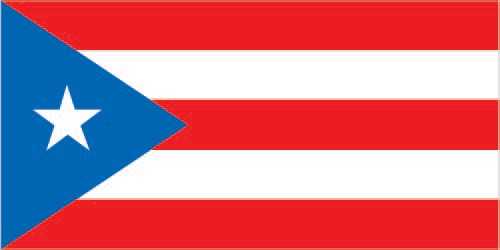
five equal horizontal bands of red (top, center, and bottom) alternating with white; a blue isosceles triangle based on the hoist side has a large five-pointed white star in the center, symbolizing the country; the three sides of the triangle stand for the executive, legislative, and judicial parts of the government; blue stands for the sky and the coastal waters, red for the blood shed by warriors, and white for liberty, victory, and peace
Note: Design initially influenced by the US flag, but similar to the Cuban flag, with the colors of the bands and triangle reversed
Note: Design initially influenced by the US flag, but similar to the Cuban flag, with the colors of the bands and triangle reversed
Independence
none (territory of the US with commonwealth status)
Judicial branch
Highest court(s): Supreme Court (consists of the chief justice and 8 associate justices)
Judge selection and term of office: Justices appointed by the governor and confirmed by majority Senate vote; judges serve until compulsory retirement at age 70
Subordinate courts: Court of Appeals; First Instance Court comprised of superior and municipal courts
Judge selection and term of office: Justices appointed by the governor and confirmed by majority Senate vote; judges serve until compulsory retirement at age 70
Subordinate courts: Court of Appeals; First Instance Court comprised of superior and municipal courts
Legal system
civil law system based on the Spanish civil code, within the framework of the US federal system
Legislative branch
Legislature name: Legislative Assembly (Asamblea Legislativa)
Legislative structure: Bicameral
Term in office: 4 years
Note: Puerto Rico directly elects 1 member by simple majority vote to serve a 4-year term as a commissioner to the US House of Representatives; the commissioner can vote when serving on a committee and when the House meets as the Committee of the Whole House but not when legislation is submitted for a 'full floor' House vote; election of commissioner last held on 6 November 2018 (next to be held in November 2022)
Legislative structure: Bicameral
Term in office: 4 years
Note: Puerto Rico directly elects 1 member by simple majority vote to serve a 4-year term as a commissioner to the US House of Representatives; the commissioner can vote when serving on a committee and when the House meets as the Committee of the Whole House but not when legislation is submitted for a 'full floor' House vote; election of commissioner last held on 6 November 2018 (next to be held in November 2022)
International organization participation
AOSIS (observer), Caricom (observer), Interpol (subbureau), IOC, UNWTO (associate), UPU, WFTU (NGOs)
National holiday
US Independence Day, 4 July (1776); Puerto Rico Constitution Day, 25 July (1952)
Political parties
Citizens' Victory Movement (Movimiento Victoria Ciudadana) or MVC
Democratic Party of Puerto Rico
New Progressive Party or PNP (pro-US statehood)
Popular Democratic Party or PPD (pro-commonwealth)
Project Dignity (Projecto Dignidad) or PD
Puerto Rican Independence Party or PIP (pro-independence)
Republican Party of Puerto Rico
Democratic Party of Puerto Rico
New Progressive Party or PNP (pro-US statehood)
Popular Democratic Party or PPD (pro-commonwealth)
Project Dignity (Projecto Dignidad) or PD
Puerto Rican Independence Party or PIP (pro-independence)
Republican Party of Puerto Rico
Suffrage
18 years of age; universal; note - island residents are US citizens but do not vote in US presidential elections
Government type
unincorporated organized territory of the US with local self-government; republican form of territorial government with separate executive, legislative, and judicial branches; note - reference Puerto Rican Federal Relations Act, 2 March 1917, as amended by Public Law 600, 3 July 1950
Country name
Conventional long form: Commonwealth of Puerto Rico
Conventional short form: Puerto Rico
Abbreviation: PR
Etymology: Christopher COLUMBUS originally named the island San Juan Bautista (Saint John the Baptist) and the capital city and main port Cuidad de Puerto Rico (Rich Port City); over time, the names were shortened and transposed
Conventional short form: Puerto Rico
Abbreviation: PR
Etymology: Christopher COLUMBUS originally named the island San Juan Bautista (Saint John the Baptist) and the capital city and main port Cuidad de Puerto Rico (Rich Port City); over time, the names were shortened and transposed
Diplomatic representation in the US
none (territory of the US)
National symbol(s)
Puerto Rican spindalis (bird), coqui (frog)
Citizenship
see United States
National heritage
Total World Heritage Sites: 1 (cultural); note - excerpted from the US entry
Selected World Heritage Site locales: La Fortaleza and San Juan National Historic Site
Selected World Heritage Site locales: La Fortaleza and San Juan National Historic Site
Exports - commodities
packaged medicines, medical cultures/vaccines, hormones, orthopedic and medical appliances, sulfur compounds (2019)
Top five export commodities based on value in dollars
Top five export commodities based on value in dollars
Agricultural products
milk, plantains, bananas, tomatoes, chicken, oranges, mangoes/guavas, pineapples, eggs, pumpkins/squash (2023)
note: top ten agricultural products based on tonnage
note: top ten agricultural products based on tonnage
Budget
Revenues: $9.268 billion (2017 est.)
Expenditures: $9.974 billion (2017 est.)
Expenditures: $9.974 billion (2017 est.)
Imports - commodities
nitrogen compounds, sulfur compounds, refined petroleum, medical cultures/vaccines, cars (2019)
Exchange rates
the US dollar is used
Industries
pharmaceuticals, electronics, apparel, food products, tourism
Economic overview
US Caribbean island territorial economy; hit hard by COVID-19 and hurricanes; declining labor force and job growth after a decade of continuous recession; capital-based industry and tourism; high poverty; energy import-dependent
GDP (official exchange rate)
$117.902 billion (2023 est.)
note: data in current dollars at official exchange rate
note: data in current dollars at official exchange rate
GDP - composition, by end use
Household consumption: 80% (2023 est.)
Government consumption: 7.1% (2023 est.)
Investment in fixed capital: 13.7% (2023 est.)
Investment in inventories: 0.5% (2023 est.)
Exports of goods and services: 53.9% (2023 est.)
Imports of goods and services: -47.8% (2023 est.)
note: figures may not total 100% due to rounding or gaps in data collection
Government consumption: 7.1% (2023 est.)
Investment in fixed capital: 13.7% (2023 est.)
Investment in inventories: 0.5% (2023 est.)
Exports of goods and services: 53.9% (2023 est.)
Imports of goods and services: -47.8% (2023 est.)
note: figures may not total 100% due to rounding or gaps in data collection
Imports - partners
Ireland 38%, Singapore 9%, Switzerland 8%, South Korea 5% (2019)
Exports - partners
Italy 15%, Netherlands 15%, Belgium 9%, Japan 8%, Germany 8%, Austria 8%, Spain 7%, China 5% (2019)
Labor force
1.15 million (2024 est.)
note: number of people ages 15 or older who are employed or seeking work
note: number of people ages 15 or older who are employed or seeking work
Public debt
51.6% of GDP (2017 est.)
Unemployment rate
5.5% (2024 est.)
5.7% (2023 est.)
6% (2022 est.)
note: % of labor force seeking employment
5.7% (2023 est.)
6% (2022 est.)
note: % of labor force seeking employment
Taxes and other revenues
8.9% (of GDP) (2017 est.)
Real GDP (purchasing power parity)
$137.828 billion (2023 est.)
$137.056 billion (2022 est.)
$132.334 billion (2021 est.)
note: data in 2021 dollars
$137.056 billion (2022 est.)
$132.334 billion (2021 est.)
note: data in 2021 dollars
Inflation rate (consumer prices)
1.8% (2017 est.)
-0.3% (2016 est.)
-0.3% (2016 est.)
Real GDP per capita
$43,000 (2023 est.)
$42,600 (2022 est.)
$40,600 (2021 est.)
note: data in 2021 dollars
$42,600 (2022 est.)
$40,600 (2021 est.)
note: data in 2021 dollars
Imports
$56.359 billion (2023 est.)
$52.15 billion (2022 est.)
$45.051 billion (2021 est.)
Note: GDP expenditure basis - imports of goods and services in current dollars
$52.15 billion (2022 est.)
$45.051 billion (2021 est.)
Note: GDP expenditure basis - imports of goods and services in current dollars
Exports
$63.579 billion (2023 est.)
$59.714 billion (2022 est.)
$57.91 billion (2021 est.)
Note: GDP expenditure basis - exports of goods and services in current dollars
$59.714 billion (2022 est.)
$57.91 billion (2021 est.)
Note: GDP expenditure basis - exports of goods and services in current dollars
Real GDP growth rate
0.56% (2023 est.)
3.57% (2022 est.)
0.39% (2021 est.)
note: annual GDP % growth based on constant local currency
3.57% (2022 est.)
0.39% (2021 est.)
note: annual GDP % growth based on constant local currency
Industrial production growth rate
4.3% (2014 est.)
note: annual % change in industrial value added based on constant local currency
note: annual % change in industrial value added based on constant local currency
GDP - composition, by sector of origin
Agriculture: 0.7% (2023 est.)
Industry: 49.1% (2023 est.)
Services: 50.6% (2023 est.)
note: figures may not total 100% due to non-allocated consumption not captured in sector-reported data
Industry: 49.1% (2023 est.)
Services: 50.6% (2023 est.)
note: figures may not total 100% due to non-allocated consumption not captured in sector-reported data
Electricity access
Electrification - total population: 100% (2022 est.)
Coal
Consumption: 1.124 million metric tons (2023 est.)
Exports: 500 metric tons (2023 est.)
Imports: 1.124 million metric tons (2023 est.)
Exports: 500 metric tons (2023 est.)
Imports: 1.124 million metric tons (2023 est.)
Electricity generation sources
Fossil fuels: 94.6% of total installed capacity (2023 est.)
Solar: 4.3% of total installed capacity (2023 est.)
Wind: 0.8% of total installed capacity (2023 est.)
Hydroelectricity: 0.2% of total installed capacity (2023 est.)
Biomass and waste: 0.1% of total installed capacity (2023 est.)
Solar: 4.3% of total installed capacity (2023 est.)
Wind: 0.8% of total installed capacity (2023 est.)
Hydroelectricity: 0.2% of total installed capacity (2023 est.)
Biomass and waste: 0.1% of total installed capacity (2023 est.)
Natural gas
Consumption: 2.315 billion cubic meters (2023 est.)
Exports: 15.627 million cubic meters (2023 est.)
Imports: 2.331 billion cubic meters (2023 est.)
Exports: 15.627 million cubic meters (2023 est.)
Imports: 2.331 billion cubic meters (2023 est.)
Petroleum
Refined petroleum consumption: 80,000 bbl/day (2023 est.)
Electricity
Installed generating capacity: 6.898 million kW (2023 est.)
Consumption: 18.669 billion kWh (2023 est.)
Transmission/distribution losses: 1.224 billion kWh (2023 est.)
Consumption: 18.669 billion kWh (2023 est.)
Transmission/distribution losses: 1.224 billion kWh (2023 est.)
Internet users
Percent of population: 87% (2022 est.)
Internet country code
.pr
Broadcast media
more than 30 TV stations; cable TV subscription services are available; roughly 125 radio stations
Telephones - mobile cellular
Total subscriptions: 4.04 million (2023 est.)
Subscriptions per 100 inhabitants: 120 (2022 est.)
Subscriptions per 100 inhabitants: 120 (2022 est.)
Broadband - fixed subscriptions
Total: 751,000 (2023 est.)
Subscriptions per 100 inhabitants: 23 (2023 est.)
Subscriptions per 100 inhabitants: 23 (2023 est.)
Telephones - fixed lines
Total subscriptions: 758,000 (2023 est.)
Subscriptions per 100 inhabitants: 23 (2023 est.)
Subscriptions per 100 inhabitants: 23 (2023 est.)
Airports
20 (2025)
Heliports
40 (2025)
Military and security forces
Puerto Rico Police; Puerto Rico (US) National Guard (Guardia Nacional de Puerto Rico or GNPR) (2025)
Note: The GNPR was created by order of the US Congress in June 1919; the organization traces its lineage and history to Spanish militias created in 1511 and is one of the oldest organizations in the US National Guard system
Note: The GNPR was created by order of the US Congress in June 1919; the organization traces its lineage and history to Spanish militias created in 1511 and is one of the oldest organizations in the US National Guard system
Military - note
defense is the responsibility of the US
Dependency status
unincorporated organized territory of the US with commonwealth status; policy relations between Puerto Rico and the US conducted under the jurisdiction of the Office of the President
National anthem
Name: "La Borinquena" (The Puerto Rican)
Lyrics/music: Manuel Fernandez JUNCOS/Felix Astol ARTES
Note: Music adopted 1952, lyrics adopted 1977; the local anthem's name is a reference to the indigenous name of the island, Borinquen; the music was originally composed as a dance in 1867 and gained popularity in the early 20th century; there is some evidence that the music was written by Francisco RAMIREZ; as a commonwealth of the US, "The Star-Spangled Banner" is official (see United States)
Lyrics/music: Manuel Fernandez JUNCOS/Felix Astol ARTES
Note: Music adopted 1952, lyrics adopted 1977; the local anthem's name is a reference to the indigenous name of the island, Borinquen; the music was originally composed as a dance in 1867 and gained popularity in the early 20th century; there is some evidence that the music was written by Francisco RAMIREZ; as a commonwealth of the US, "The Star-Spangled Banner" is official (see United States)
Ports
Total ports: 14 (2024)
Large: 0
Medium: 3
Small: 4
Very small: 7
Ports with oil terminals: 7
Key ports: Arroyo, Ensenada Honda, Mayaguez, Playa de Guanica, Playa de Guayanilla, Playa de Ponce, San Juan
Large: 0
Medium: 3
Small: 4
Very small: 7
Ports with oil terminals: 7
Key ports: Arroyo, Ensenada Honda, Mayaguez, Playa de Guanica, Playa de Guayanilla, Playa de Ponce, San Juan
Legislative branch - lower chamber
Chamber name: House of Representatives (Camara de Representantes)
Number of seats: 51 (directly elected)
Electoral system: Plurality/majority
Scope of elections: Full renewal
Term in office: 4 years
Most recent election date: 11/3/2020
Parties elected and seats per party: PPD (26); PNP (21); MVC (2); PIP (1); PD (1)
Percentage of women in chamber: 19.6%
Expected date of next election: November 2024
Number of seats: 51 (directly elected)
Electoral system: Plurality/majority
Scope of elections: Full renewal
Term in office: 4 years
Most recent election date: 11/3/2020
Parties elected and seats per party: PPD (26); PNP (21); MVC (2); PIP (1); PD (1)
Percentage of women in chamber: 19.6%
Expected date of next election: November 2024
Legislative branch - upper chamber
Chamber name: Senate (Senado)
Number of seats: 30 (directly elected)
Electoral system: Plurality/majority
Scope of elections: Full renewal
Term in office: 4 years
Most recent election date: 11/3/2020
Parties elected and seats per party: PPD (12); NP (10); MVC (2); PD (1); PIP (1); independent (1)
Percentage of women in chamber: 48.1%
Expected date of next election: November 2024
Number of seats: 30 (directly elected)
Electoral system: Plurality/majority
Scope of elections: Full renewal
Term in office: 4 years
Most recent election date: 11/3/2020
Parties elected and seats per party: PPD (12); NP (10); MVC (2); PD (1); PIP (1); independent (1)
Percentage of women in chamber: 48.1%
Expected date of next election: November 2024
National colors
red, white, blue
Quick Facts
Also in Central America and the Caribbean
AnguillaAntigua and BarbudaArubaBahamas, TheBarbadosBelizeBritish Virgin IslandsCayman IslandsCosta RicaCuba
View all →