Portugal
Background
A global maritime power during the 15th and 16th centuries, Portugal lost much of its wealth and status with the destruction of Lisbon in a 1755 earthquake, occupation during the Napoleonic Wars, and the independence of Brazil, its wealthiest colony, in 1822. A revolution deposed the monarchy in 1910, and for most of the next six decades, repressive governments ran the country. In 1974, a left-wing military coup ushered in broad democratic reforms. The following year, Portugal granted independence to all its African colonies. Portugal is a founding member of NATO and entered the EC (now the EU) in 1986.
Geographic coordinates
Natural hazards
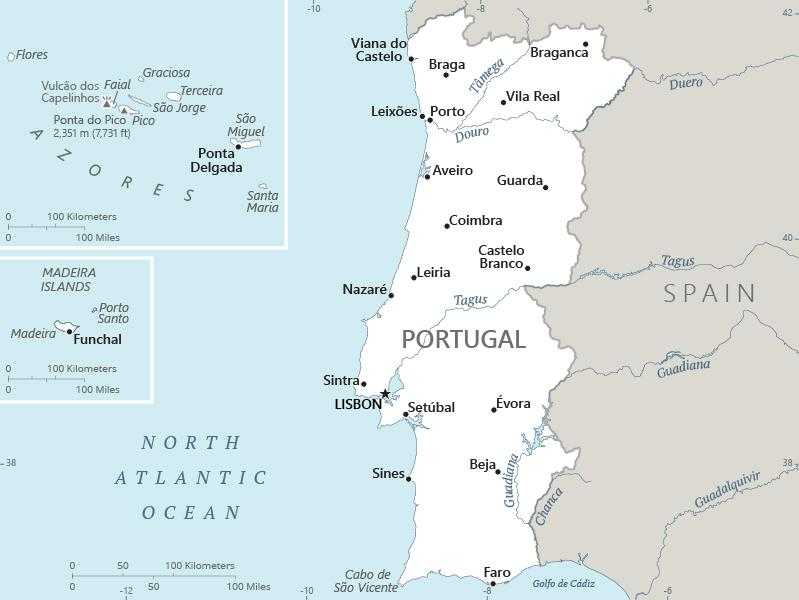
Volcanism: Limited volcanic activity in the Azores Islands; Fayal or Faial (1,043 m) last erupted in 1958; most volcanoes have not erupted in centuries; historically active volcanoes include Agua de Pau, Furnas, Pico, Picos Volcanic System, San Jorge, Sete Cidades, and Terceira
Area - comparative
Environmental issues
International environmental agreements
Signed, but not ratified: Air Pollution-Persistent Organic Pollutants, Air Pollution-Volatile Organic Compounds, Environmental Modification, Nuclear Test Ban
Climate
Coastline
Land boundaries
Border countries (1): Spain 1,224 km
Land use
Arable land: 10.1% (2023 est.)
Permanent crops: 9.6% (2023 est.)
Permanent pasture: 23.6% (2023 est.)
Forest: 36.6% (2023 est.)
Other: 5.7% (2023 est.)
Maritime claims
Contiguous zone: 24 nm
Exclusive economic zone: 200 nm
Continental shelf: 200-m depth or to the depth of exploitation
Natural resources
Geography - note
Terrain
Location
Map references
Irrigated land
Total renewable water resources
Population distribution
Elevation
Lowest point: Atlantic Ocean 0 m
Mean elevation: 372 m
Area
Land: 91,470 sq km
Water: 620 sq km
Note: Includes Azores and Madeira Islands
Age structure
15-64 years: 65% (male 3,264,766/female 3,371,087)
65 years and over: 22.3% (2024 est.) (male 908,578/female 1,369,043)
Sex ratio
0-14 years: 1.05 male(s)/female
15-64 years: 0.97 male(s)/female
65 years and over: 0.66 male(s)/female
Total population: 0.9 male(s)/female (2024 est.)
Nationality
Adjective: Portuguese
School life expectancy (primary to tertiary education)
Male: 17 years (2022 est.)
Female: 18 years (2022 est.)
Urbanization
Rate of urbanization: 0.44% annual rate of change (2020-25 est.)
Drinking water source
Urban: 99.9% of population (2022 est.)
Rural: 97.9% of population (2022 est.)
Total: 99.3% of population (2022 est.)
Unimproved:
Urban: 0.1% of population (2022 est.)
Rural: 2.1% of population (2022 est.)
Total: 0.7% of population (2022 est.)
Major urban areas - population
Physician density
Hospital bed density
Mother's mean age at first birth
Dependency ratios
Youth dependency ratio: 19.5 (2024 est.)
Elderly dependency ratio: 34.3 (2024 est.)
Potential support ratio: 2.9 (2024 est.)
Sanitation facility access
Urban: 100% of population (2022 est.)
Rural: 100% of population (2022 est.)
Total: 100% of population (2022 est.)
Unimproved:
Urban: 0% of population (2022 est.)
Rural: 0% of population (2022 est.)
Total: 0% of population (2022 est.)
Ethnic groups
Religions
Note: Data represent population 15 years of age and older
Languages
Health expenditure
14.8% of national budget (2022 est.)
Gross reproduction rate
Currently married women (ages 15-49)
Youth unemployment rate (ages 15-24)
Male: 21.6% (2024 est.)
Female: 20.7% (2024 est.)
note: % of labor force ages 15-24 seeking employment
Net migration rate
Median age
Male: 44.3 years
Female: 48.3 years
Maternal mortality ratio
Total fertility rate
Population
Male: 4,835,763
Female: 5,371,414
Infant mortality rate
Male: 2.8 deaths/1,000 live births
Female: 2.1 deaths/1,000 live births
Tobacco use
Male: 26.1% (2025 est.)
Female: 15.9% (2025 est.)
Obesity - adult prevalence rate
Death rate
Birth rate
Children under the age of 5 years underweight
Alcohol consumption per capita
Beer: 2.62 liters of pure alcohol (2019 est.)
Wine: 6.04 liters of pure alcohol (2019 est.)
Spirits: 1.34 liters of pure alcohol (2019 est.)
Other alcohols: 0.37 liters of pure alcohol (2019 est.)
Life expectancy at birth
Male: 78.8 years
Female: 85.2 years
Education expenditure
10.4% national budget (2022 est.)
Population growth rate
Total water withdrawal
Industrial: 1.83 billion cubic meters (2022 est.)
Agricultural: 3.419 billion cubic meters (2022 est.)
Waste and recycling
Percent of municipal solid waste recycled: 23.5% (2022 est.)
Particulate matter emissions
Carbon dioxide emissions
From coal and metallurgical coke: 20,000 metric tonnes of CO2 (2023 est.)
From petroleum and other liquids: 29.525 million metric tonnes of CO2 (2023 est.)
From consumed natural gas: 8.727 million metric tonnes of CO2 (2023 est.)
Energy consumption per capita
Diplomatic representation from the US
Embassy: Avenida das Forcas Armadas, 1600-081 Lisboa
Mailing address: 5320 Lisbon Place, Washington DC 20521-5320
Telephone: [351] (21) 727-3300
FAX: [351] (21) 726-9109
Email address and website:
Conslisbon@state.gov
https://pt.usembassy.gov/
Consulate(s): Ponta Delgada (Azores)
Administrative divisions
Capital
Geographic coordinates: 38 43 N, 9 08 W
Time difference: UTC 0 (5 hours ahead of Washington, DC, during Standard Time)
Daylight saving time: +1hr, begins last Sunday in March; ends last Sunday in October
Time zone note: Portugal has two time zones, including the Azores (UTC-1)
Etymology: The origin of the name is unclear; some trace it back to the legendary Greek hero Ulysses; others claim a derivation from the Phoenician alis-ubbo, or "joyful bay"
Constitution
Amendment process: Proposed by the Assembly of the Republic; adoption requires two-thirds majority vote of Assembly members
Executive branch
Head of government: Prime Minister Antonio Luis MONTENEGRO (since 2 April 2024)
Cabinet: Council of Ministers appointed by the president on the recommendation of the prime minister
Election/appointment process: President directly elected by absolute-majority popular vote in 2 rounds, if needed, for a 5-year term (eligible for a second term); following legislative elections, the president usually appoints the leader of the majority party or majority coalition as prime minister
Most recent election date: 24 January 2021
Election results:
2021: Marcelo REBELO DE SOUSA reelected president in the first round; percent of vote - Marcelo REBELO DE SOUSA (PSD) 60.7%, Ana GOMES (ran as an independent but is a member of PS) 13%, Andre VENTURA (CH) 11.9%, João FERREIRA (PCP-PEV) 4.3%, other 10.1%
2016: Marcelo REBELO DE SOUSA elected president in the first round; percent of vote - Marcelo REBELO DE SOUSA (PSD) 52%, António SAMPAIO DA NOVOA (independent) 22.9%, Marisa MATIAS (BE) 10.1%, Maria DE BELEM ROSEIRA (PS) 4.2%, other 10.8%
Expected date of next election: January 2026
Note: There is also a Council of State that acts as a consultative body to the president
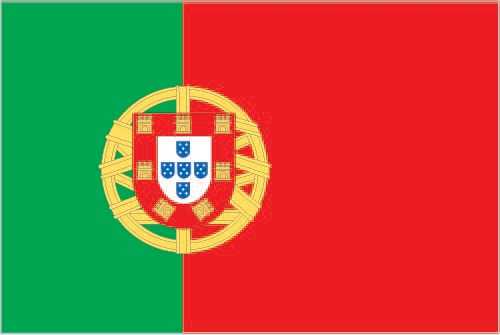
Flag
Meaning: Explanations for the color meanings are ambiguous, but a popular interpretation says that green symbolizes hope and red the blood of those defending the nation
Independence
Judicial branch
Judge selection and term of office: Supreme Court justices nominated by the president and appointed by the Assembly of the Republic; judges can serve for life; Constitutional Court judges - 10 elected by the Assembly and 3 elected by the other Constitutional Court judges; judges elected for 6-year nonrenewable terms
Subordinate courts: Supreme Administrative Court (Supremo Tribunal Administrativo); Audit Court (Tribunal de Contas); appellate, district, and municipal courts
Legal system
Legislative branch
Legislative structure: Unicameral
Number of seats: 230 (all directly elected)
Electoral system: Proportional representation
Scope of elections: Full renewal
Term in office: 4 years
Most recent election date: 5/18/2025
Parties elected and seats per party: Social Democratic Party (PPD/PSD) - Democratic and Social Centre - People's Party (CDS-PP) (88); Chega (CH) (60); Socialist Party (PS) (58); Other (24)
Percentage of women in chamber: 35.7%
Expected date of next election: September 2029
International organization participation
National holiday
Note: also called Camoes Day, the day that revered national poet Luis DE CAMOES (1524-80) died
Political parties
Democratic and Social Center/People's Party (Partido do Centro Democratico Social-Partido Popular) or CDS-PP
Ecologist Party "The Greens" or "Os Verdes" (Partido Ecologista-Os Verdes) or PEV
Enough (Chega)
Liberal Initiative (Iniciativa Liberal) or IL
LIVRE or L
People-Animals-Nature Party (Pessoas-Animais-Natureza) or PAN
People's Monarchist Party or PPM
Portuguese Communist Party (Partido Comunista Portugues) or PCP
Social Democratic Party (Partido Social Democrata) or PSD (formerly the Partido Popular Democratico or PPD)
Socialist Party (Partido Socialista) or PS
The Left Bloc (Bloco de Esquerda) or BE or O Bloco
Unitary Democratic Coalition (Coligacao Democratica Unitaria) or CDU (includes PCP and PEV) (2024)
Suffrage
Government type
Country name
Conventional short form: Portugal
Local long form: Republica Portuguesa
Local short form: Portugal
Etymology: Name derives from the Roman designation "Portus Cale," meaning "Port of Cale;" Cale was located in present-day northern Portugal, and its name is said to come from the Latin word calere (to be warm) because the harbor never iced over
Diplomatic representation in the US
Chancery: 2012 Massachusetts Avenue NW, Washington, DC 20036
Telephone: [1] (202) 350-5400
FAX: [1] (202) 462-3726
Email address and website:
Info.washington@mne.pt
https://washingtondc.embaixadaportugal.mne.gov.pt/en/
Consulate(s) general: Boston, Newark (NJ), New York, San Francisco
Consulate(s): New Bedford (MA), Providence (RI)
National anthem(s)
Lyrics/music: Henrique LOPES DE MENDOCA/Alfredo KEIL
History: Adopted 1911; originally written to protest the Portuguese monarchy's acquiescence to the 1890 British ultimatum forcing Portugal to give up areas of Africa
International law organization participation
National symbol(s)
Citizenship
Citizenship by descent only: At least one parent must be a citizen of Portugal
Dual citizenship recognized: Yes
Residency requirement for naturalization: 10 years; 6 years if from a Portuguese-speaking country
National heritage
Selected World Heritage Site locales: Historic Évora (c); Central Zone of the Town of Angra do Heroismo in the Azores (c); Cultural Landscape of Sintra (c); Laurisilva of Madeira (n); Historic Guimarães (c); Monastery of the Hieronymites and Tower of Belém in Lisbon (c); Convent of Christ in Tomar (c); Prehistoric Rock Art Sites in the Côa Valley and Siega Verde (c); University of Coimbra – Alta and Sofia (c); Sanctuary of Bom Jesus do Monte in Braga (c)

National color(s)
Population below poverty line
note: % of population with income below national poverty line
Household income or consumption by percentage share
Highest 10%: 28.8% (2022 est.)
note: % share of income accruing to lowest and highest 10% of population
Exports - commodities
note: top five export commodities based on value in dollars
Exports - partners
note: top five export partners based on percentage share of exports
Agricultural products
note: top ten agricultural products based on tonnage
Budget
Expenditures: $109.044 billion (2023 est.)
note: central government revenues (excluding grants) and expenditures converted to US dollars at average official exchange rate for year indicated
Imports - commodities
note: top five import commodities based on value in dollars
Exchange rates
Exchange rates:
0.924 (2024 est.)
0.925 (2023 est.)
0.95 (2022 est.)
0.845 (2021 est.)
0.876 (2020 est.)
Industries
Economic overview
High-income EU and eurozone economy; strong services sector led by tourism and banking; tight labor market; growth driven by private consumption, trade surplus, and public investment from EU funds; declining public debt
GDP (official exchange rate)
note: data in current dollars at official exchange rate
GDP - composition, by end use
Government consumption: 16.8% (2023 est.)
Investment in fixed capital: 20.1% (2023 est.)
Investment in inventories: 0.4% (2023 est.)
Exports of goods and services: 47.5% (2023 est.)
Imports of goods and services: -46.4% (2023 est.)
note: figures may not total 100% due to rounding or gaps in data collection
Imports - partners
note: top five import partners based on percentage share of imports
Average household expenditures
On alcohol and tobacco: 3.1% of household expenditures (2023 est.)
Remittances
0.6% of GDP (2023 est.)
0.6% of GDP (2022 est.)
note: personal transfers and compensation between resident and non-resident individuals/households/entities
Labor force
note: number of people ages 15 or older who are employed or seeking work
Reserves of foreign exchange and gold
$35.243 billion (2023 est.)
$32.232 billion (2022 est.)
note: holdings of gold (year-end prices)/foreign exchange/special drawing rights in current dollars
Public debt
Note: Data cover general government debt and include debt instruments issued (or owned) by government entities other than the treasury; the data include treasury debt held by foreign entities; the data include debt issued by subnational entities, as well as intragovernmental debt; intragovernmental debt consists of treasury borrowings from surpluses in the social funds, such as for retirement, medical care, and unemployment; debt instruments for the social funds are not sold at public auctions
Unemployment rate
6.6% (2023 est.)
6.1% (2022 est.)
note: % of labor force seeking employment
Taxes and other revenues
note: central government tax revenue as a % of GDP
Real GDP (purchasing power parity)
$439.745 billion (2023 est.)
$428.547 billion (2022 est.)
note: data in 2021 dollars
Inflation rate (consumer prices)
4.3% (2023 est.)
7.8% (2022 est.)
note: annual % change based on consumer prices
Current account balance
$1.624 billion (2023 est.)
-$5.356 billion (2022 est.)
note: balance of payments - net trade and primary/secondary income in current dollars
Real GDP per capita
$41,600 (2023 est.)
$41,100 (2022 est.)
note: data in 2021 dollars
Imports
$133.617 billion (2023 est.)
$132.193 billion (2022 est.)
note: balance of payments - imports of goods and services in current dollars
Exports
$137.934 billion (2023 est.)
$126.953 billion (2022 est.)
note: balance of payments - exports of goods and services in current dollars
Real GDP growth rate
2.6% (2023 est.)
7% (2022 est.)
note: annual GDP % growth based on constant local currency
Industrial production growth rate
note: annual % change in industrial value added based on constant local currency
GDP - composition, by sector of origin
Industry: 18.4% (2024 est.)
Services: 66.4% (2024 est.)
note: figures may not total 100% due to non-allocated consumption not captured in sector-reported data
Electricity access
Coal
Exports: 1 metric tons (2023 est.)
Imports: 6,000 metric tons (2023 est.)
Proven reserves: 3 million metric tons (2023 est.)
Electricity generation sources
Solar: 12.6% of total installed capacity (2023 est.)
Wind: 29% of total installed capacity (2023 est.)
Hydroelectricity: 24.7% of total installed capacity (2023 est.)
Geothermal: 0.4% of total installed capacity (2023 est.)
Biomass and waste: 7.6% of total installed capacity (2023 est.)
Natural gas
Imports: 4.251 billion cubic meters (2023 est.)
Petroleum
Refined petroleum consumption: 204,000 bbl/day (2024 est.)
Electricity
Consumption: 50.317 billion kWh (2023 est.)
Exports: 3.422 billion kWh (2023 est.)
Imports: 13.656 billion kWh (2023 est.)
Transmission/distribution losses: 5.129 billion kWh (2023 est.)
Internet users
Internet country code
Broadcast media
Telephones - mobile cellular
Subscriptions per 100 inhabitants: 125 (2022 est.)
Broadband - fixed subscriptions
Subscriptions per 100 inhabitants: 44 (2023 est.)
Telephones - fixed lines
Subscriptions per 100 inhabitants: 53 (2023 est.)
Railways
Civil aircraft registration country code prefix
Airports
Merchant marine
By type: Bulk carrier 110, container ship 299, general cargo 191, oil tanker 29, other 259
Heliports
Military expenditures
1.6% of GDP (2024 est.)
1.3% of GDP (2023 est.)
1.4% of GDP (2022 est.)
1.5% of GDP (2021 est.)
Military and security forces
Ministry of Internal Administration: Public Security Police (Polícia de Segurança Pública, PSP) , National Republican Guard (Guarda Nacional Republicana, GNR) (2025)
Note: The PSP has jurisdiction in cities while the GNR has jurisdiction in rural areas; the GNR is a national gendarmerie force comprised of military personnel with law enforcement, internal security, civil defense, disaster response, and coast guard duties; it is responsible to both the Ministry of Internal Administration and to the Ministry of National Defense; it is not part of the Armed Forces, but may be placed under its operational command in the event of a national emergency
Military - note
Portugal was one of the original signers of the North Atlantic Treaty (also known as the Washington Treaty) in 1949 establishing NATO, and the Alliance forms a key pillar of Portugal’s defense policy; Portugal is also a signatory of the EU’s Common Security and Defense Policy, and it regularly participates in a variety of EU and NATO, as well as UN deployments around the world; the military’s largest commitments include air, ground, and naval forces under NATO-led missions and standing task forces in the Baltics, Eastern Europe, and the Mediterranean Sea; the military also participates in exercises with NATO partners (2025)
Military and security service personnel strengths
Military equipment inventories and acquisitions
Military deployments
Military service age and obligation
Refugees and internally displaced persons
IDPs: 21 (2024 est.)
Stateless persons: 31 (2024 est.)
Terrorist group(s)
Note: Details about the history, aims, leadership, organization, areas of operation, tactics, targets, weapons, size, and sources of support of the group(s) appear(s) in the Terrorism reference guide
Space program overview
Space launch site(s)
Space agency/agencies
Geoparks
Global geoparks and regional networks: Açores; Arouca; Estrela; Naturtejo da Meseta Meridional; Oeste; Terras de Cavaleiros (2024)
Ports
Large: 3
Medium: 2
Small: 4
Very small: 9
Ports with oil terminals: 5
Key ports: Aveiro, Funchal, Lagos, Lisboa, Sines
Key space-program milestones
2000 - joined the ESA
2020 - launched strategic plan for space development (Portugal Space 2030), which included building a spaceport, developing a reusable rocket/satellite launch vehicle, growing the country's domestic commercial space sector, and establishing an Earth observation/remote sensing satellite constellation
2024 - first Portuguese communications satellite (PoSat-2) launched by US as part of a planned constellation of 12 ocean-monitoring/maritime communication satellites
Gini Index coefficient - distribution of family income
note: index (0-100) of income distribution; higher values represent greater inequality