Albania
Background
After declaring independence from the Ottoman Empire in 1912, Albania experienced a period of political upheaval that led to a short-lived monarchy, which ended in 1939 when Italy conquered the country. Germany then occupied Albania in 1943, and communist partisans took over the country in 1944. Albania allied itself first with the USSR (until 1960) and then with China (until 1978). In the early 1990s, Albania ended communist rule and established a multiparty democracy.
Government-endorsed pyramid schemes in 1997 led to economic collapse and civil disorder, which only ended when UN peacekeeping troops intervened. In 1999, some 450,000 ethnic Albanians fled from Kosovo to Albania to escape the war with the Serbs. Albania joined NATO in 2009 and became an official candidate for EU membership in 2014.
Geographic coordinates
Natural hazards
Area - comparative
Environmental issues
International environmental agreements
Signed, but not ratified: None of the selected agreements
Climate
Coastline
Land boundaries
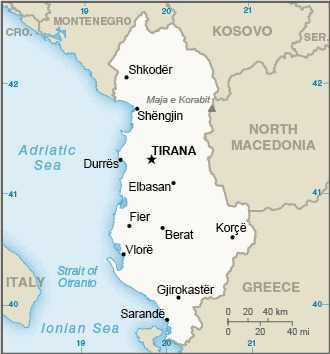
Border countries (4): Greece 212 km; Kosovo 112 km; North Macedonia 181 km; Montenegro 186 km
Land use
Arable land: 21.6% (2023 est.)
Permanent crops: 3.2% (2023 est.)
Permanent pasture: 13.4% (2023 est.)
Forest: 34.3% (2023 est.)
Other: 27.5% (2023 est.)
Maritime claims
Continental shelf: 200-m depth or to the depth of exploitation
Natural resources
Geography - note
Terrain
Location
Map references
Irrigated land
Total renewable water resources
Population distribution
Elevation
Lowest point: Adriatic Sea 0 m
Mean elevation: 708 m
Major watersheds (area sq km)
Major lakes (area sq km)
Note - largest lake in the Balkans
Area
Land: 27,398 sq km
Water: 1,350 sq km
Age structure
15-64 years: 66.9% (male 1,023,515/female 1,055,388)
65 years and over: 15.1% (2024 est.) (male 215,252/female 253,597)
Sex ratio
0-14 years: 1.09 male(s)/female
15-64 years: 0.97 male(s)/female
65 years and over: 0.85 male(s)/female
Total population: 0.97 male(s)/female (2024 est.)
Literacy
Male: 98.2% (2023 est.)
Female: 97.2% (2023 est.)
Nationality
Adjective: Albanian
School life expectancy (primary to tertiary education)
Male: 14 years (2023 est.)
Female: 15 years (2023 est.)
Urbanization
Rate of urbanization: 1.29% annual rate of change (2020-25 est.)
Drinking water source
Urban: 95.7% of population (2022 est.)
Rural: 94.1% of population (2022 est.)
Total: 95.1% of population (2022 est.)
Unimproved:
Urban: 4.3% of population (2022 est.)
Rural: 5.9% of population (2022 est.)
Total: 4.9% of population (2022 est.)
Major urban areas - population
Physician density
Hospital bed density
Mother's mean age at first birth
Dependency ratios
Youth dependency ratio: 24.3 (2024 est.)
Elderly dependency ratio: 23.5 (2024 est.)
Potential support ratio: 4.3 (2024 est.)
Sanitation facility access
Urban: 99.8% of population (2022 est.)
Rural: 100% of population (2022 est.)
Total: 99.9% of population (2022 est.)
Unimproved:
Urban: 0.2% of population (2022 est.)
Rural: 0% of population (2022 est.)
Total: 0.1% of population (2022 est.)
Ethnic groups
Note: Data represent population by ethnic and cultural affiliation
Religions
Note: All mosques and churches were closed in 1967 and religious observances prohibited; in November 1990, Albania began allowing private religious practice
Languages
Major-language sample(s):
Libri i fakteve boterore, burimi i pazevendesueshem per informacione elementare (Albanian)
The World Factbook, the indispensable source for basic information.
Health expenditure
9.2% of national budget (2022 est.)
Child marriage
Women married by age 18: 11.8% (2018)
Men married by age 18: 1.2% (2018)
Gross reproduction rate
Currently married women (ages 15-49)
Youth unemployment rate (ages 15-24)
Male: 23.9% (2024 est.)
Female: 26.9% (2024 est.)
note: % of labor force ages 15-24 seeking employment
Net migration rate
Median age
Male: 34.8 years
Female: 37.8 years
Maternal mortality ratio
Total fertility rate
Population
Male: 1,531,063
Female: 1,576,037
Infant mortality rate
Male: 11.3 deaths/1,000 live births
Female: 9.2 deaths/1,000 live births
Tobacco use
Male: 37% (2025 est.)
Female: 6.2% (2025 est.)
Obesity - adult prevalence rate
Death rate
Birth rate
Children under the age of 5 years underweight
Alcohol consumption per capita
Beer: 1.75 liters of pure alcohol (2019 est.)
Wine: 1.15 liters of pure alcohol (2019 est.)
Spirits: 1.43 liters of pure alcohol (2019 est.)
Other alcohols: 0.08 liters of pure alcohol (2019 est.)
Life expectancy at birth
Male: 77.3 years
Female: 82.8 years
Education expenditure
10.9% national budget (2023 est.)
Population growth rate
Total water withdrawal
Industrial: 11 million cubic meters (2022)
Agricultural: 565 million cubic meters (2022)
Waste and recycling
Percent of municipal solid waste recycled: 20.5% (2022 est.)
Particulate matter emissions
Carbon dioxide emissions
From coal and metallurgical coke: 566,000 metric tonnes of CO2 (2023 est.)
From petroleum and other liquids: 2.734 million metric tonnes of CO2 (2023 est.)
From consumed natural gas: 93,000 metric tonnes of CO2 (2023 est.)
Energy consumption per capita
Diplomatic representation from the US
Embassy: Rruga Stavro Vinjau, No. 14, Tirana
Mailing address: 9510 Tirana Place, Washington DC 20521-9510
Telephone: [355] 4 2247-285
FAX: [355] 4 2232-222
Email address and website:
ACSTirana@state.gov
https://al.usembassy.gov/
Administrative divisions
Capital
Geographic coordinates: 41 19 N, 19 49 E
Time difference: UTC+1 (6 hours ahead of Washington, DC, during Standard Time)
Daylight saving time: +1hr, begins last Sunday in March; ends last Sunday in October
Etymology: The name "Tirana" first appears in a 1418 Venetian document; the origin of the name is unclear
Constitution
Amendment process: Proposed by at least one-fifth of the Assembly membership; passage requires at least a two-thirds majority vote by the Assembly; referendum required only if approved by two-thirds of the Assembly; amendments approved by referendum effective upon declaration by the president of the republic
Executive branch
Head of government: Prime Minister Edi RAMA (since 10 September 2013)
Cabinet: Council of Ministers proposed by the prime minister, nominated by the president, and approved by the Assembly
Election/appointment process: President indirectly elected by the Assembly for a 5-year term (eligible for a second term); a candidate needs three-fifths majority vote of the Assembly in 1 of 3 rounds or a simple majority in 2 additional rounds to become president; prime minister appointed by the president on the proposal of the majority party or coalition of parties in the Assembly
Most recent election date: Held in 4 rounds on 16, 23, and 30 May and 4 June 2022
Election results:
2022: Bajram BEGAJ elected president in the fourth round; Assembly vote - 78-4, opposition parties boycotted
2017: Ilir META elected president in the fourth round; Assembly vote - 87-2
Expected date of next election: 2027
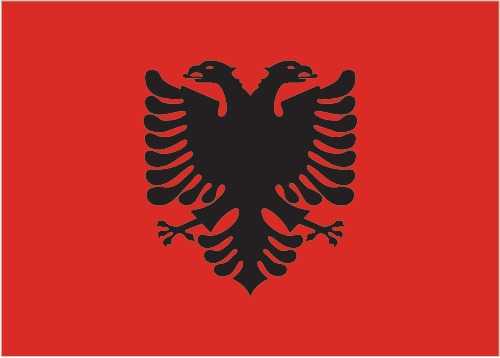
Flag
Meaning: Albanians traditionally see themselves as descendants of the eagle; they refer to themselves as "Shqiptare," which translates as "sons of the eagle"
History: The design is said to originate with 15th-century Albanian hero Georgi Kastrioti SKANDERBEG, who led a successful uprising against the Ottoman Turks
Independence
Judicial branch
Judge selection and term of office: Supreme Court judges appointed by the High Judicial Council with the consent of the president to serve single 9-year terms; Supreme Court chairman is elected for a single 3-year term by the court members; appointments of Constitutional Court judges are rotated among the president, Parliament, and Supreme Court from a list of pre-qualified candidates (each institution selects 3 judges), to serve single 9-year terms; candidates are pre-qualified by a randomly selected body of experienced judges and prosecutors; Constitutional Court chairman is elected by the court members for a single, renewable 3-year term
Subordinate courts: Courts of Appeal; Courts of First Instance; specialized courts: Court for Corruption and Organized Crime, Appeals Court for Corruption and Organized Crime (responsible for corruption, organized crime, and crimes of high officials)
Legal system
Legislative branch
Legislative structure: Unicameral
Chamber name: Parliament (Kuvendi)
Number of seats: 140 (all directly elected)
Electoral system: Proportional representation
Scope of elections: Full renewal
Term in office: 4 years
Most recent election date: 5/11/2025
Parties elected and seats per party: Socialist Party of Albania (PS) (83); Democratic Party - Alliance for a Greater Albania (PD-ASHM) (50); Other (7)
Percentage of women in chamber: 35%
Expected date of next election: May 2029
International organization participation
Note: Albania is an EU candidate country and must complete accession criteria before being granted full membership
National holiday
Political parties
Democratic Party or PD
Party for Justice, Integration and Unity or PDIU (part of the Alliance for Change)
Social Democratic Party or PSD
Freedom Party of Albania or PL (formerly the Socialist Movement for Integration or LSI)
Socialist Party or PS
Suffrage
Government type
Country name
Conventional short form: Albania
Local long form: Republika e Shqiperise
Local short form: Shqiperia
Former: People's Socialist Republic of Albania
Etymology: Name may be derived from the pre-Celtic word alb, meaning "hill," or from the Indo-European root word albh, meaning "white;" the local name "Shqiperia" is derived from the Albanian word shqiponje ("eagle") and is popularly interpreted to mean "Land of the Eagles"
Diplomatic representation in the US
Chancery: 2100 S Street NW, Washington, DC 20008
Telephone: [1] (202) 223-4942
FAX: [1] (202) 628-7342
Email address and website:
Embassy.washington@mfa.gov.al
http://www.ambasadat.gov.al/usa/en
Consulate(s) general: New York
National anthem(s)
Lyrics/music: Aleksander Stavre DRENOVA/Ciprian PORUMBESCU
History: Adopted 1912; only the first two stanzas of the original poem are used, with the second stanza as a chorus
International law organization participation
National symbol(s)
Citizenship
Citizenship by descent only: At least one parent must be a citizen of Albania
Dual citizenship recognized: Yes
Residency requirement for naturalization: 5 years
National heritage
Selected World Heritage Site locales: Butrint (c); Historic Berat and Gjirokastër (c); Primeval Beech Forests (n); Lake Ohrid Region (m)
National color(s)
Population below poverty line
note: % of population with income below national poverty line
Household income or consumption by percentage share
Highest 10%: 22.8% (2020 est.)
note: % share of income accruing to lowest and highest 10% of population
Exports - commodities
note: top five export commodities based on value in dollars
Exports - partners
note: top five export partners based on percentage share of exports
Agricultural products
note: top ten agricultural products based on tonnage
Budget
Expenditures: $6.966 billion (2023 est.)
note: central government revenues (excluding grants) and expenditures converted to US dollars at average official exchange rate for year indicated
Imports - commodities
note: top five import commodities based on value in dollars
Exchange rates
Exchange rates:
93.123 (2024 est.)
100.645 (2023 est.)
113.042 (2022 est.)
103.52 (2021 est.)
108.65 (2020 est.)
Industries
Economic overview
Upper-middle-income Balkan economy; EU accession candidate; growth bolstered by tourism, agriculture, mining, construction, and private consumption; fiscal consolidation through revenue collection and tax compliance enhancements to address public debt; challenges include weak governance, corruption, and high emigration rates
GDP (official exchange rate)
note: data in current dollars at official exchange rate
GDP - composition, by end use
Government consumption: 12% (2023 est.)
Investment in fixed capital: 24% (2023 est.)
Investment in inventories: -1.1% (2023 est.)
Exports of goods and services: 38.7% (2023 est.)
Imports of goods and services: -43.8% (2023 est.)
note: figures may not total 100% due to rounding or gaps in data collection
Imports - partners
note: top five import partners based on percentage share of imports
Remittances
8.6% of GDP (2023 est.)
9.2% of GDP (2022 est.)
note: personal transfers and compensation between resident and non-resident individuals/households/entities
Labor force
note: number of people ages 15 or older who are employed or seeking work
Debt - external
note: present value of external debt in current US dollars
Reserves of foreign exchange and gold
$6.455 billion (2023 est.)
$5.266 billion (2022 est.)
note: holdings of gold (year-end prices)/foreign exchange/special drawing rights in current dollars
Public debt
note: central government debt as a % of GDP
Unemployment rate
10.2% (2023 est.)
10.2% (2022 est.)
note: % of labor force seeking employment
Taxes and other revenues
note: central government tax revenue as a % of GDP
Real GDP (purchasing power parity)
$49.403 billion (2023 est.)
$47.532 billion (2022 est.)
note: data in 2021 dollars
Inflation rate (consumer prices)
4.8% (2023 est.)
6.7% (2022 est.)
note: annual % change based on consumer prices
Current account balance
-$281.7 million (2023 est.)
-$1.117 billion (2022 est.)
note: balance of payments - net trade and primary/secondary income in current dollars
Real GDP per capita
$18,000 (2023 est.)
$17,100 (2022 est.)
note: data in 2021 dollars
Imports
$10.374 billion (2023 est.)
$9.016 billion (2022 est.)
note: balance of payments - imports of goods and services in current dollars
Exports
$9.099 billion (2023 est.)
$7.057 billion (2022 est.)
note: balance of payments - exports of goods and services in current dollars
Real GDP growth rate
3.9% (2023 est.)
4.8% (2022 est.)
note: annual GDP % growth based on constant local currency
Industrial production growth rate
note: annual % change in industrial value added based on constant local currency
GDP - composition, by sector of origin
Industry: 22.4% (2024 est.)
Services: 48.9% (2024 est.)
note: figures may not total 100% due to non-allocated consumption not captured in sector-reported data
Electricity access
Coal
Consumption: 255,000 metric tons (2023 est.)
Exports: 345,000 metric tons (2023 est.)
Imports: 180,000 metric tons (2023 est.)
Proven reserves: 522 million metric tons (2023 est.)
Electricity generation sources
Hydroelectricity: 96.7% of total installed capacity (2023 est.)
Natural gas
Consumption: 49.977 million cubic meters (2023 est.)
Proven reserves: 5.692 billion cubic meters (2021 est.)
Petroleum
Refined petroleum consumption: 21,000 bbl/day (2023 est.)
Crude oil estimated reserves: 150 million barrels (2021 est.)
Electricity
Consumption: 7.49 billion kWh (2023 est.)
Exports: 2.2 billion kWh (2023 est.)
Imports: 1.922 billion kWh (2023 est.)
Transmission/distribution losses: 1.238 billion kWh (2023 est.)
Internet users
Internet country code
Broadcast media
Telephones - mobile cellular
Subscriptions per 100 inhabitants: 98 (2022 est.)
Broadband - fixed subscriptions
Subscriptions per 100 inhabitants: 22 (2023 est.)
Telephones - fixed lines
Subscriptions per 100 inhabitants: 6 (2023 est.)
Railways
2021-All the trains in the country suspended
Civil aircraft registration country code prefix
Airports
Merchant marine
By type: General cargo 46, oil tanker 1, other 22
Heliports
Military expenditures
1.7% of GDP (2024 est.)
1.7% of GDP (2023 est.)
1.2% of GDP (2022 est.)
1.2% of GDP (2021 est.)
Military and security forces
Ministry of Interior: Guard of the Republic, State Police (includes the Border and Migration Police) (2025)
Note: The State Police are primarily responsible for internal security, including counterterrorism, while the Guard of the Republic protects senior state officials, foreign dignitaries, and certain state properties
Military - note
Military and security service personnel strengths
Military equipment inventories and acquisitions
Military deployments
Military service age and obligation
Note: As of 2024, women comprised about 15% of the military's full-time personnel
Refugees and internally displaced persons
Stateless persons: 2,203 (2024 est.)
Terrorist group(s)
Note: Details about the history, aims, leadership, organization, areas of operation, tactics, targets, weapons, size, and sources of support of the group(s) appear(s) in the Terrorism reference guide
Ports
Large: 0
Medium: 0
Small: 1
Very small: 2
Ports with oil terminals: 0
Key ports: Durres, Shengjin, Vlores
National coat of arms
Gini Index coefficient - distribution of family income
note: index (0-100) of income distribution; higher values represent greater inequality