Liberia
Background
With 28 ethnic groups and languages, Liberia is one of the most ethnically diverse countries in the world. For hundreds of years, the Mali and Songhai Empires claimed most of Liberia. Beginning in the 15th century, European traders began establishing outposts along the Liberian coast. Unlike its neighbors, however, Liberia did not fall under European colonial rule. In the early 19th century, the US began sending freed enslaved people and other people of color to Liberia to establish settlements. In 1847, these settlers declared independence from the US, writing their own constitution and establishing Africa’s first republic.
Early in Liberia’s history, tensions arose between the Americo-Liberian settlers and the indigenous population. In 1980, Samuel DOE, who was from the indigenous population, led a military coup and ushered in a decade of authoritarian rule. In 1989, Charles TAYLOR launched a rebellion that led to a prolonged civil war in which DOE was killed. A period of relative peace in 1997 permitted an election that brought TAYLOR to power. In 2000, fighting resumed. A 2003 peace agreement ended the war and prompted TAYLOR’s resignation. He was later convicted by the UN-backed Special Court for Sierra Leone in The Hague for his involvement in Sierra Leone's civil war.
In 2005, Ellen JOHNSON SIRLEAF became president after two years of transitional governments; she was the first female head of state in Africa. In 2011, JOHNSON SIRLEAF won reelection but struggled to rebuild Liberia's economy -- particularly after the 2014-15 Ebola epidemic -- and to reconcile a nation still recovering from 14 years of fighting. In 2017, former soccer star George WEAH won the presidential runoff election, marking the first successful transfer of power from one democratically elected government to another since the end of Liberia’s civil wars. Like his predecessor, WEAH struggled to improve the country’s economy. In 2023, former Vice President Joseph BOAKAI was elected president, edging out WEAH by a thin margin, the first time since 1927 that an incumbent was not re-elected after one term.
Geographic coordinates
Natural hazards
Area - comparative
Environmental issues
International environmental agreements
Signed, but not ratified: Environmental Modification, Marine Life Conservation
Climate
Coastline
Land boundaries
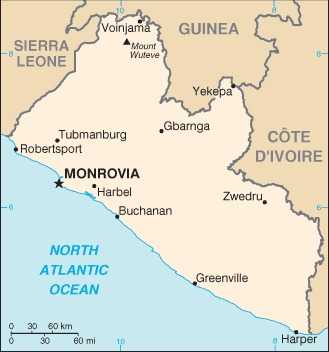
Border countries (3): Guinea 590 km; Cote d'Ivoire 778 km; Sierra Leone 299 km
Maritime claims
Contiguous zone: 24 nm
Exclusive economic zone: 200 nm
Continental shelf: 200 nm
Natural resources
Geography - note
Terrain
Location
Map references
Irrigated land
Total renewable water resources
Population distribution
Elevation
Lowest point: Atlantic Ocean 0 m
Mean elevation: 243 m
Area
Land: 96,320 sq km
Water: 15,049 sq km
Land use
Arable land: 5.2% (2023 est.)
Permanent crops: 2.1% (2023 est.)
Permanent pasture: 12.7% (2023 est.)
Forest: 66.5% (2023 est.)
Other: 13.5% (2023 est.)
Age structure
15-64 years: 57.9% (male 1,566,263/female 1,579,835)
65 years and over: 3.2% (2024 est.) (male 80,961/female 93,534)
Sex ratio
0-14 years: 1.01 male(s)/female
15-64 years: 0.99 male(s)/female
65 years and over: 0.87 male(s)/female
Total population: 1 male(s)/female (2024 est.)
Nationality
Adjective: Liberian
Urbanization
Rate of urbanization: 3.41% annual rate of change (2015-20 est.)
Drinking water source
Urban: 84.6% of population (2022 est.)
Rural: 65.5% of population (2022 est.)
Total: 75.6% of population (2022 est.)
Unimproved:
Urban: 15.4% of population (2022 est.)
Rural: 34.5% of population (2022 est.)
Total: 24.4% of population (2022 est.)
Major urban areas - population
Physician density
Hospital bed density
Mother's mean age at first birth
Note: Data represents median age at first birth among women 25-49
Dependency ratios
Youth dependency ratio: 67.3 (2024 est.)
Elderly dependency ratio: 5.5 (2024 est.)
Potential support ratio: 18 (2024 est.)
Sanitation facility access
Urban: 70.1% of population (2022 est.)
Rural: 25.1% of population (2022 est.)
Total: 49% of population (2022 est.)
Unimproved:
Urban: 29.9% of population (2022 est.)
Rural: 74.9% of population (2022 est.)
Total: 51% of population (2022 est.)
Ethnic groups
Religions
Languages
Health expenditure
4.8% of national budget (2022 est.)
Child marriage
Women married by age 18: 24.9% (2020)
Men married by age 18: 8.4% (2020)
Gross reproduction rate
Youth unemployment rate (ages 15-24)
Male: 2.2% (2024 est.)
Female: 2% (2024 est.)
note: % of labor force ages 15-24 seeking employment
Net migration rate
Median age
Male: 19.8 years
Female: 20 years
Maternal mortality ratio
Total fertility rate
Population
Male: 2,711,324
Female: 2,725,925
Infant mortality rate
Male: 61 deaths/1,000 live births
Female: 50.2 deaths/1,000 live births
Tobacco use
Male: 11.5% (2025 est.)
Female: 1.5% (2025 est.)
Obesity - adult prevalence rate
Death rate
Birth rate
Alcohol consumption per capita
Beer: 0.38 liters of pure alcohol (2019 est.)
Wine: 0.44 liters of pure alcohol (2019 est.)
Spirits: 2.28 liters of pure alcohol (2019 est.)
Other alcohols: 0.02 liters of pure alcohol (2019 est.)
Life expectancy at birth
Male: 59.9 years
Female: 63.3 years
Population growth rate
Currently married women (ages 15-49)
Children under the age of 5 years underweight
Education expenditure
7.4% national budget (2021 est.)
Total water withdrawal
Industrial: 53.4 million cubic meters (2022 est.)
Agricultural: 12.3 million cubic meters (2022 est.)
Waste and recycling
Percent of municipal solid waste recycled: 7.9% (2022 est.)
Particulate matter emissions
Carbon dioxide emissions
From coal and metallurgical coke: 4 metric tonnes of CO2 (2023 est.)
From petroleum and other liquids: 671,000 metric tonnes of CO2 (2023 est.)
Energy consumption per capita
Diplomatic representation from the US
Embassy: 502 Benson Street, Monrovia
Mailing address: 8800 Monrovia Place, Washington DC 20521-8800
Telephone: [231] 77-677-7000
FAX: [231] 77-677-7370
Email address and website:
ACSMonrovia@state.gov
https://lr.usembassy.gov/
Administrative divisions
Capital
Geographic coordinates: 6 18 N, 10 48 W
Time difference: UTC 0 (5 hours ahead of Washington, DC, during Standard Time)
Etymology: Named after James MONROE (1758-1831), the fifth president of the United States and supporter of Liberia's colonization by freed slaves
Constitution
Amendment process: Proposed by agreement of at least two thirds of both National Assembly houses or by petition of at least 10,000 citizens; passage requires at least two-thirds majority approval of both houses and approval in a referendum by at least two-thirds majority of registered voters
Executive branch
Head of government: President Joseph BOAKAI (since 22 January 2024)
Cabinet: Cabinet appointed by the president, confirmed by the Senate
Election/appointment process: President directly elected by absolute-majority popular vote in 2 rounds, if needed, for a 6-year term (eligible for a second term)
Most recent election date: 10 October 2023, with a runoff on 14 November 2023
Election results:
2023: Joseph BOAKAI elected president in second round; percent of vote in first round - George WEAH (CDC) 43.8%, Joseph BOAKAI (UP) 43.4%, Edward APPLETON (GDM) 2.2%, Lusinee KAMARA (ALCOP) 2%, Alexander B. CUMMINGS, Jr. (CPP) 1.6%, Tiawan Saye GONGLOE (LPP) 1.4%, other 5.6%; percentage of vote in second round - Joseph BOAKAI 50.6%, George WEAH 49.4%
2017: George WEAH elected president in second round; percent of vote in first round - George WEAH (Coalition for Democratic Change) 38.4%, Joseph BOAKAI (UP) 28.8%, Charles BRUMSKINE (LP) 9.6%, Prince JOHNSON (MDR) 8.2%, Alexander B. CUMMINGS (ANC) 7.2%, other 7.8%; percentage of vote in second round - George WEAH 61.5%, Joseph BOAKAI 38.5%
Expected date of next election: October 2029
Note: the president is both chief of state and head of government
Flag
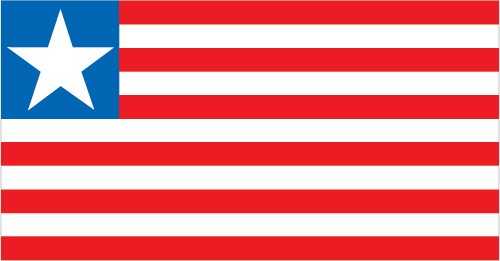
Meaning: The stripes stand for the signatories of the Liberian Declaration of Independence, the blue square for the African mainland, and the star for the freedom granted to ex-slaves; the blue stands for liberty, justice, and fidelity; the white for purity, cleanliness, and guilelessness; the red for steadfastness, valor, and fervor
Note: The design is based on the US flag
Independence
Judicial branch
Judge selection and term of office: Chief justice and associate justices appointed by the president of Liberia with consent of the Senate; judges can serve until age 70
Subordinate courts: Judicial circuit courts; special courts, including criminal, civil, labor, traffic; magistrate and traditional or customary courts
Note: The Supreme Court has jurisdiction for all constitutional cases
Legal system
Legislative branch
Legislative structure: Bicameral
International organization participation
National holiday
Political parties
Alliance for Peace and Democracy or APD
Alternative National Congress or ANC
Coalition for Democratic Change (includes CDC, NPP, and LPDP)
Collaborating Political Parties or CPP (coalition includes ANC, LP; CPP dissolved in April 2024)
Congress for Democratic Change or CDC
Liberia Destiny Party or LDP
Liberia National Union or LINU
Liberia Transformation Party or LTP
Liberian People Democratic Party or LPDP
Liberian People's Party or LPP
Liberian Restoration Party or LRP
Liberty Party or LP
Movement for Democracy and Reconstruction or MDR
Movement for Economic Empowerment
Movement for Progressive Change or MPC
National Democratic Coalition or NDC
National Democratic Party of Liberia or NDPL
National Patriotic Party or NPP
National Reformist Party or NRP
National Union for Democratic Progress or NUDP
People's Unification Party or PUP
Unity Party or UP
United People's Party
Victory for Change Party or VCP
Suffrage
Government type
Country name
Conventional short form: Liberia
Etymology: Name derives from the Latin word liber, meaning "free;" so named because the nation was created as a homeland for liberated African-American slaves
Diplomatic representation in the US
Chancery: 5201 16th Street NW, Washington, DC 20011
Telephone: [1] (202) 723-0437
FAX: [1] (202) 723-0436
Email address and website:
Info@liberianembassyus.org
http://www.liberianembassyus.org/
Consulate(s) general: New York
National anthem(s)
Lyrics/music: Daniel Bashiel WARNER/Olmstead LUCA
History: Lyrics adopted 1847, music adopted 1860; the anthem's author later became the third president of Liberia
International law organization participation
National symbol(s)
Citizenship
Citizenship by descent only: At least one parent must be a citizen of Liberia
Dual citizenship recognized: No
Residency requirement for naturalization: 2 years
National color(s)
Population below poverty line
note: % of population with income below national poverty line
Household income or consumption by percentage share
Highest 10%: 27.1% (2016 est.)
note: % share of income accruing to lowest and highest 10% of population
Exports - commodities
note: top five export commodities based on value in dollars
Exports - partners
note: top five export partners based on percentage share of exports
Agricultural products
note: top ten agricultural products based on tonnage
Budget
Expenditures: $6 million (2019 est.)
Imports - commodities
note: top five import commodities based on value in dollars
Exchange rates
Exchange rates:
174.956 (2023 est.)
152.934 (2022 est.)
166.154 (2021 est.)
191.518 (2020 est.)
186.43 (2019 est.)
Industries
Economic overview
GDP (official exchange rate)
note: data in current dollars at official exchange rate
Imports - partners
note: top five import partners based on percentage share of imports
Remittances
17.2% of GDP (2022 est.)
15.1% of GDP (2021 est.)
note: personal transfers and compensation between resident and non-resident individuals/households/entities
Labor force
note: number of people ages 15 or older who are employed or seeking work
Debt - external
note: present value of external debt in current US dollars
Reserves of foreign exchange and gold
$700.829 million (2021 est.)
$340.966 million (2020 est.)
note: holdings of gold (year-end prices)/foreign exchange/special drawing rights in current dollars
Unemployment rate
3% (2023 est.)
3% (2022 est.)
note: % of labor force seeking employment
Real GDP (purchasing power parity)
$8.882 billion (2023 est.)
$8.484 billion (2022 est.)
note: data in 2021 dollars
Inflation rate (consumer prices)
7.6% (2022 est.)
7.8% (2021 est.)
note: annual % change based on consumer prices
Current account balance
-$101.746 million (2021 est.)
-$274.971 million (2020 est.)
note: balance of payments - net trade and primary/secondary income in current dollars
Real GDP per capita
$1,600 (2023 est.)
$1,600 (2022 est.)
note: data in 2021 dollars
Imports
$1.739 billion (2021 est.)
$1.371 billion (2020 est.)
note: balance of payments - imports of goods and services in current dollars
Exports
$1.041 billion (2021 est.)
$731.658 million (2020 est.)
note: balance of payments - exports of goods and services in current dollars
Real GDP growth rate
4.7% (2023 est.)
4.8% (2022 est.)
note: annual GDP % growth based on constant local currency
Industrial production growth rate
note: annual % change in industrial value added based on constant local currency
GDP - composition, by sector of origin
Industry: 23.3% (2024 est.)
Services: 42.1% (2024 est.)
note: figures may not total 100% due to non-allocated consumption not captured in sector-reported data
Electricity access
Electrification - urban areas: 53.7%
Electrification - rural areas: 14.9%
Coal
Electricity generation sources
Solar: 1.3% of total installed capacity (2023 est.)
Hydroelectricity: 32.4% of total installed capacity (2023 est.)
Biomass and waste: 0.3% of total installed capacity (2023 est.)
Petroleum
Electricity
Consumption: 215.96 million kWh (2023 est.)
Transmission/distribution losses: 179.222 million kWh (2023 est.)
Internet users
Internet country code
Broadcast media
Telephones - mobile cellular
Subscriptions per 100 inhabitants: 32 (2021 est.)
Broadband - fixed subscriptions
Subscriptions per 100 inhabitants: (2022 est.) less than 1
Telephones - fixed lines
Subscriptions per 100 inhabitants: (2022 est.) less than 1
Railways
Standard gauge: 345 km (2008) 1.435-m gauge
Narrow gauge: 84 km (2008) 1.067-m gauge
Note: Most sections of the railways inoperable due to damage sustained during the civil wars from 1980 to 2003, but many are being rebuilt
Civil aircraft registration country code prefix
Airports
Merchant marine
By type: Bulk carrier 1,895, container ship 1,013, general cargo 170, oil tanker 1,038, other 705
Military service age and obligation
Military expenditures
1.3% of GDP (2023 est.)
1.3% of GDP (2022 est.)
0.8% of GDP (2021 est.)
0.5% of GDP (2020 est.)
Military and security forces
Ministry of Justice: Liberia National Police, Liberia Drug Enforcement Agency (2025)
Military - note
The first militia unit established for defense of the Liberia colony was raised in 1832; the AFL traces its origins to the 1908 establishment of the Liberia Frontier Force, which became the Liberian National Guard in 1965; the AFL was established in 1970 (2025)
Military and security service personnel strengths
Military equipment inventories and acquisitions
Refugees and internally displaced persons
Trafficking in persons
Ports
Large: 0
Medium: 0
Small: 1
Very small: 3
Ports with oil terminals: 3
Key ports: Buchanan, Cape Palmas, Greenville, Monrovia
Legislative branch - lower chamber
Number of seats: 73 (all directly elected)
Electoral system: Plurality/majority
Scope of elections: Full renewal
Term in office: 6 years
Most recent election date: 10/10/2023
Parties elected and seats per party: Congress for Democratic Change (CDC) (25); Unity Party (UP) (11); Collaborating Political Parties (CPP) (6); Movement for Democracy and Reconstruction (MDR) (4); Independents (19); Other (8)
Percentage of women in chamber: 11%
Expected date of next election: October 2029
Legislative branch - upper chamber
Number of seats: 30 (all directly elected)
Electoral system: Plurality/majority
Scope of elections: Partial renewal
Term in office: 9 years
Most recent election date: 10/10/2023
Parties elected and seats per party: Congress for Democratic Change (CDC) (6); Unity Party (UP) (1); Movement for Democracy and Reconstruction (MDR) (1); Liberia Restoration Party (LRP) (1); Independents (6)
Percentage of women in chamber: 10%
Expected date of next election: October 2029
Gini Index coefficient - distribution of family income
note: index (0-100) of income distribution; higher values represent greater inequality