Lesotho
AfricaLT October 01, 2025
Background
Paramount chief MOSHOESHOE I consolidated what would become Basutoland in the early 19th century and made himself king in 1822. Continuing encroachments by Dutch settlers from the neighboring Orange Free State caused the king to enter into an 1868 agreement with the UK that made Basutoland first a British protectorate and, after 1884, a crown colony. After gaining independence in 1966, the country was renamed the Kingdom of Lesotho. The Basotho National Party ruled the country during its first two decades. King MOSHOESHOE II was exiled in 1990, returned to Lesotho in 1992, was reinstated in 1995, and was then succeeded by his son, King LETSIE III, in 1996. Constitutional government was restored in 1993 after seven years of military rule.
In 1998, violent protests and a military mutiny following a contentious election prompted a brief but bloody intervention by South African and Batswana military forces under the aegis of the Southern African Development Community (SADC). Subsequent constitutional reforms restored relative political stability. Peaceful parliamentary elections were held in 2002, but the National Assembly elections in 2007 were hotly contested, and aggrieved parties disputed how seats were awarded. In 2012, competitive elections saw Prime Minister Motsoahae Thomas THABANE form a coalition government -- the first in the country's history -- that ousted the 14-year incumbent, Pakalitha MOSISILI, who peacefully transferred power the following month. MOSISILI returned to power in snap elections in 2015 after the collapse of THABANE’s coalition government and an alleged attempted military coup. In 2017, THABANE returned to become prime minister but stepped down in 2020 after being implicated in his estranged wife’s murder. He was succeeded by Moseketsi MAJORO. In 2022, Ntsokoane Samuel MATEKANE was inaugurated as prime minister and head of a three-party coalition.
In 1998, violent protests and a military mutiny following a contentious election prompted a brief but bloody intervention by South African and Batswana military forces under the aegis of the Southern African Development Community (SADC). Subsequent constitutional reforms restored relative political stability. Peaceful parliamentary elections were held in 2002, but the National Assembly elections in 2007 were hotly contested, and aggrieved parties disputed how seats were awarded. In 2012, competitive elections saw Prime Minister Motsoahae Thomas THABANE form a coalition government -- the first in the country's history -- that ousted the 14-year incumbent, Pakalitha MOSISILI, who peacefully transferred power the following month. MOSISILI returned to power in snap elections in 2015 after the collapse of THABANE’s coalition government and an alleged attempted military coup. In 2017, THABANE returned to become prime minister but stepped down in 2020 after being implicated in his estranged wife’s murder. He was succeeded by Moseketsi MAJORO. In 2022, Ntsokoane Samuel MATEKANE was inaugurated as prime minister and head of a three-party coalition.
Geographic coordinates
29 30 S, 28 30 E
Natural hazards
periodic droughts
Area - comparative
slightly smaller than Maryland
Environmental issues
overgrazing; severe soil erosion; soil exhaustion; desertification; Highlands Water Project controls, stores, and redirects water to South Africa
International environmental agreements
Party to: Biodiversity, Climate Change, Climate Change-Kyoto Protocol, Climate Change-Paris Agreement, Comprehensive Nuclear Test Ban, Desertification, Endangered Species, Hazardous Wastes, Law of the Sea, Marine Life Conservation, Ozone Layer Protection, Wetlands
Signed, but not ratified: None of the selected agreements
Signed, but not ratified: None of the selected agreements
Climate
temperate; cool to cold, dry winters; hot, wet summers
Coastline
0 km (landlocked)
Land boundaries
Total: 1,106 km
Border countries (1): South Africa 1,106 km
Border countries (1): South Africa 1,106 km
Land use
Agricultural land: 74.8% (2022 est.)
Arable land: 8.8% (2022 est.)
Permanent crops: 0.1% (2022 est.)
Permanent pasture: 65.9% (2022 est.)
Forest: 1.1% (2022 est.)
Other: 24.1% (2022 est.)
Arable land: 8.8% (2022 est.)
Permanent crops: 0.1% (2022 est.)
Permanent pasture: 65.9% (2022 est.)
Forest: 1.1% (2022 est.)
Other: 24.1% (2022 est.)
Maritime claims
none (landlocked)
Natural resources
water, agricultural and grazing land, diamonds, sand, clay, building stone
Geography - note
landlocked, surrounded by South Africa; mountainous, more than 80% of the country is 1,800 m (5,900 ft) above sea level
Terrain
mostly highland with plateaus, hills, and mountains
Location
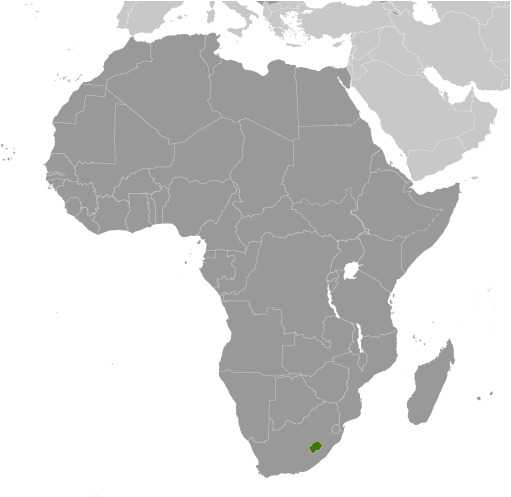
Southern Africa, an enclave of South Africa
Map references
Africa
Irrigated land
12 sq km (2013)
Total renewable water resources
3.022 billion cubic meters (2022 est.)
Population distribution
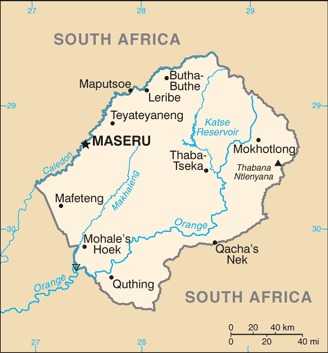
relatively higher population density in the western half of the nation, with the capital of Maseru and the smaller cities of Mafeteng, Teyateyaneng, and Leribe attracting the most people, as shown in this population distribution map
Elevation
Highest point: Thabana Ntlenyana 3,482 m
Lowest point: Junction of the Orange and Makhaleng Rivers 1,400 m
Mean elevation: 2,161 m
Lowest point: Junction of the Orange and Makhaleng Rivers 1,400 m
Mean elevation: 2,161 m
Major watersheds (area sq km)
Atlantic Ocean drainage: Orange (941,351 sq km)
Major rivers (by length in km)
Orange river source (shared with South Africa and Namibia [m]) - 2,092 km
Note: [s] after country name indicates river source; [m] after country name indicates river mouth
Note: [s] after country name indicates river source; [m] after country name indicates river mouth
Area
Total : 30,355 sq km
Land: 30,355 sq km
Water: 0 sq km
Land: 30,355 sq km
Water: 0 sq km
Age structure
0-14 years: 32% (male 358,137/female 353,618)
15-64 years: 62.7% (male 699,197/female 696,626)
65 years and over: 5.4% (2024 est.) (male 44,625/female 75,345)
15-64 years: 62.7% (male 699,197/female 696,626)
65 years and over: 5.4% (2024 est.) (male 44,625/female 75,345)
Sex ratio
At birth: 1.03 male(s)/female
0-14 years: 1.01 male(s)/female
15-64 years: 1 male(s)/female
65 years and over: 0.59 male(s)/female
Total population: 0.98 male(s)/female (2024 est.)
0-14 years: 1.01 male(s)/female
15-64 years: 1 male(s)/female
65 years and over: 0.59 male(s)/female
Total population: 0.98 male(s)/female (2024 est.)
Literacy
Total population: 86.2% (2018 est.)
Male: 80.2% (2018 est.)
Female: 91.8% (2018 est.)
Male: 80.2% (2018 est.)
Female: 91.8% (2018 est.)
Nationality
Noun: Mosotho (singular), Basotho (plural)
Adjective: Basotho
Adjective: Basotho
School life expectancy (primary to tertiary education)
Total: 11 years (2017 est.)
Male: 11 years (2017 est.)
Female: 11 years (2017 est.)
Male: 11 years (2017 est.)
Female: 11 years (2017 est.)
Urbanization
Urban population: 30.4% of total population (2023)
Rate of urbanization: 2.77% annual rate of change (2020-25 est.)
Rate of urbanization: 2.77% annual rate of change (2020-25 est.)
Drinking water source
Improved:
Urban: 93% of population (2022 est.)
Rural: 65.9% of population (2022 est.)
Total: 74% of population (2022 est.)
Unimproved:
Urban: 7% of population (2022 est.)
Rural: 34.1% of population (2022 est.)
Total: 26% of population (2022 est.)
Urban: 93% of population (2022 est.)
Rural: 65.9% of population (2022 est.)
Total: 74% of population (2022 est.)
Unimproved:
Urban: 7% of population (2022 est.)
Rural: 34.1% of population (2022 est.)
Total: 26% of population (2022 est.)
Major urban areas - population
202,000 MASERU (capital) (2018)
Mother's mean age at first birth
20.9 years (2014 est.)
Note: Data represents median age at first birth among women 25-49
Note: Data represents median age at first birth among women 25-49
Dependency ratios
Total dependency ratio: 59.6 (2024 est.)
Youth dependency ratio: 51 (2024 est.)
Elderly dependency ratio: 8.6 (2024 est.)
Potential support ratio: 11.6 (2024 est.)
Youth dependency ratio: 51 (2024 est.)
Elderly dependency ratio: 8.6 (2024 est.)
Potential support ratio: 11.6 (2024 est.)
Sanitation facility access
Improved:
Urban: 93.6% of population (2022 est.)
Rural: 62.4% of population (2022 est.)
Total: 71.7% of population (2022 est.)
Unimproved:
Urban: 6.4% of population (2022 est.)
Rural: 37.6% of population (2022 est.)
Total: 28.3% of population (2022 est.)
Urban: 93.6% of population (2022 est.)
Rural: 62.4% of population (2022 est.)
Total: 71.7% of population (2022 est.)
Unimproved:
Urban: 6.4% of population (2022 est.)
Rural: 37.6% of population (2022 est.)
Total: 28.3% of population (2022 est.)
Ethnic groups
Sotho 99.7%, other 0.3% (includes Kwena, Nguni (Hlubi and Phuthi), Zulu)
Religions
Protestant 47.8% (Pentecostal 23.1%, Lesotho Evangelical 17.3%, Anglican 7.4%), Roman Catholic 39.3%, other Christian 9.1%, non-Christian 1.4%, none 2.3% (2014 est.)
Languages
Sesotho (official), English (official), Phuthi, Xhosa, Zulu
Physician density
0.24 physicians/1,000 population (2022)
Health expenditure
10.2% of GDP (2021)
13.1% of national budget (2022 est.)
13.1% of national budget (2022 est.)
Child marriage
Women married by age 15: 1% (2018)
Women married by age 18: 16.4% (2018)
Men married by age 18: 1.9% (2018)
Women married by age 18: 16.4% (2018)
Men married by age 18: 1.9% (2018)
Gross reproduction rate
1.4 (2024 est.)
Currently married women (ages 15-49)
53.7% (2023 est.)
Youth unemployment rate (ages 15-24)
Total: 24.2% (2024 est.)
Male: 17.7% (2024 est.)
Female: 36.2% (2024 est.)
note: % of labor force ages 15-24 seeking employment
Male: 17.7% (2024 est.)
Female: 36.2% (2024 est.)
note: % of labor force ages 15-24 seeking employment
Net migration rate
-4.5 migrant(s)/1,000 population (2024 est.)
Median age
Total: 23.9 years (2024 est.)
Male: 23.4 years
Female: 24.3 years
Male: 23.4 years
Female: 24.3 years
Maternal mortality ratio
478 deaths/100,000 live births (2023 est.)
Total fertility rate
2.85 children born/woman (2024 est.)
Population
Total: 2,227,548 (2024 est.)
Male: 1,101,959
Female: 1,125,589
Male: 1,101,959
Female: 1,125,589
Infant mortality rate
Total: 45.7 deaths/1,000 live births (2024 est.)
Male: 51 deaths/1,000 live births
Female: 40.2 deaths/1,000 live births
Male: 51 deaths/1,000 live births
Female: 40.2 deaths/1,000 live births
Tobacco use
Total: 22.8% (2025 est.)
Male: 42.4% (2025 est.)
Female: 4.1% (2025 est.)
Male: 42.4% (2025 est.)
Female: 4.1% (2025 est.)
Obesity - adult prevalence rate
16.6% (2016)
Death rate
10.8 deaths/1,000 population (2024 est.)
Birth rate
22.9 births/1,000 population (2024 est.)
Children under the age of 5 years underweight
10.5% (2018)
Alcohol consumption per capita
Total: 3.56 liters of pure alcohol (2019 est.)
Beer: 1.98 liters of pure alcohol (2019 est.)
Wine: 0.44 liters of pure alcohol (2019 est.)
Spirits: 0.31 liters of pure alcohol (2019 est.)
Other alcohols: 0.82 liters of pure alcohol (2019 est.)
Beer: 1.98 liters of pure alcohol (2019 est.)
Wine: 0.44 liters of pure alcohol (2019 est.)
Spirits: 0.31 liters of pure alcohol (2019 est.)
Other alcohols: 0.82 liters of pure alcohol (2019 est.)
Life expectancy at birth
Total population: 60.2 years (2024 est.)
Male: 58.1 years
Female: 62.3 years
Male: 58.1 years
Female: 62.3 years
Education expenditure
6.6% of GDP (2024 est.)
10.4% national budget (2024 est.)
10.4% national budget (2024 est.)
Population growth rate
0.76% (2024 est.)
Total water withdrawal
Municipal: 20 million cubic meters (2022 est.)
Industrial: 20 million cubic meters (2022 est.)
Agricultural: 3.8 million cubic meters (2022 est.)
Industrial: 20 million cubic meters (2022 est.)
Agricultural: 3.8 million cubic meters (2022 est.)
Waste and recycling
Municipal solid waste generated annually: 73,500 tons (2024 est.)
Percent of municipal solid waste recycled: 11.9% (2022 est.)
Percent of municipal solid waste recycled: 11.9% (2022 est.)
Particulate matter emissions
17.4 micrograms per cubic meter (2019 est.)
Carbon dioxide emissions
1.148 million metric tonnes of CO2 (2023 est.)
From coal and metallurgical coke: 175,000 metric tonnes of CO2 (2023 est.)
From petroleum and other liquids: 973,000 metric tonnes of CO2 (2023 est.)
From coal and metallurgical coke: 175,000 metric tonnes of CO2 (2023 est.)
From petroleum and other liquids: 973,000 metric tonnes of CO2 (2023 est.)
Energy consumption per capita
8.117 million Btu/person (2023 est.)
Diplomatic representation from the US
Chief of mission: Ambassador (vacant); Chargé d'Affaires Thomas HINES (since August 2024)
Embassy: 254 Kingsway Avenue, Maseru
Mailing address: 2340 Maseru Place, Washington DC 20521-2340
Telephone: [266] 22312666
FAX: [266] 22310116
Email address and website:
USConsularMaseru@state.gov
https://ls.usembassy.gov/
Embassy: 254 Kingsway Avenue, Maseru
Mailing address: 2340 Maseru Place, Washington DC 20521-2340
Telephone: [266] 22312666
FAX: [266] 22310116
Email address and website:
USConsularMaseru@state.gov
https://ls.usembassy.gov/
Administrative divisions
10 districts; Berea, Butha-Buthe, Leribe, Mafeteng, Maseru, Mohale's Hoek, Mokhotlong, Qacha's Nek, Quthing, Thaba-Tseka
Capital
Name: Maseru
Geographic coordinates: 29 19 S, 27 29 E
Time difference: UTC+2 (7 hours ahead of Washington, DC, during Standard Time)
Etymology: The name means "[place of] red sandstones" in the Sesotho language
Geographic coordinates: 29 19 S, 27 29 E
Time difference: UTC+2 (7 hours ahead of Washington, DC, during Standard Time)
Etymology: The name means "[place of] red sandstones" in the Sesotho language
Constitution
History: Previous 1959, 1967; latest adopted 2 April 1993 (effectively restoring the 1967 version)
Amendment process: Proposed by Parliament; passage of amendments affecting constitutional provisions, including fundamental rights and freedoms, sovereignty of the kingdom, the office of the king, and powers of Parliament, requires a majority vote by the National Assembly, approval by the Senate, approval in a referendum by a majority of qualified voters, and assent of the king; passage of amendments other than those specified provisions requires at least a two-thirds majority vote in both houses of Parliament
Amendment process: Proposed by Parliament; passage of amendments affecting constitutional provisions, including fundamental rights and freedoms, sovereignty of the kingdom, the office of the king, and powers of Parliament, requires a majority vote by the National Assembly, approval by the Senate, approval in a referendum by a majority of qualified voters, and assent of the king; passage of amendments other than those specified provisions requires at least a two-thirds majority vote in both houses of Parliament
Executive branch
Chief of state: King LETSIE III (since 7 February 1996)
Head of government: Prime Minister Ntsokoane Samuel MATEKANE (28 October 2022)
Cabinet: Consists of the prime minister (appointed by the King on the advice of the Council of State), the deputy prime minister, and 18 other ministers; the prime minister is the leader of the majority party or majority coalition in the National Assembly
Election/appointment process: The monarchy is hereditary but has no executive or legislative powers under the constitution; under traditional law, the College of Chiefs has the power to depose the monarch, determine next in line of succession, or serve as regent in the event that a successor is not of mature age
Note: King LETSIE III previously occupied the throne from November 1990 to February 1995 while his father was in exile
Head of government: Prime Minister Ntsokoane Samuel MATEKANE (28 October 2022)
Cabinet: Consists of the prime minister (appointed by the King on the advice of the Council of State), the deputy prime minister, and 18 other ministers; the prime minister is the leader of the majority party or majority coalition in the National Assembly
Election/appointment process: The monarchy is hereditary but has no executive or legislative powers under the constitution; under traditional law, the College of Chiefs has the power to depose the monarch, determine next in line of succession, or serve as regent in the event that a successor is not of mature age
Note: King LETSIE III previously occupied the throne from November 1990 to February 1995 while his father was in exile
Flag
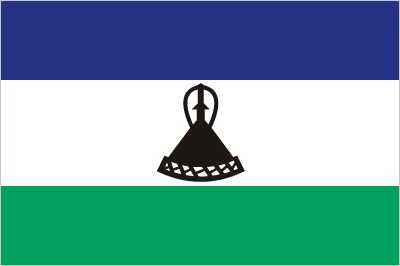
Description: Three horizontal stripes of blue (top), white, and green; centered on the white stripe is a black mokorotlo, a traditional Basotho straw hat and national symbol
Meaning: Blue stands for rain, white for peace, and green for prosperity
History: The redesigned flag was introduced in 2006 to celebrate 40 years of independence
Meaning: Blue stands for rain, white for peace, and green for prosperity
History: The redesigned flag was introduced in 2006 to celebrate 40 years of independence
Independence
4 October 1966 (from the UK)
Judicial branch
Highest court(s): Court of Appeal (consists of the court president, such number of justices of appeal as set by Parliament, and the Chief Justice and the puisne judges of the High Court ex officio); High Court (consists of the chief justice and such number of puisne judges as set by Parliament)
Judge selection and term of office: Court of Appeal president and High Court chief justice appointed by the monarch on the advice of the prime minister; puisne judges appointed by the monarch on advice of the Judicial Service Commission, an independent body of judicial officers and officials designated by the monarch; judges of both courts can serve until age 75
Subordinate courts: Magistrate Courts; customary or traditional courts; military courts
Note: Both the Court of Appeal and the High Court have jurisdiction in constitutional issues
Judge selection and term of office: Court of Appeal president and High Court chief justice appointed by the monarch on the advice of the prime minister; puisne judges appointed by the monarch on advice of the Judicial Service Commission, an independent body of judicial officers and officials designated by the monarch; judges of both courts can serve until age 75
Subordinate courts: Magistrate Courts; customary or traditional courts; military courts
Note: Both the Court of Appeal and the High Court have jurisdiction in constitutional issues
Legal system
mixed system of English common law and Roman-Dutch law; High Court and Court of Appeal review legislative acts
Legislative branch
Legislature name: Parliament
Legislative structure: Bicameral
Legislative structure: Bicameral
International organization participation
ACP, AfDB, AU, C, CD, FAO, G-77, IAEA, IBRD, ICAO, ICCt, ICRM, IDA, IFAD, IFC, IFRCS, ILO, IMF, Interpol, IOC, IOM, IPU, ISO (correspondent), ITU, MIGA, NAM, OPCW, SACU, SADC, UN, UNCTAD, UNESCO, UNHCR, UNIDO, UNWTO, UPU, WCO, WFTU (NGOs), WHO, WIPO, WMO, WTO
National holiday
Independence Day, 4 October (1966)
Political parties
All Basotho Convention or ABC
Alliance of Democrats or AD
Basotho Action Party or BAP
Basotho National Party or BNP
Democratic Congress or DC
Democratic Party of Lesotho or DPL
Lesotho People's Congress or LPC
Movement of Economic Change or MEC
National Independent Party or NIP
Popular Front for Democracy of PFD
Reformed Congress of Lesotho or RCL
Alliance of Democrats or AD
Basotho Action Party or BAP
Basotho National Party or BNP
Democratic Congress or DC
Democratic Party of Lesotho or DPL
Lesotho People's Congress or LPC
Movement of Economic Change or MEC
National Independent Party or NIP
Popular Front for Democracy of PFD
Reformed Congress of Lesotho or RCL
Suffrage
18 years of age; universal
Government type
parliamentary constitutional monarchy
Country name
Conventional long form: Kingdom of Lesotho
Conventional short form: Lesotho
Local long form: Kingdom of Lesotho
Local short form: Lesotho
Former: Basutoland
Etymology: The name comes from the Sotho people, whose name means "dark-skinned;" Le- is a singular noun prefix; the former name, Basutoland, uses the plural noun prefix, Ba-
Conventional short form: Lesotho
Local long form: Kingdom of Lesotho
Local short form: Lesotho
Former: Basutoland
Etymology: The name comes from the Sotho people, whose name means "dark-skinned;" Le- is a singular noun prefix; the former name, Basutoland, uses the plural noun prefix, Ba-
Diplomatic representation in the US
Chief of mission: Ambassador Tumisang MOSOTHO (since 16 September 2022)
Chancery: 2511 Massachusetts Avenue NW, Washington, DC 20008
Telephone: [1] (202) 797-5533
FAX: [1] (202) 234-6815
Email address and website:
Lesothoembassy@verizon.net
https://www.gov.ls/
Chancery: 2511 Massachusetts Avenue NW, Washington, DC 20008
Telephone: [1] (202) 797-5533
FAX: [1] (202) 234-6815
Email address and website:
Lesothoembassy@verizon.net
https://www.gov.ls/
National anthem(s)
Title: "Lesotho fatse la bo ntat'a rona" (Lesotho, Land of Our Fathers)
Lyrics/music: Francois COILLARD/Ferdinand-Samuel LAUR
History: Adopted 1967; music derives from an 1823 Swiss songbook
Lyrics/music: Francois COILLARD/Ferdinand-Samuel LAUR
History: Adopted 1967; music derives from an 1823 Swiss songbook
International law organization participation
accepts compulsory ICJ jurisdiction with reservations; accepts ICCt jurisdiction
National symbol(s)
mokorotio (Basotho hat)
Citizenship
Citizenship by birth: Yes
Citizenship by descent only: Yes
Dual citizenship recognized: No
Residency requirement for naturalization: 5 years
Citizenship by descent only: Yes
Dual citizenship recognized: No
Residency requirement for naturalization: 5 years
National heritage

National color(s)
blue, white, green, black
Population below poverty line
49.7% (2017 est.)
note: % of population with income below national poverty line
note: % of population with income below national poverty line
Household income or consumption by percentage share
Lowest 10%: 1.7% (2017 est.)
Highest 10%: 32.9% (2017 est.)
note: % share of income accruing to lowest and highest 10% of population
Highest 10%: 32.9% (2017 est.)
note: % share of income accruing to lowest and highest 10% of population
Exports - commodities
diamonds, garments, wool, power equipment, bedding (2023)
note: top five export commodities based on value in dollars
note: top five export commodities based on value in dollars
Exports - partners
South Africa 31%, Belgium 26%, USA 20%, UAE 8%, India 8% (2023)
note: top five export partners based on percentage share of exports
note: top five export partners based on percentage share of exports
Agricultural products
milk, potatoes, maize, vegetables, fruits, sorghum, wheat, game meat, beans, wool (2023)
note: top ten agricultural products based on tonnage
note: top ten agricultural products based on tonnage
Budget
Revenues: $1.13 billion (2022 est.)
Expenditures: $1.256 billion (2022 est.)
note: central government revenues and expenses (excluding grants/extrabudgetary units/social security funds) converted to US dollars at average official exchange rate for year indicated
Expenditures: $1.256 billion (2022 est.)
note: central government revenues and expenses (excluding grants/extrabudgetary units/social security funds) converted to US dollars at average official exchange rate for year indicated
Imports - commodities
refined petroleum, fabric, trucks, garments, cotton fabric (2023)
note: top five import commodities based on value in dollars
note: top five import commodities based on value in dollars
Exchange rates
maloti (LSL) per US dollar -
Exchange rates:
18.329 (2024 est.)
18.45 (2023 est.)
16.356 (2022 est.)
14.779 (2021 est.)
16.459 (2020 est.)
Exchange rates:
18.329 (2024 est.)
18.45 (2023 est.)
16.356 (2022 est.)
14.779 (2021 est.)
16.459 (2020 est.)
Industries
food, beverages, textiles, apparel assembly, handicrafts, construction, tourism
Economic overview
lower middle-income economy surrounded by South Africa; environmentally fragile and politically unstable; key infrastructure and renewable energy investments; dire poverty; urban job and income losses due to COVID-19; systemic corruption
GDP (official exchange rate)
$2.272 billion (2024 est.)
note: data in current dollars at official exchange rate
note: data in current dollars at official exchange rate
GDP - composition, by end use
Household consumption: 92.9% (2023 est.)
Government consumption: 35.6% (2023 est.)
Investment in fixed capital: 28.3% (2023 est.)
Investment in inventories: -1.1% (2023 est.)
Exports of goods and services: 42.9% (2023 est.)
Imports of goods and services: -98.6% (2023 est.)
note: figures may not total 100% due to rounding or gaps in data collection
Government consumption: 35.6% (2023 est.)
Investment in fixed capital: 28.3% (2023 est.)
Investment in inventories: -1.1% (2023 est.)
Exports of goods and services: 42.9% (2023 est.)
Imports of goods and services: -98.6% (2023 est.)
note: figures may not total 100% due to rounding or gaps in data collection
Imports - partners
South Africa 78%, China 10%, Taiwan 3%, Japan 1%, India 1% (2023)
note: top five import partners based on percentage share of imports
note: top five import partners based on percentage share of imports
Remittances
22% of GDP (2024 est.)
22.9% of GDP (2023 est.)
22.6% of GDP (2022 est.)
note: personal transfers and compensation between resident and non-resident individuals/households/entities
22.9% of GDP (2023 est.)
22.6% of GDP (2022 est.)
note: personal transfers and compensation between resident and non-resident individuals/households/entities
Labor force
884,200 (2024 est.)
note: number of people ages 15 or older who are employed or seeking work
note: number of people ages 15 or older who are employed or seeking work
Debt - external
$928.019 million (2023 est.)
note: present value of external debt in current US dollars
note: present value of external debt in current US dollars
Reserves of foreign exchange and gold
$1.008 billion (2024 est.)
$854.089 million (2023 est.)
$771.278 million (2022 est.)
note: holdings of gold (year-end prices)/foreign exchange/special drawing rights in current dollars
$854.089 million (2023 est.)
$771.278 million (2022 est.)
note: holdings of gold (year-end prices)/foreign exchange/special drawing rights in current dollars
Public debt
3% of GDP (2020 est.)
note: central government debt as a % of GDP
note: central government debt as a % of GDP
Unemployment rate
16.2% (2024 est.)
16.5% (2023 est.)
16.7% (2022 est.)
note: % of labor force seeking employment
16.5% (2023 est.)
16.7% (2022 est.)
note: % of labor force seeking employment
Taxes and other revenues
30.4% (of GDP) (2022 est.)
note: central government tax revenue as a % of GDP
note: central government tax revenue as a % of GDP
Real GDP (purchasing power parity)
$6.166 billion (2024 est.)
$6 billion (2023 est.)
$5.893 billion (2022 est.)
note: data in 2021 dollars
$6 billion (2023 est.)
$5.893 billion (2022 est.)
note: data in 2021 dollars
Inflation rate (consumer prices)
6.1% (2024 est.)
6.3% (2023 est.)
8.3% (2022 est.)
note: annual % change based on consumer prices
6.3% (2023 est.)
8.3% (2022 est.)
note: annual % change based on consumer prices
Current account balance
$84.393 million (2024 est.)
-$151.577 million (2023 est.)
-$268.876 million (2022 est.)
note: balance of payments - net trade and primary/secondary income in current dollars
-$151.577 million (2023 est.)
-$268.876 million (2022 est.)
note: balance of payments - net trade and primary/secondary income in current dollars
Real GDP per capita
$2,600 (2024 est.)
$2,600 (2023 est.)
$2,600 (2022 est.)
note: data in 2021 dollars
$2,600 (2023 est.)
$2,600 (2022 est.)
note: data in 2021 dollars
Imports
$2.083 billion (2024 est.)
$2.077 billion (2023 est.)
$2.247 billion (2022 est.)
note: balance of payments - imports of goods and services in current dollars
$2.077 billion (2023 est.)
$2.247 billion (2022 est.)
note: balance of payments - imports of goods and services in current dollars
Exports
$983.027 million (2024 est.)
$885.789 million (2023 est.)
$1.07 billion (2022 est.)
note: balance of payments - exports of goods and services in current dollars
$885.789 million (2023 est.)
$1.07 billion (2022 est.)
note: balance of payments - exports of goods and services in current dollars
Real GDP growth rate
2.8% (2024 est.)
1.8% (2023 est.)
2.4% (2022 est.)
note: annual GDP % growth based on constant local currency
1.8% (2023 est.)
2.4% (2022 est.)
note: annual GDP % growth based on constant local currency
Industrial production growth rate
2.6% (2024 est.)
note: annual % change in industrial value added based on constant local currency
note: annual % change in industrial value added based on constant local currency
GDP - composition, by sector of origin
Agriculture: 6.5% (2024 est.)
Industry: 31% (2024 est.)
Services: 48% (2024 est.)
note: figures may not total 100% due to non-allocated consumption not captured in sector-reported data
Industry: 31% (2024 est.)
Services: 48% (2024 est.)
note: figures may not total 100% due to non-allocated consumption not captured in sector-reported data
Electricity access
Electrification - total population: 50% (2022 est.)
Electrification - urban areas: 83.6%
Electrification - rural areas: 37.7%
Electrification - urban areas: 83.6%
Electrification - rural areas: 37.7%
Coal
Production: 57,000 metric tons (2023 est.)
Consumption: 81,000 metric tons (2023 est.)
Exports: 1 metric tons (2023 est.)
Imports: 24,000 metric tons (2023 est.)
Consumption: 81,000 metric tons (2023 est.)
Exports: 1 metric tons (2023 est.)
Imports: 24,000 metric tons (2023 est.)
Electricity generation sources
Fossil fuels: 0.1% of total installed capacity (2023 est.)
Solar: 0.3% of total installed capacity (2023 est.)
Hydroelectricity: 99.6% of total installed capacity (2023 est.)
Solar: 0.3% of total installed capacity (2023 est.)
Hydroelectricity: 99.6% of total installed capacity (2023 est.)
Petroleum
Refined petroleum consumption: 7,000 bbl/day (2023 est.)
Electricity
Installed generating capacity: 104,000 kW (2023 est.)
Consumption: 833.009 million kWh (2023 est.)
Imports: 453.992 million kWh (2023 est.)
Transmission/distribution losses: 102.88 million kWh (2023 est.)
Consumption: 833.009 million kWh (2023 est.)
Imports: 453.992 million kWh (2023 est.)
Transmission/distribution losses: 102.88 million kWh (2023 est.)
Internet users
Percent of population: 48% (2023 est.)
Internet country code
.ls
Broadcast media
1 state-owned TV station and 2 state-owned radio stations; most private broadcast media transmitters are connected to government radio signal towers; satellite TV subscription service available; transmissions of multiple international broadcasters obtainable (2019)
Telephones - mobile cellular
Total subscriptions: 1.6 million (2023 est.)
Subscriptions per 100 inhabitants: 68 (2022 est.)
Subscriptions per 100 inhabitants: 68 (2022 est.)
Broadband - fixed subscriptions
Total: 9,000 (2023 est.)
Subscriptions per 100 inhabitants: (2023 est.) less than 1
Subscriptions per 100 inhabitants: (2023 est.) less than 1
Telephones - fixed lines
Total subscriptions: 7,000 (2023 est.)
Subscriptions per 100 inhabitants: (2023 est.) less than 1
Subscriptions per 100 inhabitants: (2023 est.) less than 1
Civil aircraft registration country code prefix
7P
Airports
34 (2025)
Military service age and obligation
18-30 years of age for voluntary military service for both men and women (women can serve in combat arms); no conscription (2024)
Military expenditures
1.5% of GDP (2024 est.)
1.6% of GDP (2023 est.)
1.6% of GDP (2022 est.)
1.5% of GDP (2021 est.)
1.6% of GDP (2020 est.)
1.6% of GDP (2023 est.)
1.6% of GDP (2022 est.)
1.5% of GDP (2021 est.)
1.6% of GDP (2020 est.)
Military and security forces
Lesotho Defense Force (LDF) (2025)
Note: The Lesotho Mounted Police Service is responsible for internal security and reports to the Minister of Local Government, Chieftainship, Home Affairs and Police
Note: The Lesotho Mounted Police Service is responsible for internal security and reports to the Minister of Local Government, Chieftainship, Home Affairs and Police
Military - note
the Lesotho Defense Force (LDF) is responsible for the maintenance of the country's sovereignty and the preservation of internal security; in practice, external security is guaranteed by South Africa; the LDF is a small force that began in 1964 as the Police Mobile Unit (PMU); the PMU was designated as the Lesotho Paramilitary Force in 1980 and became the Royal Lesotho Defense Force in 1986; it was renamed the Lesotho Defense Force in 1993 (2025)
Military and security service personnel strengths
approximately 2,000 active Defense Forces (2025)
Military equipment inventories and acquisitions
the LDF is lightly armed and has a small inventory of mostly older or second-hand equipment of European, South African, and US origin (2025)
Refugees and internally displaced persons
Refugees: 610 (2024 est.)
Legislative branch - lower chamber
Chamber name: National Assembly
Number of seats: 122 (all directly elected)
Electoral system: Mixed system
Scope of elections: Full renewal
Term in office: 5 years
Most recent election date: 10/7/2022
Parties elected and seats per party: Revolution for Prosperity (RFP) (56); Democratic Congress (DC) (29); All Basotho Convention (ABC) (8); Basotho Action Party (BAP) (6); Other (20)
Percentage of women in chamber: 25%
Expected date of next election: October 2027
Number of seats: 122 (all directly elected)
Electoral system: Mixed system
Scope of elections: Full renewal
Term in office: 5 years
Most recent election date: 10/7/2022
Parties elected and seats per party: Revolution for Prosperity (RFP) (56); Democratic Congress (DC) (29); All Basotho Convention (ABC) (8); Basotho Action Party (BAP) (6); Other (20)
Percentage of women in chamber: 25%
Expected date of next election: October 2027
Legislative branch - upper chamber
Chamber name: Senate
Number of seats: 33 (11 appointed)
Scope of elections: Full renewal
Term in office: 5 years
Most recent election date: 11/2/2022
Percentage of women in chamber: 21.2%
Expected date of next election: November 2027
Number of seats: 33 (11 appointed)
Scope of elections: Full renewal
Term in office: 5 years
Most recent election date: 11/2/2022
Percentage of women in chamber: 21.2%
Expected date of next election: November 2027
Gini Index coefficient - distribution of family income
44.9 (2017 est.)
note: index (0-100) of income distribution; higher values represent greater inequality
note: index (0-100) of income distribution; higher values represent greater inequality