Guinea-Bissau
Background
For much of its history, Guinea-Bissau was under the control of the Mali Empire and the Kaabu Kingdom. In the 16th century, Portugal began establishing trading posts along Guinea-Bissau’s shoreline. Initially, the Portuguese were restricted to the coastline and islands. However, the slave and gold trades were lucrative to local African leaders, and the Portuguese were slowly able to expand their power and influence inland. Starting in the 18th century, the Mali Empire and Kingdom of Kaabu slowly disintegrated into smaller local entities. By the 19th century, Portugal had fully incorporated Guinea-Bissau into its empire.
Since gaining independence in 1974, Guinea-Bissau has experienced considerable political and military upheaval. In 1980, a military coup established General Joao Bernardo 'Nino' VIEIRA as president. VIEIRA's regime suppressed political opposition and purged political rivals. Several coup attempts through the 1980s and early 1990s failed to unseat him, but a military mutiny and civil war in 1999 led to VIEIRA's ouster. In 2000, a transitional government turned over power to opposition leader Kumba YALA. In 2003, a bloodless military coup overthrew YALA and installed businessman Henrique ROSA as interim president. In 2005, VIEIRA was reelected, pledging to pursue economic development and national reconciliation; he was assassinated in 2009. Malam Bacai SANHA was then elected president, but he passed away in 2012 from a long-term illness. A military coup blocked the second round of the election to replace him, but after mediation from the Economic Community of Western African States, a civilian transitional government assumed power. In 2014, Jose Mario VAZ was elected president in a free and fair election, and in 2019, he became the first president in Guinea-Bissau’s history to complete a full term. Umaro Sissoco EMBALO was elected president in 2019, but he did not take office until 2020 because of a prolonged challenge to the election results.
Geographic coordinates
Natural hazards
Area - comparative
Environmental issues
International environmental agreements
Signed, but not ratified: None of the selected agreements
Climate
Coastline
Land boundaries
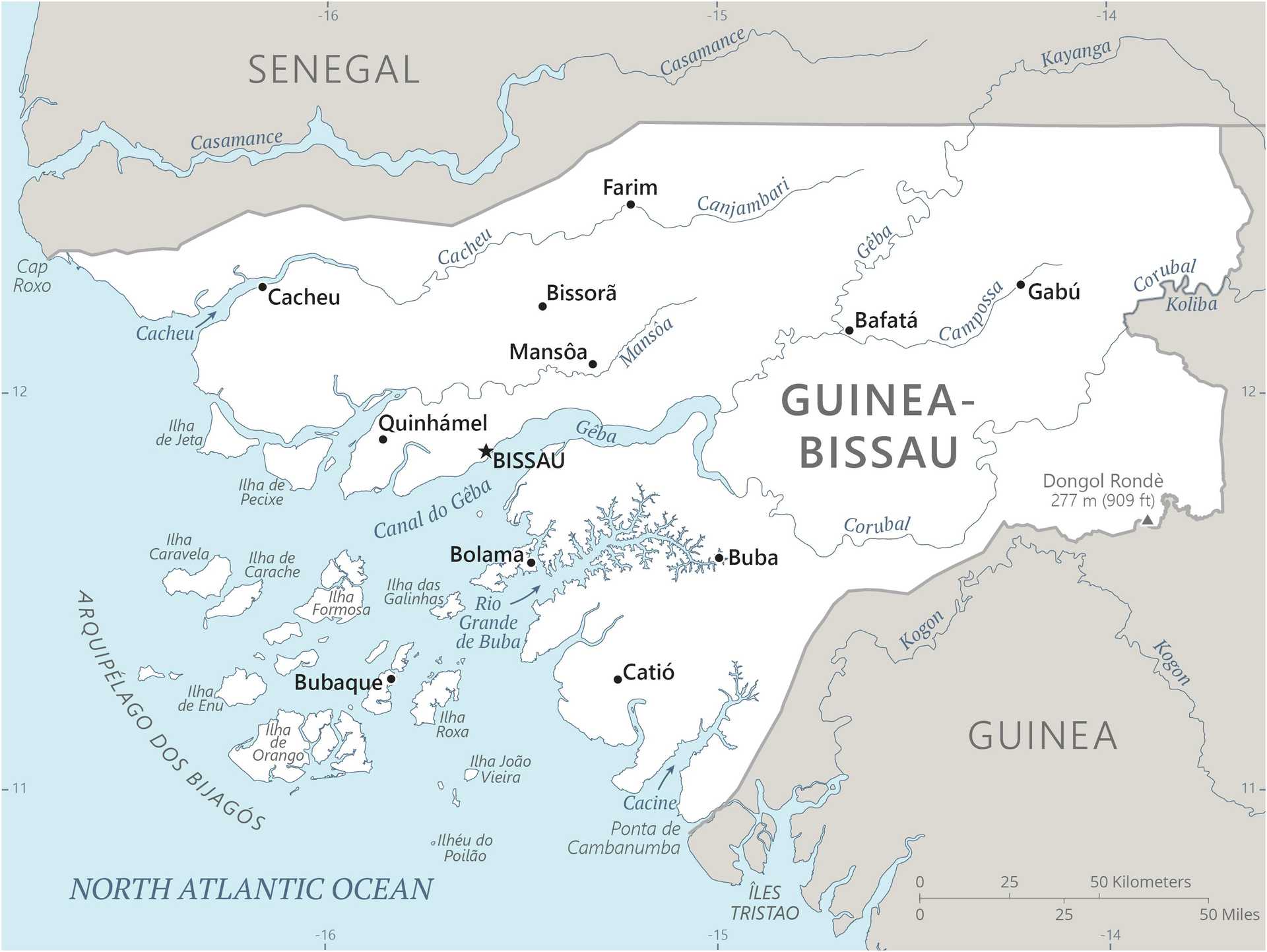
Border countries (2): Guinea 421 km; Senegal 341 km
Land use
Arable land: 14% (2022 est.)
Permanent crops: 8.9% (2022 est.)
Permanent pasture: 7.1% (2022 est.)
Forest: 69.8% (2022 est.)
Other: 0.1% (2022 est.)
Maritime claims
Exclusive economic zone: 200 nm
Natural resources
Geography - note
Terrain
Location
Map references
Irrigated land
Total renewable water resources
Population distribution
Elevation
Lowest point: Atlantic Ocean 0 m
Mean elevation: 70 m
Major aquifers
Area
Land: 28,120 sq km
Water: 8,005 sq km
Age structure
15-64 years: 54.6% (male 561,868/female 602,280)
65 years and over: 3.1% (2024 est.) (male 27,529/female 38,621)
Sex ratio
0-14 years: 1.01 male(s)/female
15-64 years: 0.93 male(s)/female
65 years and over: 0.71 male(s)/female
Total population: 0.96 male(s)/female (2024 est.)
Literacy
Male: 77.3% (2022 est.)
Female: 52.2% (2022 est.)
Nationality
Adjective: Bissau-Guinean
Urbanization
Rate of urbanization: 3.22% annual rate of change (2020-25 est.)
Drinking water source
Urban: 73.1% of population (2022 est.)
Rural: 52.5% of population (2022 est.)
Total: 61.8% of population (2022 est.)
Unimproved:
Urban: 26.9% of population (2022 est.)
Rural: 47.5% of population (2022 est.)
Total: 38.2% of population (2022 est.)
Major urban areas - population
Physician density
Dependency ratios
Youth dependency ratio: 77.5 (2024 est.)
Elderly dependency ratio: 5.7 (2024 est.)
Potential support ratio: 17.6 (2024 est.)
Sanitation facility access
Urban: 72.2% of population (2022 est.)
Rural: 23.8% of population (2022 est.)
Total: 45.6% of population (2022 est.)
Unimproved:
Urban: 27.8% of population (2022 est.)
Rural: 76.2% of population (2022 est.)
Total: 54.4% of population (2022 est.)
Ethnic groups
Religions
Languages
Health expenditure
5.2% of national budget (2022 est.)
Child marriage
Women married by age 18: 25.7% (2019)
Men married by age 18: 2.2% (2019)
Gross reproduction rate
Currently married women (ages 15-49)
Youth unemployment rate (ages 15-24)
Male: 3.4% (2024 est.)
Female: 2% (2024 est.)
note: % of labor force ages 15-24 seeking employment
Net migration rate
Median age
Male: 17.8 years
Female: 18.9 years
Maternal mortality ratio
Total fertility rate
Population
Male: 1,042,910
Female: 1,089,415
Infant mortality rate
Male: 52 deaths/1,000 live births
Female: 40.6 deaths/1,000 live births
Tobacco use
Male: 13.2% (2025 est.)
Female: 0.5% (2025 est.)
Obesity - adult prevalence rate
Death rate
Birth rate
Children under the age of 5 years underweight
Alcohol consumption per capita
Beer: 0.41 liters of pure alcohol (2019 est.)
Wine: 0.98 liters of pure alcohol (2019 est.)
Spirits: 0.54 liters of pure alcohol (2019 est.)
Other alcohols: 1.28 liters of pure alcohol (2019 est.)
Life expectancy at birth
Male: 62.2 years
Female: 66.8 years
Education expenditure
Population growth rate
Total water withdrawal
Industrial: 11.9 million cubic meters (2022 est.)
Agricultural: 144 million cubic meters (2022 est.)
Waste and recycling
Percent of municipal solid waste recycled: 10.1% (2022 est.)
Particulate matter emissions
Carbon dioxide emissions
From coal and metallurgical coke: 1 metric tonnes of CO2 (2023 est.)
From petroleum and other liquids: 366,000 metric tonnes of CO2 (2023 est.)
Energy consumption per capita
Diplomatic representation from the US
Mailing address: 2080 Bissau Place, Washington DC 20521-2080
Email address and website:
DakarACS@state.gov
https://gw.usmission.gov/
Administrative divisions
Capital
Geographic coordinates: 11 51 N, 15 35 W
Time difference: UTC 0 (5 hours ahead of Washington, DC, during Standard Time)
Etymology: The name is derived from the local Bijuga people and is used to distinguish the country from neighboring Guinea
Constitution
Amendment process: Proposed by the National People’s Assembly if supported by at least one third of its members, by the Council of State (a presidential consultant body), or by the government; passage requires approval by at least two-thirds majority vote of the Assembly; constitutional articles on the republican and secular form of government and national sovereignty cannot be amended
Executive branch
Head of government: Prime Minister Braima CAMARA (since 7 August 2025)
Cabinet: Cabinet nominated by the prime minister, appointed by the president
Election/appointment process: President directly elected by absolute-majority popular vote in 2 rounds, if needed, for up to 2 consecutive 5-year terms; prime minister appointed by the president after consultation with party leaders in the National People's Assembly
Most recent election date: 24 November 2019, with a runoff on 29 December 2019
Election results:
2019: Umaro Sissoco EMBALO elected president in second round; percent of vote in first round - Domingos Simoes PEREIRA (PAIGC) 40.1%, Umaro Sissoco EMBALO (Madem G15) 27.7%, Nuno Gomez NABIAM (APU-PDGB) 13.2%, Jose Mario VAZ (independent) 12.4%, other 6.6%; percent of vote in second round - Umaro Sissoco EMBALO 53.6%, Domingos Simoes PEREIRA 46.5%
2014: Jose Mario VAZ elected president in second round; percent of vote in first round - Jose Mario VAZ (PAIGC) 41%, Nuno Gomez NABIAM (independent) 25.1%, other 33.9%; percent of vote in second round - Jose Mario VAZ 61.9%, Nuno Gomez NABIAM 38.1% (2019)
Expected date of next election: 2025
Note: President EMBALO was declared winner of the 2019 runoff presidential election by the electoral commission; in 2020, EMBALO inaugurated himself with only military leadership present, even though the Supreme Court of Justice had yet to rule on an electoral litigation appeal
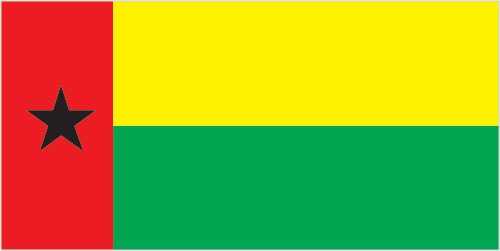
Flag
Meaning: Yellow stands for the sun, green for hope, red for blood shed during the struggle for independence; the black star stands for African unity
History: Uses the colors of the Pan-African movement; the Ghanaian flag heavily influenced the design
Independence
Judicial branch
Judge selection and term of office: Judges nominated by the Higher Council of the Magistrate, a major government organ responsible for judge appointments, dismissals, and judiciary discipline; judges appointed by the president for life
Subordinate courts: Appeals Court; regional (first instance) courts; military court
Note: the Supreme Court has both appellate and constitutional jurisdiction
Legal system
Legislative branch
Legislative structure: Unicameral
Number of seats: 102 (all directly elected)
Electoral system: Proportional representation
Scope of elections: Full renewal
Term in office: 4 years
Most recent election date: 6/4/2023
Parties elected and seats per party: Inclusive Alliance Platform/Terra Coalition (54); Movement for Democratic Alternation (MADEM G.15) (29); Party for Social Renewal (PRS) (12); Bissau-Guinean Workers’ Party (6); Other (1)
Percentage of women in chamber: 9.8%
Expected date of next election: November 2025
International organization participation
National holiday
Political parties
Democratic Convergence Party or PCD
Movement for Democratic Alternation Group of 15 or MADEM-G15
National People’s Assembly – Democratic Party of Guinea Bissau or APU-PDGB
New Democracy Party or PND
Party for Social Renewal or PRS
Republican Party for Independence and Development or PRID
Union for Change or UM
Suffrage
Government type
Country name
Conventional short form: Guinea-Bissau
Local long form: Republica da Guine-Bissau
Local short form: Guine-Bissau
Former: Portuguese Guinea
Etymology: The country is partly named after the Guinea region of West Africa that lies along the Gulf of Guinea; the name itself is derived from the Tuareg word aginaw, meaning "black people;" Bissau, the name of the capital city, distinguishes the country from neighboring Guinea and is derived from the local Bijuga people
Diplomatic representation in the US
Chancery: 918 16th Street, NW (Mezzanine Suite)
Washington DC 20006
Telephone: [1] (202) 872-4222
FAX: [1] (202) 872-4226
National anthem(s)
Lyrics/music: Amilcar Lopes CABRAL/XIAO He
History: Adopted 1974; a delegation from Portuguese Guinea visited China in 1963 and heard music by XIAO He; Amilcar Lopes CABRAL, the leader of Guinea-Bissau's independence movement, asked the composer to create a piece that would inspire his people to fight for independence
International law organization participation
National symbol(s)
Citizenship
Citizenship by descent only: Yes
Dual citizenship recognized: No
Residency requirement for naturalization: 5 years
National heritage
Selected World Heritage Site locales: Coastal and Marine Ecosystems of the Bijagós Archipelago – Omatí Minhô (n)
National color(s)
Population below poverty line
note: % of population with income below national poverty line
Household income or consumption by percentage share
Highest 10%: 26.1% (2021 est.)
note: % share of income accruing to lowest and highest 10% of population
Exports - commodities
note: top five export commodities based on value in dollars
Exports - partners
note: top five export partners based on percentage share of exports
Agricultural products
note: top ten agricultural products based on tonnage
Budget
Expenditures: $450.953 million (2023 est.)
note: central government revenues and expenses (excluding grants/extrabudgetary units/social security funds) converted to US dollars at average official exchange rate for year indicated
Imports - commodities
note: top five import commodities based on value in dollars
Exchange rates
Exchange rates:
606.345 (2024 est.)
606.57 (2023 est.)
623.76 (2022 est.)
554.531 (2021 est.)
575.586 (2020 est.)
Industries
Economic overview
GDP (official exchange rate)
note: data in current dollars at official exchange rate
GDP - composition, by end use
Government consumption: 17.8% (2024 est.)
Investment in fixed capital: 22.8% (2024 est.)
Investment in inventories: -1.9% (2024 est.)
Exports of goods and services: 12.5% (2024 est.)
Imports of goods and services: -28.2% (2024 est.)
note: figures may not total 100% due to rounding or gaps in data collection
Imports - partners
note: top five import partners based on percentage share of imports
Remittances
10.3% of GDP (2022 est.)
11% of GDP (2021 est.)
note: personal transfers and compensation between resident and non-resident individuals/households/entities
Labor force
note: number of people ages 15 or older who are employed or seeking work
Debt - external
Note: Present value of external debt in current US dollars
Unemployment rate
2.7% (2023 est.)
2.7% (2022 est.)
note: % of labor force seeking employment
Taxes and other revenues
note: central government tax revenue as a % of GDP
Real GDP (purchasing power parity)
$5.64 billion (2023 est.)
$5.399 billion (2022 est.)
note: data in 2021 dollars
Inflation rate (consumer prices)
7.1% (2023 est.)
9.4% (2022 est.)
note: annual % change based on consumer prices
Current account balance
-$146.64 million (2022 est.)
-$14.128 million (2021 est.)
note: balance of payments - net trade and primary/secondary income in current dollars
Real GDP per capita
$2,600 (2023 est.)
$2,600 (2022 est.)
note: data in 2021 dollars
Imports
$577.899 million (2022 est.)
$518.162 million (2021 est.)
note: balance of payments - imports of goods and services in current dollars
Exports
$280.065 million (2022 est.)
$334.904 million (2021 est.)
note: balance of payments - exports of goods and services in current dollars
Real GDP growth rate
4.5% (2023 est.)
5.6% (2022 est.)
note: annual GDP % growth based on constant local currency
Industrial production growth rate
note: annual % change in industrial value added based on constant local currency
GDP - composition, by sector of origin
Industry: 16.6% (2024 est.)
Services: 42.1% (2024 est.)
note: figures may not total 100% due to non-allocated consumption not captured in sector-reported data
Electricity access
Electrification - urban areas: 61%
Electrification - rural areas: 15.8%
Coal
Electricity generation sources
Solar: 3.5% of total installed capacity (2023 est.)
Petroleum
Electricity
Consumption: 79.8 million kWh (2023 est.)
Transmission/distribution losses: 6 million kWh (2023 est.)
Internet users
Internet country code
Broadcast media
Telephones - mobile cellular
Subscriptions per 100 inhabitants: 126 (2022 est.)
Broadband - fixed subscriptions
Subscriptions per 100 inhabitants: (2023 est.) less than 1
Telephones - fixed lines
Subscriptions per 100 inhabitants: (2022 est.) less than 1
Civil aircraft registration country code prefix
Airports
Merchant marine
By type: Bulk carrier 3, general cargo 12, other 5
Military service age and obligation
Military expenditures
1.2% of GDP (2023 est.)
1.4% of GDP (2022 est.)
1.5% of GDP (2021 est.)
1.5% of GDP (2020 est.)
Military and security forces
Ministry of Internal Administration: National Guard (a gendarmerie force), Public Order Police, Border Police, Rapid Intervention Police, Maritime Police (2024)
Note: The Public Order Police is responsible for maintaining law and order, while the Judicial Police, under the Ministry of Justice, has primary responsibility for investigating drug trafficking, terrorism, and other transnational crimes
Military and security service personnel strengths
Military equipment inventories and acquisitions
Military - note
Refugees and internally displaced persons
Ports
Large: 0
Medium: 0
Small: 0
Very small: 2
Ports with oil terminals: 1
Key ports: Bissau, Rio Cacheu
Gini Index coefficient - distribution of family income
note: index (0-100) of income distribution; higher values represent greater inequality