Ghana
Background
Ghana is a multiethnic country rich in natural resources and is one of the most stable and democratic countries in West Africa. Ghana has been inhabited for at least several thousand years, but little is known about its early inhabitants. By the 12th century, the gold trade started to boom in Bono (Bonoman) state in what is today southern Ghana, and it became the genesis of the Akan people's power and wealth in the region. Beginning in the 15th century, the Portuguese, followed by other European powers, arrived and competed for trading rights. Numerous kingdoms and empires emerged in the area, among the most powerful were the Kingdom of Dagbon in the north and the Asante (Ashanti) Empire in the south. By the mid-18th century, Asante was a highly organized state with immense wealth; it provided enslaved people for the Atlantic slave trade, and in return received firearms that facilitated its territorial expansion. The Asante resisted increasing British influence in the coastal areas, engaging in a series of wars during the 19th century before ultimately falling under British control. Formed from the merger of the British colony of the Gold Coast and the Togoland trust territory, Ghana in 1957 became the first Sub-Saharan country in colonial Africa to gain its independence, with Kwame NKRUMAH as its first leader.
Ghana endured a series of coups before Lt. Jerry RAWLINGS took power in 1981 and banned political parties. After approving a new constitution and restoring multiparty politics in 1992, RAWLINGS won presidential elections in 1992 and 1996 but was constitutionally prevented from running for a third term in 2000. John KUFUOR of the opposition New Patriotic Party (NPP) succeeded him and was reelected in 2004. John Atta MILLS of the National Democratic Congress won the 2008 presidential election and took over as head of state. MILLS died in 2012 and was constitutionally succeeded by his vice president, John Dramani MAHAMA, who subsequently won the 2012 presidential election. In 2016, Nana Addo Dankwa AKUFO-ADDO of the NPP defeated MAHAMA, marking the third time that Ghana’s presidency had changed parties since the return to democracy. AKUFO-ADDO was reelected in 2020. In recent years, Ghana has taken an active role in promoting regional stability and is highly integrated in international affairs.
Geographic coordinates
Natural hazards
Area - comparative
Environmental issues
International environmental agreements
Signed, but not ratified: Marine Life Conservation
Climate
Coastline
Land boundaries
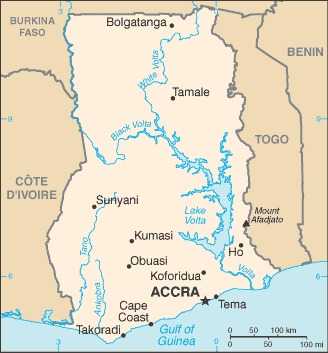
Border countries (3): Burkina Faso 602 km; Cote d'Ivoire 720 km; Togo 1098 km
Land use
Arable land: 20.7% (2023 est.)
Permanent crops: 11.9% (2023 est.)
Permanent pasture: 22.8% (2023 est.)
Forest: 30.7% (2023 est.)
Other: 13.9% (2023 est.)
Maritime claims
Contiguous zone: 24 nm
Exclusive economic zone: 200 nm
Continental shelf: 200 nm
Natural resources
Geography - note
Terrain
Location
Map references
Irrigated land
Total renewable water resources
Population distribution
Elevation
Lowest point: Atlantic Ocean 0 m
Mean elevation: 190 m
Major watersheds (area sq km)
Major rivers (by length in km)
Note: [s] after country name indicates river source; [m] after country name indicates river mouth
Area
Land: 227,533 sq km
Water: 11,000 sq km
Age structure
15-64 years: 58.2% (male 9,690,498/female 10,444,197)
65 years and over: 4.4% (2024 est.) (male 684,189/female 842,577)
Sex ratio
0-14 years: 1.02 male(s)/female
15-64 years: 0.93 male(s)/female
65 years and over: 0.81 male(s)/female
Total population: 0.96 male(s)/female (2024 est.)
Literacy
Male: 81.3% (2021 est.)
Female: 72.1% (2021 est.)
Nationality
Adjective: Ghanaian
School life expectancy (primary to tertiary education)
Male: 12 years (2022 est.)
Female: 12 years (2022 est.)
Urbanization
Rate of urbanization: 3.06% annual rate of change (2020-25 est.)
Drinking water source
Urban: 98.4% of population (2022 est.)
Rural: 74.1% of population (2022 est.)
Total: 88.4% of population (2022 est.)
Unimproved:
Urban: 1.6% of population (2022 est.)
Rural: 25.9% of population (2022 est.)
Total: 11.6% of population (2022 est.)
Major urban areas - population
Physician density
Hospital bed density
Mother's mean age at first birth
Note: Data represents median age at first birth among women 25-49
Dependency ratios
Youth dependency ratio: 64.2 (2024 est.)
Elderly dependency ratio: 7.6 (2024 est.)
Potential support ratio: 13.2 (2024 est.)
Sanitation facility access
Urban: 85.7% of population (2022 est.)
Rural: 55.3% of population (2022 est.)
Total: 73.1% of population (2022 est.)
Unimproved:
Urban: 14.3% of population (2022 est.)
Rural: 44.7% of population (2022 est.)
Total: 26.9% of population (2022 est.)
Ethnic groups
Religions
Languages
Note: English is the official language
Health expenditure
7.4% of national budget (2022 est.)
Child marriage
Women married by age 18: 16.1% (2022)
Men married by age 18: 2.4% (2022)
Gross reproduction rate
Currently married women (ages 15-49)
Youth unemployment rate (ages 15-24)
Male: 5.5% (2024 est.)
Female: 5.3% (2024 est.)
note: % of labor force ages 15-24 seeking employment
Net migration rate
Median age
Male: 20.6 years
Female: 22.3 years
Maternal mortality ratio
Total fertility rate
Population
Male: 16,902,073
Female: 17,687,019
Infant mortality rate
Male: 34.5 deaths/1,000 live births
Female: 27.8 deaths/1,000 live births
Tobacco use
Male: 5.4% (2025 est.)
Female: 0.3% (2025 est.)
Obesity - adult prevalence rate
Death rate
Birth rate
Children under the age of 5 years underweight
Alcohol consumption per capita
Beer: 0.53 liters of pure alcohol (2019 est.)
Wine: 0.05 liters of pure alcohol (2019 est.)
Spirits: 0.39 liters of pure alcohol (2019 est.)
Other alcohols: 0.61 liters of pure alcohol (2019 est.)
Life expectancy at birth
Male: 68.4 years
Female: 71.8 years
Education expenditure
13.2% national budget (2022 est.)
Population growth rate
Total water withdrawal
Industrial: 95 million cubic meters (2022 est.)
Agricultural: 1.07 billion cubic meters (2022 est.)
Waste and recycling
Percent of municipal solid waste recycled: 13.3% (2022 est.)
Particulate matter emissions
Carbon dioxide emissions
From coal and metallurgical coke: 107,000 metric tonnes of CO2 (2023 est.)
From petroleum and other liquids: 13.349 million metric tonnes of CO2 (2023 est.)
From consumed natural gas: 7.366 million metric tonnes of CO2 (2023 est.)
Energy consumption per capita
Diplomatic representation from the US
Embassy: No. 24, Fourth Circular Road, Cantonments, Accra, P.O. Box 2288, Accra
Mailing address: 2020 Accra Place, Washington DC 20521-2020
Telephone: [233] (0) 30-274-1000
Email address and website:
ACSAccra@state.gov
https://gh.usembassy.gov/
Administrative divisions
Capital
Geographic coordinates: 5 33 N, 0 13 W
Time difference: UTC 0 (5 hours ahead of Washington, DC, during Standard Time)
Etymology: The name derives from the Akan word nkran, meaning "ant," and may refer to the nickname local forest dwellers gave to the Nigerian tribes who settled in the area in the 16th century
Constitution
Amendment process: Proposed by Parliament; consideration requires prior referral to the Council of State, a body of prominent citizens who advise the president of the republic; passage of amendments to "entrenched" constitutional articles (including those on national sovereignty, fundamental rights and freedoms, the structure and authorities of the branches of government, and amendment procedures) requires approval in a referendum by at least 40% participation of eligible voters and at least 75% of votes cast, followed by at least two-thirds majority vote in Parliament, and assent of the president; amendments to non-entrenched articles do not require referenda
Executive branch
Head of government: President John Dramani MAHAMA (since 7 January 2025)
Cabinet: Council of Ministers; nominated by the president, approved by Parliament
Election/appointment process: President and vice president directly elected on the same ballot by absolute-majority popular vote in 2 rounds, if needed, for a 4-year term (eligible for a second term); the president is both chief of state and head of government
Most recent election date: 7 December 2024
Election results:
2024: John Dramani MAHAMA elected president in the first round; percent of vote- John Dramani MAHAMA (NDC) 56.5%, Mahamudu BAWUMIA (NPC) 41%, other 2.5%
2020: Nana Addo Dankwa AKUFO-ADDO reelected president in the first round; percent of vote - Nana Addo Dankwa AKUFO-ADDO (NPP) 51.3%, John Dramani MAHAMA (NDC) 47.4%, other 1.3% (2020)
Expected date of next election: 7 December 2028
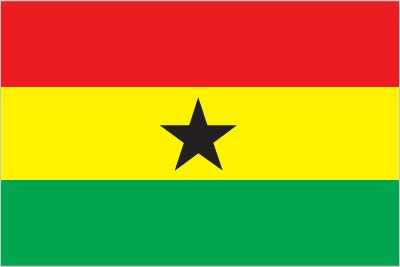
Flag
Meaning: Red stands for the blood shed for independence, yellow for the country's mineral wealth, and green for its forests and natural wealth; the black star is said to be the lodestar of African freedom
History: Uses the colors of the Pan-African movement
Note: Similar to the flag of Bolivia, which has a coat of arms centered in the yellow band
Independence
Judicial branch
Judge selection and term of office: Chief justice appointed by the president in consultation with the Council of State (a small advisory body of prominent citizens) and with the approval of Parliament; other justices appointed by the president on the advice of the Judicial Council (an 18-member independent body of judicial, military and police officials, and presidential nominees) and on the advice of the Council of State; justices can retire at age 60, with compulsory retirement at age 70
Subordinate courts: Court of Appeal; High Court; Circuit Court; District Court; regional tribunals
Legal system
Legislative branch
Legislative structure: Unicameral
Number of seats: 276 (all directly elected)
Electoral system: Plurality/majority
Scope of elections: Full renewal
Term in office: 4 years
Most recent election date: 12/7/2024
Parties elected and seats per party: National Democratic Congress (NDC) (183); New Patriotic Party (NPP) (88); Other (4)
Percentage of women in chamber: 14.5%
Expected date of next election: December 2028
International organization participation
National holiday
Political parties
Convention People's Party or CPP
Ghana Freedom Party or GFP
Ghana Union Movement or GUM
Great Consolidated Popular Party or GCPP
Liberal Party of Ghana or LPG
National Democratic Congress or NDC
National Democratic Party or NDP
New Patriotic Party or NPP
People's National Convention or PNC
Progressive People's Party or PPP
United Front Party or UFP
United Progressive Party or UPP
Suffrage
Government type
Country name
Conventional short form: Ghana
Former: Gold Coast
Etymology: Named for a tribal chieftain who ruled a large part of the region prior to the 13th century, even though his territory was northwest of modern-day Ghana; the former name, Gold Coast, came from the gold that Portuguese explorers discovered in the region in the late 15th century
Diplomatic representation in the US
Chancery: 3512 International Drive NW, Washington, DC 20008
Telephone: [1] (202) 686-4520
FAX: [1] (202) 686-4527
Email address and website:
Info.washington@mfa.gov.gh
https://washington.mfa.gov.gh/
Consulate(s) general: New York
National anthem(s)
Lyrics/music: Unknown/Philip GBEHO
History: Music adopted 1957, lyrics adopted 1966; the lyrics were changed twice, in 1960 when a republic was declared and after a 1966 coup
International law organization participation
National symbol(s)
Citizenship
Citizenship by descent only: At least one parent or grandparent must be a citizen of Ghana
Dual citizenship recognized: Yes
Residency requirement for naturalization: 5 years
National heritage
Selected World Heritage Site locales: Forts and Castles, Volta, Greater Accra, Central and Western Regions; Asante Traditional Buildings
National color(s)
Population below poverty line
note: % of population with income below national poverty line
Household income or consumption by percentage share
Highest 10%: 32.2% (2016 est.)
note: % share of income accruing to lowest and highest 10% of population
Exports - commodities
note: top five export commodities based on value in dollars
Exports - partners
note: top five export partners based on percentage share of exports
Agricultural products
note: top ten agricultural products based on tonnage
Budget
Expenditures: $19.102 billion (2022 est.)
note: central government revenues and expenses (excluding grants/extrabudgetary units/social security funds) converted to US dollars at average official exchange rate for year indicated
Imports - commodities
note: top five import commodities based on value in dollars
Exchange rates
Exchange rates:
11.02 (2023 est.)
8.272 (2022 est.)
5.806 (2021 est.)
5.596 (2020 est.)
5.217 (2019 est.)
Industries
Economic overview
GDP (official exchange rate)
note: data in current dollars at official exchange rate
GDP - composition, by end use
Government consumption: 4.8% (2024 est.)
Investment in fixed capital: 9.8% (2024 est.)
Investment in inventories: 0.2% (2024 est.)
Exports of goods and services: 35.3% (2024 est.)
Imports of goods and services: -34.1% (2024 est.)
note: figures may not total 100% due to rounding or gaps in data collection
Imports - partners
note: top five import partners based on percentage share of imports
Average household expenditures
On alcohol and tobacco: 0.4% of household expenditures (2023 est.)
Remittances
2.8% of GDP (2022 est.)
2.4% of GDP (2021 est.)
note: personal transfers and compensation between resident and non-resident individuals/households/entities
Labor force
note: number of people ages 15 or older who are employed or seeking work
Debt - external
Note: Present value of external debt in current US dollars
Reserves of foreign exchange and gold
$5.205 billion (2022 est.)
$9.917 billion (2021 est.)
note: holdings of gold (year-end prices)/foreign exchange/special drawing rights in current dollars
Unemployment rate
3.1% (2023 est.)
3.1% (2022 est.)
note: % of labor force seeking employment
Taxes and other revenues
note: central government tax revenue as a % of GDP
Real GDP (purchasing power parity)
$230.046 billion (2023 est.)
$223.043 billion (2022 est.)
note: data in 2021 dollars
Inflation rate (consumer prices)
38.1% (2023 est.)
31.3% (2022 est.)
note: annual % change based on consumer prices
Current account balance
-$1.741 billion (2022 est.)
-$2.541 billion (2021 est.)
note: balance of payments - net trade and primary/secondary income in current dollars
Real GDP per capita
$6,800 (2023 est.)
$6,700 (2022 est.)
note: data in 2021 dollars
Imports
$26.329 billion (2022 est.)
$25.967 billion (2021 est.)
note: balance of payments - imports of goods and services in current dollars
Exports
$25.52 billion (2022 est.)
$23.901 billion (2021 est.)
note: balance of payments - exports of goods and services in current dollars
Real GDP growth rate
3.1% (2023 est.)
3.8% (2022 est.)
note: annual GDP % growth based on constant local currency
Industrial production growth rate
note: annual % change in industrial value added based on constant local currency
GDP - composition, by sector of origin
Industry: 28.8% (2024 est.)
Services: 43.9% (2024 est.)
note: figures may not total 100% due to non-allocated consumption not captured in sector-reported data
Electricity access
Electrification - urban areas: 95%
Electrification - rural areas: 71.6%
Coal
Exports: 21 metric tons (2023 est.)
Imports: 52,000 metric tons (2023 est.)
Electricity generation sources
Solar: 0.6% of total installed capacity (2023 est.)
Hydroelectricity: 37.8% of total installed capacity (2023 est.)
Biomass and waste: 0.1% of total installed capacity (2023 est.)
Natural gas
Consumption: 3.755 billion cubic meters (2023 est.)
Imports: 639.204 million cubic meters (2023 est.)
Proven reserves: 22.653 billion cubic meters (2021 est.)
Petroleum
Refined petroleum consumption: 96,000 bbl/day (2023 est.)
Crude oil estimated reserves: 660 million barrels (2021 est.)
Electricity
Consumption: 19.534 billion kWh (2023 est.)
Exports: 2 billion kWh (2023 est.)
Imports: 48.449 million kWh (2023 est.)
Transmission/distribution losses: 2.796 billion kWh (2023 est.)
Internet users
Internet country code
Broadcast media
Telephones - mobile cellular
Subscriptions per 100 inhabitants: 120 (2022 est.)
Broadband - fixed subscriptions
Subscriptions per 100 inhabitants: 1 (2023 est.)
Telephones - fixed lines
Subscriptions per 100 inhabitants: 1 (2023 est.) less than 1
Railways
Narrow gauge: 947 km (2022) 1.067-m gauge
Civil aircraft registration country code prefix
Airports
Merchant marine
By type: General cargo 8, oil tanker 3, other 41
Heliports
Military service age and obligation
Note: As of 2024, women comprised approximately 15% of the military; Ghanaian women first began serving in the late 1950s
Military expenditures
0.4% of GDP (2023 est.)
0.4% of GDP (2022 est.)
0.5% of GDP (2021 est.)
0.4% of GDP (2020 est.)
Military and security forces
Ministry of Interior: Ghana Police Service (2025)
Note: The GAF also has a Medical Service/Corps
Military and security service personnel strengths
Note: Over the past decade, Ghana has sought to increase the size of the GAF, particularly the Army, which has added a number of new units
Military deployments
Note: Since sending a contingent of troops to the Congo in 1960, the military has been a regular contributor to African- and UN-sponsored peacekeeping missions
Military - note
In recent years, Ghana has expanded the Army and reinforced its presence in the northern part of the country to shore up porous borders, interdict smuggling routes, and counter threats from the terrorist organization Jama’at Nasr al-Islam wal Muslimin (JNIM), a coalition of al-Qa'ida linked militant groups which has a considerable presence in Burkina Faso and has conducted attacks in Cote d'Ivoire and Togo; Ghana has also made efforts to increase the Navy's capabilities to protect its maritime claims and counter threats such as piracy and illegal fishing (2025)
Military equipment inventories and acquisitions
Refugees and internally displaced persons
IDPs: 4,937 (2024 est.)
Space program overview
Space agency/agencies
Note: The GSSTI is eventually slated to become the Ghana Space Agency
Ports
Large: 0
Medium: 1
Small: 1
Very small: 2
Ports with oil terminals: 3
Key ports: Saltpond, Sekondi, Takoradi, Tema
Key space-program milestones
2024 - released a national space policy
Methane emissions
Agriculture: 166.7 kt (2019-2021 est.)
Waste: 134 kt (2019-2021 est.)
Other: 28.1 kt (2019-2021 est.)
Gini Index coefficient - distribution of family income
note: index (0-100) of income distribution; higher values represent greater inequality