El Salvador
Background
Geographic coordinates
Natural hazards
Known as the Land of Volcanoes; frequent and sometimes destructive earthquakes and volcanic activity; extremely susceptible to hurricanes
Volcanism: Significant volcanic activity; San Salvador (1,893 m), which last erupted in 1917, has the potential to cause major harm to the country's capital, which lies just below the volcano's slopes; San Miguel (2,130 m), which last erupted in 2002, is one of the most active volcanoes in the country; other historically active volcanoes include Conchaguita, Ilopango, Izalco, and Santa Ana
Area - comparative
Climate
Coastline
Land boundaries
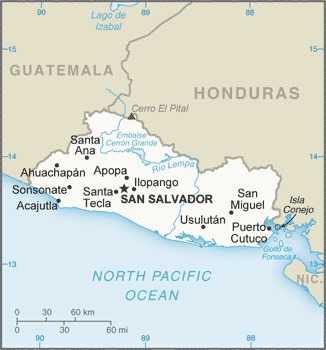
Border countries (2): Guatemala 199 km; Honduras 391 km
Land use
Arable land: 34.8% (2022 est.)
Permanent crops: 7.7% (2022 est.)
Permanent pasture: 15.2% (2022 est.)
Forest: 27.7% (2022 est.)
Other: 14.5% (2022 est.)
Maritime claims
Contiguous zone: 24 nm
Exclusive economic zone: 200 nm
Natural resources
Geography - note
Terrain
Location
Map references
Irrigated land
Total renewable water resources
Population distribution
Elevation
Lowest point: Pacific Ocean 0 m
Mean elevation: 442 m
Area
Land: 20,721 sq km
Water: 320 sq km
Age structure
15-64 years: 66.3% (male 2,077,745/female 2,317,416)
65 years and over: 8.4% (2024 est.) (male 238,658/female 320,400)
Sex ratio
0-14 years: 1.05 male(s)/female
15-64 years: 0.9 male(s)/female
65 years and over: 0.74 male(s)/female
Total population: 0.92 male(s)/female (2024 est.)
Literacy
Total population: 89.1%
Male: 91.3%
Female: 87.3% (2019)
Nationality
Adjective: Salvadoran
School life expectancy (primary to tertiary education)
Male: 12 years
Female: 12 years (2018)
Urbanization
Rate of urbanization: 1.33% annual rate of change (2020-25 est.)
Drinking water source
Rural: 94.2% of population
Total: 98.2% of population
Unimproved: Urban: 0.4% of population
Rural: 5.8% of population
Total: 1.8% of population (2020 est.)
Major urban areas - population
Physician density
Hospital bed density
Mother's mean age at first birth
Note: Data represents median age at first birth among women 25-29
Demographic profile
El Salvador is the smallest and most densely populated country in Central America. It is well into its demographic transition, experiencing slower population growth, a decline in its number of youths, and the gradual aging of its population. The increased use of family planning has substantially lowered El Salvador's fertility rate, from approximately 6 children per woman in the 1970s to replacement level today. A 2008 national family planning survey showed that female sterilization remained the most common contraception method in El Salvador - its sterilization rate is among the highest in Latin America and the Caribbean - but that the use of injectable contraceptives is growing. Fertility differences between rich and poor and urban and rural women are narrowing.
Salvadorans fled during the 1979 to 1992 civil war mainly to the United States but also to Canada and to neighboring Mexico, Guatemala, Honduras, Nicaragua, and Costa Rica. Emigration to the United States increased again in the 1990s and 2000s as a result of deteriorating economic conditions, natural disasters (Hurricane Mitch in 1998 and earthquakes in 2001), and family reunification. At least 20% of El Salvador's population lives abroad. The remittances they send home account for close to 20% of GDP, are the second largest source of external income after exports, and have helped reduce poverty.
Contraceptive prevalence rate
Dependency ratios
Youth dependency ratio: 39
Elderly dependency ratio: 12.3
Potential support ratio: 8.1 (2021 est.)
Sanitation facility access
Rural: 97.1% of population
Total: 99.2% of population
Unimproved: Urban: 0% of population
Rural: 2.9% of population
Total: 0.8% of population (2020 est.)
Ethnic groups
Religions
Languages
Major-language sample(s):
La Libreta Informativa del Mundo, la fuente indispensable de información básica. (Spanish)
The World Factbook, the indispensable source for basic information.
Current health expenditure
Gross reproduction rate
Currently married women (ages 15-49)
Child marriage
Women married by age 18: 19.7% (2021 est.)
Youth unemployment rate (ages 15-24)
Male: 5.3% (2023 est.)
Female: 10.8% (2023 est.)
note: % of labor force ages 15-24 seeking employment
Net migration rate
Median age
Male: 28.2 years
Female: 31.2 years
Maternal mortality ratio
Total fertility rate
Population
Male: 3,172,244
Female: 3,456,458 (2024 est.)
Infant mortality rate
Male: 13.3 deaths/1,000 live births
Female: 10 deaths/1,000 live births
Tobacco use
Male: 14.1% (2020 est.)
Female: 1.7% (2020 est.)
Obesity - adult prevalence rate
Death rate
Birth rate
Children under the age of 5 years underweight
Alcohol consumption per capita
Beer: 1.5 liters of pure alcohol (2019 est.)
Wine: 0.06 liters of pure alcohol (2019 est.)
Spirits: 1.37 liters of pure alcohol (2019 est.)
Other alcohols: 0 liters of pure alcohol (2019 est.)
Life expectancy at birth
Male: 72.4 years
Female: 79.5 years
Population growth rate
Environment - current issues
Environment - international agreements
Signed, but not ratified: Law of the Sea
Total water withdrawal
Industrial: 210 million cubic meters (2020 est.)
Agricultural: 1.43 billion cubic meters (2020 est.)
Waste and recycling
Carbon dioxide emissions
From coal and metallurgical coke: 1,000 metric tonnes of CO2 (2022 est.)
From petroleum and other liquids: 7.814 million metric tonnes of CO2 (2022 est.)
From consumed natural gas: 441,000 metric tonnes of CO2 (2022 est.)
Energy consumption per capita
Diplomatic representation from the US
Embassy: Final Boulevard Santa Elena, Antiguo Cuscatlan, La Libertad, San Salvador
Mailing address: 3450 San Salvador Place, Washington, DC 20521-3450
Telephone: [503] 2501-2999
FAX: [503] 2501-2150
Email address and website:
ACSSanSal@state.gov
https://sv.usembassy.gov/
Administrative divisions
Capital
Geographic coordinates: 13 42 N, 89 12 W
Time difference: UTC-6 (1 hour behind Washington, DC, during Standard Time)
Etymology: Spanish for "Holy Savior" (referring to Jesus Christ)
Constitution
Amendment process: Proposals require agreement by absolute majority of the Legislative Assembly membership; passage requires at least two-thirds majority vote of the Assembly; constitutional articles on basic principles, and citizen rights and freedoms cannot be amended
Executive branch
Head of government: President Nayib Armando BUKELE Ortez (since 1 June 2019)
Cabinet: Council of Ministers selected by the president
Elections/appointments: President and vice president directly elected on the same ballot by absolute majority popular vote in 2 rounds if needed for a single 5-year term; election last held on 4 February 2024 (next to be held in 2029)
Election results:
2024: Nayib Armando BUKELE Ortez reelected president - Nayib Armando BUKELE Ortez (Nuevas Ideas) 84.7%, Manuel FLORES (FMLN) 6.4%, Joel SANCHEZ (ARENA) 5.6%, Luis PARADA (NT) 2%, other 1.3%
2019: Nayib Armando BUKELE Ortez elected president - Nayib Armando BUKELE Ortez (GANA) 53.1%, Carlos CALLEJA Hakker (ARENA) 31.7%, Hugo MARTINEZ (FMLN) 14.4%, other 0.8%
Note: the president is both chief of state and head of government
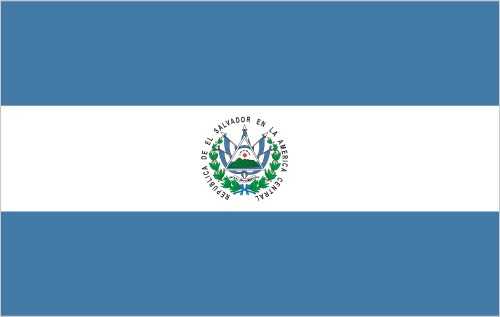
Flag description
Note: Similar to the flag of Nicaragua, which has a different coat of arms centered in the white band; also similar to the flag of Honduras, which has five blue stars arranged in an X pattern centered in the white band
Independence
Judicial branch
Judge selection and term of office: Judges elected by the Legislative Assembly on the recommendation of both the National Council of the Judicature, an independent body elected by the Legislative Assembly, and the Bar Association; judges elected for 9-year terms, with renewal of one third of membership every 3 years; consecutive reelection is allowed
Subordinate courts: Appellate Courts; Courts of First Instance; Courts of Peace
Legal system
Legislative branch
Legislative structure: Unicameral
Number of seats: 60 (all directly elected)
Electoral system: Proportional representation
Scope of elections: Full renewal
Term in office: 3 years
Most recent election date: 2/4/2024
Parties elected and seats per party: New Ideas (N) (54); Other (6)
Percentage of women in chamber: 31.7%
Expected date of next election: February 2027
International organization participation
National holiday
Political parties
Farabundo Marti National Liberation Front or FMLN
Great Alliance for National Unity or GANA
National Coalition Party or PCN
Nationalist Republican Alliance or ARENA
New Ideas (Nuevas Ideas) or NI
Our Time (Nuestro Tiempo) or NT
Vamos or V
Suffrage
Government type
Country name
Conventional short form: El Salvador
Local long form: República de El Salvador
Local short form: El Salvador
Etymology: Means "the Savior" in Spanish and is a shortened form of "the Divine Savior of the World" (el Divino Salvador del Mundo), referring to Jesus Christ; 16th-century Spanish colonists gave the name "San Salvador" to the fort located where the country's capital of San Salvador now stands, and the name was later used for the city and the surrounding region; the country was officially named El Salvador in 1824
Diplomatic representation in the US
Chancery: 1400 16th Street NW, Suite 100, Washington, DC 20036
Telephone: [1] (202) 595-7500
FAX: [1] (202) 232-3763
Email address and website:
InfoEEUU@rree.gob.sv
Consulate(s) general: Aurora (CO), Boston, Charlotte (NC), Chicago, Dallas, Doral (FL), Duluth (GA), El Paso (TX), Elizabeth (NJ), Fresno (CA), Houston, Las Vegas (NV), Laredo (TX), Long Island (NY), Los Angeles, McAllen (TX), New York, Omaha (NE), San Bernardino (CA), San Francisco, Salt Lake City, Seattle, Silver Spring (MD), Springdale (AR), St. Paul (MN), Tucson (AZ), Woodbridge (VA)
International law organization participation
National symbol(s)
Citizenship
Citizenship by descent only: Yes
Dual citizenship recognized: Yes
Residency requirement for naturalization: 5 years
National heritage
Selected World Heritage Site locales: Joya de Cerén Archaeological Site
Population below poverty line
note: % of population with income below national poverty line
Household income or consumption by percentage share
Highest 10%: 28.7% (2022 est.)
note: % share of income accruing to lowest and highest 10% of population
Exports - commodities
note: top five export commodities based on value in dollars
Exports - partners
note: top five export partners based on percentage share of exports
Agricultural products
note: top ten agricultural products based on tonnage
Budget
Expenditures: $9.371 billion (2023 est.)
note: central government revenues (excluding grants) and expenses converted to US dollars at average official exchange rate for year indicated
Imports - commodities
note: top five import commodities based on value in dollars
Exchange rates
Industries
Economic overview
GDP (official exchange rate)
note: data in current dollars at official exchange rate
Credit ratings
Moody's rating: B3 (2018)
Standard & Poors rating: B- (2018)
Note: The year refers to the year in which the current credit rating was first obtained.
GDP - composition, by end use
Government consumption: 18% (2023 est.)
Investment in fixed capital: 22% (2023 est.)
Investment in inventories: -2.7% (2023 est.)
Exports of goods and services: 31.1% (2023 est.)
Imports of goods and services: -49.8% (2023 est.)
note: figures may not total 100% due to rounding or gaps in data collection
Imports - partners
note: top five import partners based on percentage share of imports
Average household expenditures
On alcohol and tobacco: 0.5% of household expenditures (2023 est.)
Remittances
24.54% of GDP (2022 est.)
26.25% of GDP (2021 est.)
note: personal transfers and compensation between resident and non-resident individuals/households/entities
Labor force
note: number of people ages 15 or older who are employed or seeking work
Debt - external
note: present value of external debt in current US dollars
Reserves of foreign exchange and gold
$3.083 billion (2020 est.)
$4.446 billion (2019 est.)
note: holdings of gold (year-end prices)/foreign exchange/special drawing rights in current dollars
Public debt
note: central government debt as a % of GDP
Unemployment rate
3% (2022 est.)
4.33% (2021 est.)
note: % of labor force seeking employment
Taxes and other revenues
note: central government tax revenue as a % of GDP
Real GDP (purchasing power parity)
$69.516 billion (2022 est.)
$67.623 billion (2021 est.)
note: data in 2021 dollars
Inflation rate (consumer prices)
7.2% (2022 est.)
3.47% (2021 est.)
note: annual % change based on consumer prices
Current account balance
-$2.182 billion (2022 est.)
-$1.25 billion (2021 est.)
note: balance of payments - net trade and primary/secondary income in current dollars
Real GDP per capita
$11,100 (2022 est.)
$10,800 (2021 est.)
note: data in 2021 dollars
Imports
$18.184 billion (2022 est.)
$15.483 billion (2021 est.)
note: balance of payments - imports of goods and services in current dollars
Exports
$10.164 billion (2022 est.)
$8.351 billion (2021 est.)
note: balance of payments - exports of goods and services in current dollars
Real GDP growth rate
2.8% (2022 est.)
11.9% (2021 est.)
note: annual GDP % growth based on constant local currency
Industrial production growth rate
note: annual % change in industrial value added based on constant local currency
GDP - composition, by sector of origin
Industry: 25% (2023 est.)
Services: 59.8% (2023 est.)
note: figures may not total 100% due to non-allocated consumption not captured in sector-reported data
Electricity access
Coal
Imports: 2,000 metric tons (2022 est.)
Electricity generation sources
Solar: 16.2% of total installed capacity (2022 est.)
Hydroelectricity: 35.6% of total installed capacity (2022 est.)
Geothermal: 24.8% of total installed capacity (2022 est.)
Biomass and waste: 14.3% of total installed capacity (2022 est.)
Natural gas
Imports: 226.472 million cubic meters (2022 est.)
Petroleum
Refined petroleum consumption: 58,000 bbl/day (2022 est.)
Electricity
Consumption: 6.666 billion kWh (2022 est.)
Exports: 85.75 million kWh (2022 est.)
Imports: 1.351 billion kWh (2022 est.)
Transmission/distribution losses: 953.156 million kWh (2022 est.)
Telecommunication systems
Domestic: Fixed-line services, roughly 14 per 100, mobile-cellular competition now at 175 subscribers per 100 inhabitants (2021)
International: Country code - 503; satellite earth station - 1 Intelsat (Atlantic Ocean); connected to Central American Microwave System (2019)
Internet users
Internet country code
Broadcast media
Telephones - mobile cellular
Subscriptions per 100 inhabitants: 182 (2022 est.)
Broadband - fixed subscriptions
Subscriptions per 100 inhabitants: 11 (2022 est.)
Telephones - fixed lines
Subscriptions per 100 inhabitants: 14 (2022 est.)
National air transport system
Inventory of registered aircraft operated by air carriers: 13
Annual passenger traffic on registered air carriers: 2,545,105 (2018)
Annual freight traffic on registered air carriers: 10.73 million (2018) mt-km
Civil aircraft registration country code prefix
Waterways
Roadways
Paved: 5,341 km
Unpaved: 3,671 km (2017)
Airports
Merchant marine
By type: Other 5
Railways
Narrow gauge: 12.5 km (2014) 0.914-mm gauge
Military service age and obligation
Military and security forces
Note: The National Civil Police (Policia Nacional Civil, PNC) are under the Ministry of Justice and Public Safety; in 2016, El Salvador created a combined Army commando and PNC unit to combat criminal gang violence
Military - note
The FAES exercises with regional partners and the US, in such areas as internal security and disaster relief operations; it has deployed small numbers of personnel on UN peacekeeping missions and in support of military operations in Iraq (2003-2009)
The military led the country for much of the 20th century; from 1980 to 1992, it fought a bloody civil war against guerrillas from the Farabundo Martí National Liberation Front or FMLN, the paramilitary arm of the Democratic Revolutionary Front (Frente Democrático Revolucionario), a coalition of left-wing dissident political groups backed by Cuba and the Soviet Union; the FAES received considerable US support during the conflict; significant human rights violations occurred during the war and approximately 75,000 Salvadorans, mostly civilians, were killed (2023)
Military and security service personnel strengths
Military equipment inventories and acquisitions
Military expenditures
1.2% of GDP (2022 est.)
1.2% of GDP (2021 est.)
1.2% of GDP (2020 est.)
1.2% of GDP (2019 est.)
Illicit drugs
A transit country for illicit drugs destined for the United States; a major source of precursor or essential chemicals used in the production of illicit narcotics
Refugees and internally displaced persons
National anthem
Lyrics/music: Juan Jose CANAS/Juan ABERLE
Note: Officially adopted 1953, in use since 1879; at 4:20 minutes, the anthem of El Salvador is one of the world's longest
Air pollutants
Carbon dioxide emissions: 7.17 megatons (2016 est.)
Methane emissions: 4.71 megatons (2020 est.)
Ports
Large: 0
Medium: 0
Small: 0
Very small: 3
Ports with oil terminals: 3
Key ports: Acajutla, Acajutla Offshore Terminal, La Union
Gini Index coefficient - distribution of family income
note: index (0-100) of income distribution; higher values represent greater inequality