Canada
Background
Geographic coordinates
Natural hazards
Volcanism: The vast majority of volcanoes in Western Canada's Coast Mountains remain dormant
Area - comparative
Environmental issues
International environmental agreements
Signed, but not ratified: Air Pollution-Volatile Organic Compounds, Marine Life Conservation
Climate
Coastline
Note: The Canadian Arctic Archipelago -- consisting of 36,563 islands, several of them among the world's largest -- gives Canada the longest coastline in the world
Land boundaries
Border countries (2): US 8,891 km (includes 2,475 km with Alaska); Denmark (Greenland) 1.3 km
Land use
Arable land: 4.3% (2023 est.)
Permanent crops: 0% (2023 est.)
Permanent pasture: 2.1% (2023 est.)
Forest: 42% (2023 est.)
Other: 51.4% (2023 est.)
Maritime claims
Contiguous zone: 24 nm
Exclusive economic zone: 200 nm
Continental shelf: 200 nm or to the edge of the continental margin
Natural resources
Geography - note
Note 2: Canada has more fresh water than any other country, and almost 9% of Canadian territory is water; Canada has at least 2 million and possibly over 3 million lakes, more than all other countries combined
Terrain
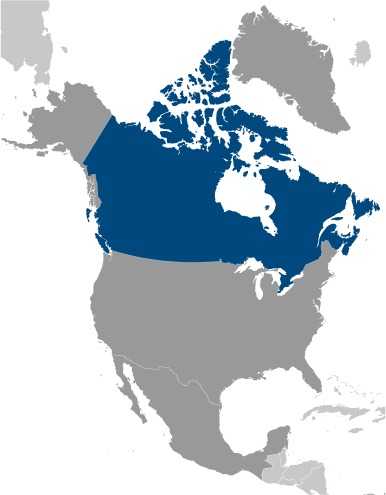
Location
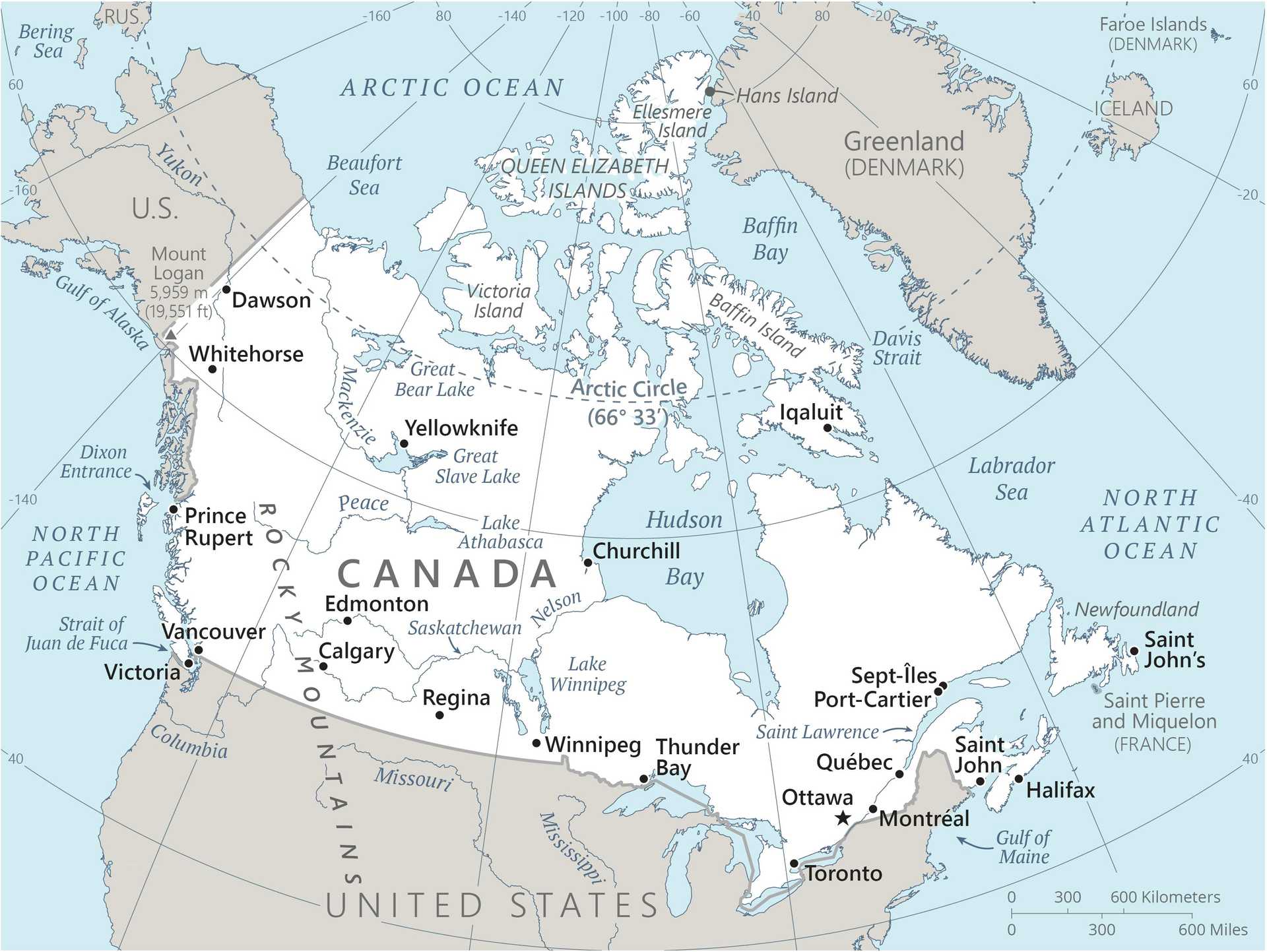
Map references
Irrigated land
Total renewable water resources
Population distribution
Elevation
Lowest point: Atlantic/Pacific/Arctic Oceans 0 m
Mean elevation: 487 m
Major lakes (area sq km)
Note - Great Lakes* area shown as Canadian waters
Major aquifers
Major rivers (by length in km)
Note: [s] after country name indicates river source; [m] after country name indicates river mouth
Major watersheds (area sq km)
Atlantic Ocean drainage: Mississippi* (Gulf of America) (3,202,185 sq km, Canada only 32,000 sq km), Nelson (Hudson Bay) (1,093,141 sq km), Saint Lawrence* (1,049,636 sq km, Canada only 839,200 sq km)
Pacific Ocean drainage: Yukon* (847,620 sq km, Canada only 823,800 sq km), Columbia* (657,501 sq km, Canada only 103,000 sq km)
Note: watersheds shared with the US shown with *
Area
Land: 9,093,507 sq km
Water: 891,163 sq km
Age structure
15-64 years: 63.4% (male 12,382,422/female 12,227,512)
65 years and over: 21% (2024 est.) (male 3,753,829/female 4,403,424)
Sex ratio
0-14 years: 1.06 male(s)/female
15-64 years: 1.01 male(s)/female
65 years and over: 0.85 male(s)/female
Total population: 0.98 male(s)/female (2024 est.)
Nationality
Adjective: Canadian
Urbanization
Rate of urbanization: 0.95% annual rate of change (2020-25 est.)
Drinking water source
Urban: 99.3% of population (2022 est.)
Rural: 99.1% of population (2022 est.)
Total: 99.2% of population (2022 est.)
Unimproved:
Urban: 0.7% of population (2022 est.)
Rural: 0.9% of population (2022 est.)
Total: 0.8% of population (2022 est.)
Major urban areas - population
Physician density
Hospital bed density
Mother's mean age at first birth
Dependency ratios
Youth dependency ratio: 23.9 (2024 est.)
Elderly dependency ratio: 32.9 (2024 est.)
Potential support ratio: 3 (2024 est.)
Sanitation facility access
Urban: 98.6% of population (2022 est.)
Rural: 98.8% of population (2022 est.)
Total: 98.6% of population (2022 est.)
Unimproved:
Urban: 1.4% of population (2022 est.)
Rural: 1.2% of population (2022 est.)
Total: 1.4% of population (2022 est.)
Ethnic groups
Note: Percentages add up to more than 100% because respondents were able to identify more than one ethnic origin
Religions
Languages
Major-language sample(s):
The World Factbook, the indispensable source for basic information. (English)
The World Factbook, une source indispensable d'informations de base. (French)
School life expectancy (primary to tertiary education)
Male: 15 years (2022 est.)
Female: 17 years (2022 est.)
Health expenditure
19.5% of national budget (2022 est.)
Gross reproduction rate
Currently married women (ages 15-49)
Youth unemployment rate (ages 15-24)
Male: 13.8% (2024 est.)
Female: 12.1% (2024 est.)
note: % of labor force ages 15-24 seeking employment
Net migration rate
Median age
Male: 41.4 years
Female: 43.8 years
Maternal mortality ratio
Total fertility rate
Population
Male: 19,234,729
Female: 19,560,084
Infant mortality rate
Male: 4.5 deaths/1,000 live births
Female: 4 deaths/1,000 live births
Tobacco use
Male: 12.3% (2025 est.)
Female: 8% (2025 est.)
Obesity - adult prevalence rate
Death rate
Birth rate
Alcohol consumption per capita
Beer: 3.5 liters of pure alcohol (2019 est.)
Wine: 2 liters of pure alcohol (2019 est.)
Spirits: 2.1 liters of pure alcohol (2019 est.)
Other alcohols: 0.4 liters of pure alcohol (2019 est.)
Life expectancy at birth
Male: 81.9 years
Female: 86.6 years
Education expenditure
10.7% national budget (2022 est.)
Population growth rate
Total water withdrawal
Industrial: 27.357 billion cubic meters (2022 est.)
Agricultural: 3.859 billion cubic meters (2022 est.)
Waste and recycling
Percent of municipal solid waste recycled: 23.1% (2022 est.)
Particulate matter emissions
Carbon dioxide emissions
From coal and metallurgical coke: 32.486 million metric tonnes of CO2 (2023 est.)
From petroleum and other liquids: 294.196 million metric tonnes of CO2 (2023 est.)
From consumed natural gas: 259.171 million metric tonnes of CO2 (2023 est.)
Energy consumption per capita
Diplomatic representation from the US
Embassy: 490 Sussex Drive, Ottawa, Ontario K1N 1G8
Mailing address: 5480 Ottawa Place, Washington DC 20521-5480
Telephone: [1] (613) 688-5335
FAX: [1] (613) 241-7845
Email address and website:
OttawaNIV@state.gov
https://ca.usembassy.gov/
Consulate(s) general: Calgary, Halifax, Montreal, Quebec City, Toronto, Vancouver
Consulate(s): Winnipeg
Administrative divisions
Capital
Geographic coordinates: 45 25 N, 75 42 W
Time difference: UTC-5 (same time as Washington, DC, during Standard Time)
Daylight saving time: +1hr, begins second Sunday in March; ends first Sunday in November
Time zone note: Canada has six time zones
Etymology: The city lies on the south bank of the Ottawa River, from which it derives its name; the river name comes from the Algonquin word adawe, meaning "to trade"
Constitution
Amendment process: Proposed by either house of Parliament or by the provincial legislative assemblies; there are 5 methods for passage though most require approval by both houses of Parliament, approval of at least two thirds of the provincial legislative assemblies and assent and formalization as a proclamation by the governor general in council; the most restrictive method is reserved for amendments affecting fundamental sections of the constitution, such as the office of the monarch or the governor general, and the constitutional amendment procedures, which require unanimous approval by both houses and by all the provincial assemblies, and assent of the governor general in council
Executive branch
Head of government: Prime Minister Mark CARNEY (since 14 March 2025)
Cabinet: Federal Ministry chosen by the prime minister usually from among members of his/her own party sitting in Parliament
Election/appointment process: The monarchy is hereditary; governor general appointed by the monarch on the advice of the prime minister for a 5-year term; after legislative elections, the governor general usually designates the leader of the majority party or majority coalition in the House of Commons as prime minister
Note: The governor general position is largely ceremonial
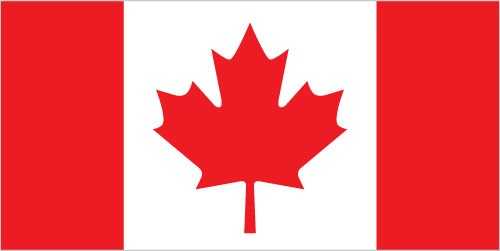
Flag
Meaning: The maple leaf is a national symbol
Independence
Judicial branch
Judge selection and term of office: Chief justice and judges appointed by the prime minister in council; all judges appointed for life with mandatory retirement at age 75
Subordinate courts: Federal level: Federal Court of Appeal; Federal Court; Tax Court; federal administrative tribunals; Courts Martial; provincial/territorial level: provincial superior, appeals, first instance, and specialized courts
Note: In 1999, the Nunavut Court -- a circuit court with the power of a provincial superior court, as well as a territorial court -- was established to serve isolated settlements
Legal system
Legislative branch
Legislative structure: Bicameral
International organization participation
National holiday
Political parties
Conservative Party of Canada or CPC
Green Party of Canada
Liberal Party of Canada
New Democratic Party
Suffrage
Government type
Country name
Conventional short form: Canada
Etymology: The name is probably derived from the Huron or Iroquois word kanata, meaning village or camp
Diplomatic representation in the US
Chancery: 501 Pennsylvania Avenue NW, Washington, DC 20001
Telephone: [1] (844) 880-6519
FAX: [1] (202) 682-7738
Email address and website:
Ccs.scc@international.gc.ca
https://www.international.gc.ca/country-pays/us-eu/washington.aspx?lang=eng
Consulate(s) general: Atlanta, Boston, Chicago, Dallas, Denver, Detroit, Los Angeles, Miami, Minneapolis, New York, San Francisco, Seattle
Trade office(s): Houston, Palo Alto (CA), San Diego; note - there are trade offices in the Consulates General
National anthem(s)
Lyrics/music: Adolphe-Basile ROUTHIER [French], Robert Stanley WEIR [English]/Calixa LAVALLEE
History: Adopted 1980; originally written in 1880, it served as an unofficial anthem for many years; the original version had four verses, but the anthem today officially consists of one verse in French and one in English
_____
Title: "God Save the King"
Lyrics/music: Unknown
History: Royal anthem, as a Commonwealth country
International law organization participation
National symbol(s)
Citizenship
Citizenship by descent only: Yes
Dual citizenship recognized: Yes
Residency requirement for naturalization: Minimum of 3 of last 5 years resident in Canada
National heritage
Selected World Heritage Site locales: L'Anse aux Meadows (c); Canadian Rocky Mountain Parks (n); Dinosaur Provincial Park (n); Historic District of Old Quebec (c); Old Town Lunenburg (c); Wood Buffalo National Park (n); Head-Smashed-In Buffalo Jump (c); Gros Morne National Park (n); Pimachiowin Aki (m)

National color(s)
Household income or consumption by percentage share
Highest 10%: 23.4% (2020 est.)
note: % share of income accruing to lowest and highest 10% of population
Exports - commodities
note: top five export commodities based on value in dollars
Exports - partners
note: top five export partners based on percentage share of exports
Agricultural products
note: top ten agricultural products based on tonnage
Budget
Expenditures: $417.421 billion (2023 est.)
note: central government revenues (excluding grants) and expenditures converted to US dollars at average official exchange rate for year indicated
Imports - commodities
note: top five import commodities based on value in dollars
Exchange rates
Exchange rates:
1.369 (2024 est.)
1.35 (2023 est.)
1.302 (2022 est.)
1.254 (2021 est.)
1.341 (2020 est.)
Industries
Economic overview
High-income economy and second-largest US trading partner; key timber, oil, and gas industries; trade uncertainties and weak business investments contributing to economic slowdown; high and growing public debt; inflation moderating but remains above target range
GDP (official exchange rate)
note: data in current dollars at official exchange rate
GDP - composition, by end use
Government consumption: 20.9% (2023 est.)
Investment in fixed capital: 22.9% (2023 est.)
Investment in inventories: 1% (2023 est.)
Exports of goods and services: 33.3% (2023 est.)
Imports of goods and services: -33.3% (2023 est.)
note: figures may not total 100% due to rounding or gaps in data collection
Imports - partners
note: top five import partners based on percentage share of imports
Average household expenditures
On alcohol and tobacco: 3.5% of household expenditures (2023 est.)
Remittances
0% of GDP (2023 est.)
0% of GDP (2022 est.)
note: personal transfers and compensation between resident and non-resident individuals/households/entities
Labor force
note: number of people ages 15 or older who are employed or seeking work
Reserves of foreign exchange and gold
$117.551 billion (2023 est.)
$106.952 billion (2022 est.)
note: holdings of gold (year-end prices)/foreign exchange/special drawing rights in current dollars
Public debt
note: central government debt as a % of GDP
Unemployment rate
5.5% (2023 est.)
5.3% (2022 est.)
note: % of labor force seeking employment
Taxes and other revenues
note: central government tax revenue as a % of GDP
Real GDP (purchasing power parity)
$2.305 trillion (2023 est.)
$2.271 trillion (2022 est.)
note: data in 2021 dollars
Inflation rate (consumer prices)
3.9% (2023 est.)
6.8% (2022 est.)
note: annual % change based on consumer prices
Current account balance
-$13.764 billion (2023 est.)
-$6.318 billion (2022 est.)
note: balance of payments - net trade and primary/secondary income in current dollars
Real GDP per capita
$57,500 (2023 est.)
$58,300 (2022 est.)
note: data in 2021 dollars
Imports
$723.399 billion (2023 est.)
$731.058 billion (2022 est.)
note: balance of payments - imports of goods and services in current dollars
Exports
$724.754 billion (2023 est.)
$743.782 billion (2022 est.)
note: balance of payments - exports of goods and services in current dollars
Real GDP growth rate
1.5% (2023 est.)
4.2% (2022 est.)
note: annual GDP % growth based on constant local currency
Industrial production growth rate
note: annual % change in industrial value added based on constant local currency
GDP - composition, by sector of origin
Industry: 25.3% (2021 est.)
Services: 66.4% (2021 est.)
note: figures may not total 100% due to non-allocated consumption not captured in sector-reported data
Electricity access
Coal
Consumption: 20.092 million metric tons (2023 est.)
Exports: 35.447 million metric tons (2023 est.)
Imports: 7.03 million metric tons (2023 est.)
Proven reserves: 6.582 billion metric tons (2023 est.)
Electricity generation sources
Nuclear: 13.7% of total installed capacity (2023 est.)
Solar: 1.4% of total installed capacity (2023 est.)
Wind: 6% of total installed capacity (2023 est.)
Hydroelectricity: 58.6% of total installed capacity (2023 est.)
Biomass and waste: 1.4% of total installed capacity (2023 est.)
Natural gas
Consumption: 131.887 billion cubic meters (2023 est.)
Exports: 82.537 billion cubic meters (2023 est.)
Imports: 29.058 billion cubic meters (2023 est.)
Proven reserves: 2.067 trillion cubic meters (2021 est.)
Petroleum
Refined petroleum consumption: 2.377 million bbl/day (2024 est.)
Crude oil estimated reserves: 170.3 billion barrels (2021 est.)
Electricity
Consumption: 555.683 billion kWh (2023 est.)
Exports: 49.444 billion kWh (2023 est.)
Imports: 21.77 billion kWh (2023 est.)
Transmission/distribution losses: 31.784 billion kWh (2023 est.)
Internet users
Internet country code
Broadcast media
Telephones - mobile cellular
Subscriptions per 100 inhabitants: 91 (2022 est.)
Broadband - fixed subscriptions
Subscriptions per 100 inhabitants: 43 (2023 est.)
Telephones - fixed lines
Subscriptions per 100 inhabitants: 28 (2023 est.)
Railways
Standard gauge: 49,422 km (2021) 1.435-m gauge
Civil aircraft registration country code prefix
Airports
Merchant marine
By type: Bulk carrier 22, container ship 1, general cargo 78, oil tanker 15, other 600
Heliports
Military expenditures
1.5% of GDP (2024 est.)
1.3% of GDP (2023 est.)
1.2% of GDP (2022 est.)
1.3% of GDP (2021 est.)
Military and security forces
Note 1: The CAF is comprised of both a Regular Force and a Reserve Force; the Reserve Force is comprised of the Primary Reserve, Canadian Rangers, Cadet Organizations Administration and Training Service, and the Supplementary Reserve; the Canadian Rangers are part of the Army Reserve Force and provide a limited presence in Canada's northern, coastal, and isolated areas for sovereignty, public safety, and surveillance roles
Note 2: The Royal Canadian Mounted Police (RCMP or "Mounties") are under the Department of Public Safety; the Coast Guard is under the Department of Fisheries and Oceans
Military - note
Canada is part of the North American Aerospace Defense Command (NORAD; established 1958); NORAD is a Canada/US bi-national military command responsible for monitoring and defending North American airspace; traditionally, a CAF officer has served as the deputy commander of NORAD; Canada’s defense relationship with the US extends back to the Ogdensburg Declaration of 1940, when the two countries formally agreed on military cooperation, including the establishment of the Permanent Joint Board on Defense (PJBD), which continues to be the highest-level bilateral defense forum between Canada and the US
British troops withdrew from Canada in 1871 as part of the US-UK Treaty of Washington; following the withdrawal, the first Canadian militia, known as the Royal Canadian Regiment, was organized in 1883 to protect Canadian territory and defend British interests abroad, which it did in the South African War (1899-1902), Canada’s first overseas conflict; militia units formed the backbone of the more than 425,000 Canadian soldiers that went to Europe during World War I in what was called the Canadian Expeditionary Force; the Royal Canadian Navy was created in 1910, while the Canadian Air Force was established in 1920 and became the Royal Canadian Air Force in 1924; the Canadian Army was officially founded in 1942; a unified Canadian Armed Forces was created in 1968 (2025)
Military and security service personnel strengths
Military deployments
Note: In 2024, Canada announced plans to have a full 2,000-person brigade deployed to Latvia by 2026
Military equipment inventories and acquisitions
Military service age and obligation
Note 1: Canada opened up all military occupations to women in 2001; women in 2024 comprised about 16% of the CAF
Note 2: The CAF offers waivers to foreign nationals applying for military service only in exceptional cases — to individuals on international military exchanges, for example, or to candidates who have specialized skills in high demand
Illicit drugs
Major precursor-chemical producer (2025)
Refugees and internally displaced persons
IDPs: 1,981 (2024 est.)
Stateless persons: 8,166 (2024 est.)
Terrorist group(s)
Note: Details about the history, aims, leadership, organization, areas of operation, tactics, targets, weapons, size, and sources of support of the group(s) appear(s) in the Terrorism reference guide
Nuclear energy
Net capacity of operational nuclear reactors: 12.71GW (2025 est.)
Percent of total electricity production: 13.7% (2023 est.)
Number of nuclear reactors permanently shut down: 8 (2025)
Space program overview
Space launch site(s)
Note: The Churchill Rocket Research Range in Manitoba was used for rocket testing from 1956-1985
Space agency/agencies
Geoparks
Global geoparks and regional networks: Perce; Stonehammer; Tumbler Ridge; Cliffs of Fundy; Discovery (2023)
Ports
Large: 4
Medium: 14
Small: 58
Very small: 149
Size unknown: 59
Ports with oil terminals: 59
Key ports: Argentia, Canaport (St. John), Halifax, Hamilton, Montreal, New Westminster, Pond Inlet, Prince Rupert, Quebec, Sept Iles, St. John, Sydney, Thunder Bay, Toronto, Trois Rivieres, Vancouver, Victoria Harbor, Windsor
Legislative branch - lower chamber
Number of seats: 343 (all directly elected)
Electoral system: Plurality/majority
Scope of elections: Full renewal
Term in office: 4 years
Most recent election date: 4/28/2025
Parties elected and seats per party: Liberal Party (169); Conservative Party (144); Bloc Québécois (BQ) (22); Other (30)
Percentage of women in chamber: 30.3%
Expected date of next election: October 2029
Legislative branch - upper chamber
Number of seats: 105 (all appointed)
Percentage of women in chamber: 54.8%
Key space-program milestones
1972-1973 - first domestic communications satellites (Anik A-1 and Anik A-2) launched by US, making Canada first country to employ satellites for domestic communications
1970s - began participating in US Space Shuttle (first Canadian in space on Shuttle in 1984) and US Mars probe/exploration programs
1995 - first Canadian-built, radar-capable remote sensing satellite (Radarsat-1) launched by US
2019 - began participating in US/NASA Lunar Gateway orbital station program; launched constellation of remote sensing satellites (RADARSAT Constellation Mission)
2020 - signed the US-led Artemis Accords for space exploration (active participant in planned Moon missions under the Artemis program)
Methane emissions
Agriculture: 1,049.8 kt (2019-2021 est.)
Waste: 816.7 kt (2019-2021 est.)
Other: 39.3 kt (2019-2021 est.)
Gini Index coefficient - distribution of family income
note: index (0-100) of income distribution; higher values represent greater inequality
National coat of arms
The current design of the Royal Coat of Arms of Canada was adopted in 1921 and references the four nations that helped found Canada. England is represented with royal lions, a union flag, and a rose, and Scotland with a royal lion, a unicorn, and a thistle. Ireland’s symbols include a harp and a shamrock, and France’s symbols are a royal fleur-de-lis and a royal flag. The maple leaves are the Canadian national symbol. A red circle displays the motto Desiderantes Meliorem Patriam (Desiring a Better Country), and a blue ribbon displays A Mari usque ad Mare (From Sea to Sea).