Mongolia
Background
The peoples of Mongolia have a long history under a number of nomadic empires dating back to the Xiongnu in the 4th century B.C., and the name Mongol goes back to at least the 11th century A.D. The most famous Mongol, TEMÜÜJIN (aka Genghis Khan), emerged as the ruler of all Mongols in the early 1200s. By the time of his death in 1227, he had created through conquest a Mongol Empire that extended across much of Eurasia. His descendants, including ÖGÖDEI and KHUBILAI (aka Kublai Khan), continued to conquer Eastern Europe, the Middle East, and the rest of China, where KHUBILAI established the Yuan Dynasty in the 1270s. The Mongols attempted to invade Japan and Java before their empire broke apart in the 14th century. In the 17th century, Mongolia fell under the rule of the Manchus of the Chinese Qing Dynasty. After Manchu rule collapsed in 1911, Mongolia declared independence, finally winning it in 1921 with help from the Soviet Union. Mongolia became a socialist state (the Mongolian People’s Republic) in 1924. Until the collapse of the Soviet Union in 1989, Mongolia was a Soviet satellite state and relied heavily on economic, military, and political assistance from Moscow. The period was also marked by purges, political repression, economic stagnation, and tensions with China.
Mongolia peacefully transitioned to an independent democracy in 1990. In 1992, it adopted a new constitution and established a free-market economy. Since the country's transition, it has conducted a series of successful presidential and legislative elections. Throughout the period, the ex-communist Mongolian People's Revolutionary Party -- which took the name Mongolian People’s Party (MPP) in 2010 -- has competed for political power with the Democratic Party and several other smaller parties. For most of its democratic history, Mongolia has had a divided government, with the presidency and the parliamentary majority held by different parties but that changed in 2021, when the MPP won the presidency after having secured a supermajority in parliament in 2020. Mongolia’s June 2021 presidential election delivered a decisive victory for MPP candidate Ukhnaagiin KHURELSUKH.
Mongolia maintains close cultural, political, and military ties with Russia, while China is its largest economic partner. Mongolia’s foreign relations are focused on preserving its autonomy by balancing relations with China and Russia, as well as its other major partners, Japan, South Korea, and the US.
Geographic coordinates
Natural hazards
Area - comparative
Environmental issues
International environmental agreements
Signed, but not ratified: None of the selected agreements
Climate
Coastline
Land boundaries
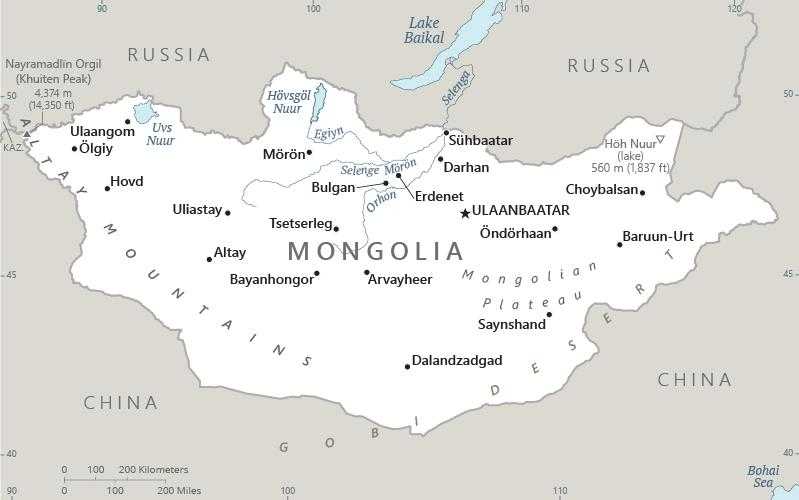
Border countries (2): China 4,630 km; Russia 3,452 km
Maritime claims
Natural resources
Geography - note
Terrain
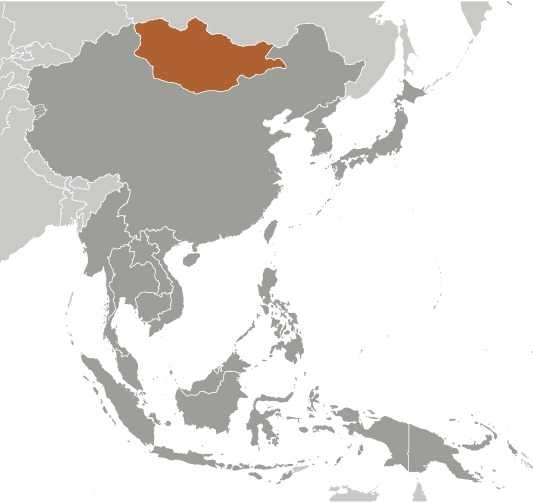
Location
Map references
Irrigated land
Total renewable water resources
Population distribution
Elevation
Lowest point: Hoh Nuur 560 m
Mean elevation: 1,528 m
Major lakes (area sq km)
Salt water lake(s): Uvs Nuur - 3,350 sq km; Hyargas Nuur - 1,360 sq km
Major rivers (by length in km)
Note: [s] after country name indicates river source; [m] after country name indicates river mouth
Area
Land: 1,553,556 sq km
Water: 10,560 sq km
Land use
Arable land: 0.7% (2023 est.)
Permanent crops: 0% (2023 est.)
Permanent pasture: 68.2% (2023 est.)
Forest: 9.1% (2023 est.)
Other: 21.9% (2023 est.)
Age structure
15-64 years: 68.4% (male 1,087,487/female 1,156,547)
65 years and over: 5.9% (2024 est.) (male 78,242/female 116,590)
Sex ratio
0-14 years: 1.04 male(s)/female
15-64 years: 0.94 male(s)/female
65 years and over: 0.67 male(s)/female
Total population: 0.95 male(s)/female (2024 est.)
Nationality
Adjective: Mongolian
School life expectancy (primary to tertiary education)
Male: 13 years (2023 est.)
Female: 14 years (2023 est.)
Urbanization
Rate of urbanization: 1.4% annual rate of change (2020-25 est.)
Drinking water source
Urban: 94.2% of population (2022 est.)
Rural: 59.7% of population (2022 est.)
Total: 83.5% of population (2022 est.)
Unimproved:
Urban: 5.8% of population (2022 est.)
Rural: 40.3% of population (2022 est.)
Total: 16.5% of population (2022 est.)
Major urban areas - population
Physician density
Hospital bed density
Mother's mean age at first birth
Note: Data represents median age at first birth among women 20-24
Dependency ratios
Youth dependency ratio: 50.2 (2024 est.)
Elderly dependency ratio: 8.9 (2024 est.)
Potential support ratio: 11.2 (2024 est.)
Sanitation facility access
Urban: 97.8% of population (2022 est.)
Rural: 78.7% of population (2022 est.)
Total: 91.9% of population (2022 est.)
Unimproved:
Urban: 2.2% of population (2022 est.)
Rural: 21.3% of population (2022 est.)
Total: 8.1% of population (2022 est.)
Ethnic groups
Religions
Languages
Major-language sample(s):
Дэлхийн баримтат ном, үндсэн мэдээллийн зайлшгүй эх сурвалж. (Mongolian)
The World Factbook, the indispensable source for basic information.
Health expenditure
9.2% of national budget (2022 est.)
Child marriage
Women married by age 18: 12% (2018)
Men married by age 18: 2.1% (2018)
Gross reproduction rate
Youth unemployment rate (ages 15-24)
Male: 15.9% (2024 est.)
Female: 10.8% (2024 est.)
note: % of labor force ages 15-24 seeking employment
Net migration rate
Median age
Male: 30.1 years
Female: 32.8 years
Maternal mortality ratio
Total fertility rate
Population
Male: 1,595,596
Female: 1,686,080
Infant mortality rate
Male: 22.4 deaths/1,000 live births
Female: 16.2 deaths/1,000 live births
Tobacco use
Male: 51.9% (2025 est.)
Female: 7.2% (2025 est.)
Obesity - adult prevalence rate
Death rate
Birth rate
Alcohol consumption per capita
Beer: 2.18 liters of pure alcohol (2019 est.)
Wine: 1.46 liters of pure alcohol (2019 est.)
Spirits: 1.82 liters of pure alcohol (2019 est.)
Other alcohols: 0 liters of pure alcohol (2019 est.)
Life expectancy at birth
Male: 67.8 years
Female: 76.3 years
Population growth rate
Literacy
Male: 98.3% (2023 est.)
Female: 98.9% (2023 est.)
Currently married women (ages 15-49)
Children under the age of 5 years underweight
Education expenditure
13.8% national budget (2024 est.)
Total water withdrawal
Industrial: 166.2 million cubic meters (2022 est.)
Agricultural: 250.9 million cubic meters (2022 est.)
Waste and recycling
Percent of municipal solid waste recycled: 13% (2022 est.)
Particulate matter emissions
Carbon dioxide emissions
From coal and metallurgical coke: 13.489 million metric tonnes of CO2 (2023 est.)
From petroleum and other liquids: 5.714 million metric tonnes of CO2 (2023 est.)
Energy consumption per capita
Diplomatic representation from the US
Embassy: Denver Street #3, 11th Micro-District, Ulaanbaatar 14190
Mailing address: 4410 Ulaanbaatar Place, Washington DC 20521-4410
Telephone: [976] 7007-6001
FAX: [976] 7007-6174
Email address and website:
UlaanbaatarACS@state.gov
https://mn.usembassy.gov/
Administrative divisions
Capital
Geographic coordinates: 47 55 N, 106 55 E
Time difference: UTC+8 (13 hours ahead of Washington, DC, during Standard Time)
Daylight saving time: +1hr, begins last Saturday in March; ends last Saturday in September
Time zone note: Mongolia has two time zones - Ulaanbaatar Time (8 hours in advance of UTC) and Hovd Time (7 hours in advance of UTC)
Etymology: The name means "red hero" in Mongolian and honors national hero Damdin SUKHBAATAR, leader of the partisan army that, with Soviet help, liberated Mongolia from Chinese occupation in the early 1920s
Constitution
Amendment process: Proposed by the State Great Hural, by the president of the republic, by the government, or by petition submitted to the State Great Hural by the Constitutional Court; conducting referenda on proposed amendments requires at least two-thirds majority vote of the State Great Hural; passage of amendments by the State Great Hural requires at least three-quarters majority vote; passage by referendum requires majority participation of qualified voters and a majority of votes
Executive branch
Head of government: Prime Minister Gombojavyn ZANDANSHATAR (since 13 June 2025)
Cabinet: Cabinet directly appointed by the prime minister
Election/appointment process: Presidential candidates nominated by political parties represented in the State Great Hural and directly elected by simple-majority popular vote for one 6-year term; following legislative elections, the State Great Hural usually elects the leader of the majority party or majority coalition as prime minister
Most recent election date: 9 June 2021
Election results:
2021: Ukhnaagiin KHURELSUKH elected president in first round; percent of vote - Ukhnaagiin KHURELSUKH (MPP) 68%, Dangaasuren ENKHBAT (RPEC) 20.1%, Sodnomzundui ERDENE (DP) 6%
2017: Khaltmaa BATTULGA elected president in second round; percent of vote in first round - Khaltmaa BATTULGA (DP) 38.1%, Miyegombo ENKHBOLD (MPP) 30.3%, Sainkhuu GANBAATAR (MPRP) 30.2%, invalid 1.4%; percent of vote in second round - Khaltmaa BATTULGA 55.2%, Miyegombo ENKHBOLD 44.8%
Expected date of next election: 2027
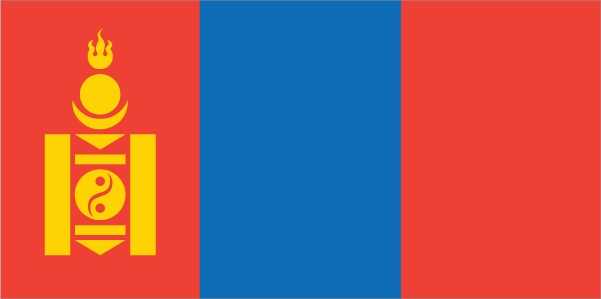
Flag
Meaning: Blue stands for the sky, and red for progress and prosperity
Independence
Judicial branch
Judge selection and term of office: Supreme Court chief justice and judges appointed by the president on recommendation of the General Council of Courts -- a 14-member body of judges and judicial officials -- to the State Great Hural; appointment is for life; chairman of the Constitutional Court elected from among its members; members appointed from nominations by the State Great Hural - 3 each by the president, the State Great Hural, and the Supreme Court; appointment is 6 years; chairmanship limited to a single renewable 3-year term
Subordinate courts: Aimag (provincial) and capital city appellate courts; soum, inter-soum, and district courts; Administrative Cases Courts
Legal system
Legislative branch
Legislative structure: Unicameral
Number of seats: 126 (all directly elected)
Electoral system: Mixed system
Scope of elections: Full renewal
Term in office: 4 years
Most recent election date: 6/28/2024
Parties elected and seats per party: Mongolian People's Party (MPP) (68); Democratic Party (DP) (42); HUN Party (8); Other (8)
Percentage of women in chamber: 25.4%
Expected date of next election: June 2028
International organization participation
National holiday
Note: The first holiday commemorates independence from China in the 1921 Revolution, and the second marks the date that the Mongolian People's Republic was created under a new constitution
Political parties
Mongolian People's Party or MPP
National Coalition (consists of Mongolian Green Party or MGP and the Mongolian National Democratic Party or MNDP)
National Labor Party or HUN
Civil Will-Green Party or CWGP
Suffrage
Government type
Country name
Conventional short form: Mongolia
Local long form: None
Local short form: Mongol Uls
Former: Outer Mongolia, Mongolian People's Republic
Etymology: Name comes from the Mongol people, whose name derives from the Mongol root word mengu or mongu, meaning "brave" or "unconquered;" the Mongolian name Mongol Uls translates as "Mongol State"
Diplomatic representation in the US
Chancery: 2833 M Street NW, Washington, DC 20007
Telephone: [1] (202) 333-7117
FAX: [1] (202) 298-9227
Email address and website:
Washington@mfa.gov.mn
http://mongolianembassy.us/
Consulate(s) general: New York, San Francisco
National anthem(s)
Lyrics/music: Tsendiin DAMDINSUREN/Bilegiin DAMDINSUREN and Luvsanjamts MURJORJ
History: Music adopted 1950, lyrics adopted 2006; lyrics altered on numerous occasions
International law organization participation
National symbol(s)
Citizenship
Citizenship by descent only: Both parents must be citizens of Mongolia; one parent if born within Mongolia
Dual citizenship recognized: No
Residency requirement for naturalization: 5 years
National heritage
Selected World Heritage Site locales: Uvs Nuur Basin (n); Orkhon Valley Cultural Landscape (c); Petroglyphic Complexes of the Mongolian Altai (c); Great Burkhan Khaldun Mountain and surrounding sacred landscape (c); Landscapes of Dauria (n); Deer Stone Monuments and Related Bronze Age Sites (c)
National color(s)
Population below poverty line
note: % of population with income below national poverty line
Household income or consumption by percentage share
Highest 10%: 24.6% (2022 est.)
note: % share of income accruing to lowest and highest 10% of population
Exports - commodities
note: top five export commodities based on value in dollars
Exports - partners
note: top five export partners based on percentage share of exports
Agricultural products
note: top ten agricultural products based on tonnage
Budget
Expenditures: $5.623 billion (2021 est.)
note: central government revenues (excluding grants) and expenditures converted to US dollars at average official exchange rate for year indicated
Imports - commodities
note: top five import commodities based on value in dollars
Exchange rates
Exchange rates:
3,389.982 (2024 est.)
3,465.737 (2023 est.)
3,140.678 (2022 est.)
2,849.289 (2021 est.)
2,813.29 (2020 est.)
Industries
Economic overview
GDP (official exchange rate)
note: data in current dollars at official exchange rate
GDP - composition, by end use
Government consumption: 16.3% (2024 est.)
Investment in fixed capital: 26.8% (2024 est.)
Investment in inventories: 7.8% (2024 est.)
Exports of goods and services: 69.1% (2024 est.)
Imports of goods and services: -69.8% (2024 est.)
note: figures may not total 100% due to rounding or gaps in data collection
Imports - partners
note: top five import partners based on percentage share of imports
Remittances
2.3% of GDP (2022 est.)
3.1% of GDP (2021 est.)
note: personal transfers and compensation between resident and non-resident individuals/households/entities
Labor force
note: number of people ages 15 or older who are employed or seeking work
Debt - external
note: present value of external debt in current US dollars
Reserves of foreign exchange and gold
$4.916 billion (2023 est.)
$3.398 billion (2022 est.)
note: holdings of gold (year-end prices)/foreign exchange/special drawing rights in current dollars
Public debt
note: central government debt as a % of GDP
Unemployment rate
5.6% (2023 est.)
6.3% (2022 est.)
note: % of labor force seeking employment
Taxes and other revenues
note: central government tax revenue as a % of GDP
Real GDP (purchasing power parity)
$56.474 billion (2023 est.)
$52.572 billion (2022 est.)
note: data in 2021 dollars
Inflation rate (consumer prices)
10.3% (2023 est.)
15.1% (2022 est.)
note: annual % change based on consumer prices
Current account balance
-$2.303 billion (2022 est.)
-$2.108 billion (2021 est.)
note: balance of payments - net trade and primary/secondary income in current dollars
Real GDP per capita
$16,200 (2023 est.)
$15,300 (2022 est.)
note: data in 2021 dollars
Imports
$12.112 billion (2022 est.)
$9.256 billion (2021 est.)
note: balance of payments - imports of goods and services in current dollars
Exports
$10.989 billion (2022 est.)
$8.95 billion (2021 est.)
note: balance of payments - exports of goods and services in current dollars
Real GDP growth rate
7.4% (2023 est.)
5% (2022 est.)
note: annual GDP % growth based on constant local currency
Industrial production growth rate
note: annual % change in industrial value added based on constant local currency
GDP - composition, by sector of origin
Industry: 38.1% (2024 est.)
Services: 44.2% (2024 est.)
note: figures may not total 100% due to non-allocated consumption not captured in sector-reported data
Electricity access
Coal
Consumption: 8.941 million metric tons (2023 est.)
Exports: 55.884 million metric tons (2023 est.)
Imports: 900 metric tons (2023 est.)
Proven reserves: 2.52 billion metric tons (2023 est.)
Electricity generation sources
Solar: 2.4% of total installed capacity (2023 est.)
Wind: 6.4% of total installed capacity (2023 est.)
Hydroelectricity: 0.8% of total installed capacity (2023 est.)
Petroleum
Refined petroleum consumption: 39,000 bbl/day (2023 est.)
Electricity
Consumption: 8.997 billion kWh (2023 est.)
Exports: 24 million kWh (2023 est.)
Imports: 2.224 billion kWh (2023 est.)
Transmission/distribution losses: 1.113 billion kWh (2023 est.)
Internet users
Internet country code
Broadcast media
Telephones - mobile cellular
Subscriptions per 100 inhabitants: 142 (2022 est.)
Broadband - fixed subscriptions
Subscriptions per 100 inhabitants: 15 (2023 est.)
Telephones - fixed lines
Subscriptions per 100 inhabitants: 15 (2023 est.)
Railways
Broad gauge: 1,815 km (2017) 1.520-m gauge
Note: National operator Ulaanbaatar Railway is jointly owned by the Mongolian Government and by the Russian State Railway
Civil aircraft registration country code prefix
Airports
Merchant marine
By type: Bulk carrier 8, container ship 8, general cargo 151, oil tanker 58, other 93
Military service age and obligation
Military expenditures
0.6% of GDP (2023 est.)
0.6% of GDP (2022 est.)
0.8% of GDP (2021 est.)
0.8% of GDP (2020 est.)
Military and security forces
Note: The National Police Agency and the General Authority for Border Protection, which operate under the Ministry of Justice and Home Affairs, are primarily responsible for internal security; they are assisted by the General Intelligence Agency under the prime minister
Military - note
Mongolia actively cooperates with NATO on issues such as counterterrorism, nonproliferation, and cybersecurity through an Individual Partnership and Cooperation Program; it supported the NATO-led Kosovo Force from 2005-2007 and contributed troops to the NATO-led missions in Afghanistan from 2009-2021; Mongolia also is an observer in the Shanghai Cooperation Organization (2025)
Military and security service personnel strengths
Military equipment inventories and acquisitions
Military deployments
Note: Since 2002, Mongolia has deployed more than 20,000 peacekeepers and observers to UN operations in more than a dozen countries
Refugees and internally displaced persons
IDPs: 22 (2024 est.)
Stateless persons: 17 (2024 est.)
Methane emissions
Agriculture: 525.2 kt (2019-2021 est.)
Waste: 14.2 kt (2019-2021 est.)
Other: 2.9 kt (2019-2021 est.)
Gini Index coefficient - distribution of family income
note: index (0-100) of income distribution; higher values represent greater inequality