Cook Islands
Australia and OceaniaCW September 16, 2025
Background
Polynesians from Tahiti were probably the first people to settle Rarotonga -- the largest of the Cook Islands -- around A.D. 900. Over time, Samoans and Tongans also settled in Rarotonga, and Rarotongans voyaged to the northern Cook Islands, settling Manihiki and Rakahanga. Pukapuka and Penrhyn in the northern Cook Islands were settled directly from Samoa. Prior to European contact, there was considerable travel and trade between inhabitants of the different islands and atolls, but they were not united in a single political entity. Spanish navigators were the first Europeans to spot the northern Cook Islands in 1595, followed by the first landing in 1606, but no further European contact occurred until the 1760s. In 1773, British explorer James COOK spotted Manuae in the southern Cook Islands, and Russian mapmakers named the islands after COOK in the 1820s.
Fearing France would militarily occupy the islands as it did in Tahiti, Rarotongans asked the UK for protectorate status in the 1840s and 1860s, a request the UK ignored. In 1888, Queen MAKEA TAKAU of Rarotonga formally petitioned for protectorate status, to which the UK reluctantly agreed. In 1901, the UK placed Rarotonga and the rest of the islands in the New Zealand Colony, and in 1915, the Cook Islands Act organized the islands into one political entity. It remained a protectorate until 1965, when New Zealand granted the Cook Islands self-governing status. The Cook Islands has a great deal of local autonomy and is an independent member of international organizations, but it is in free association with New Zealand, which is responsible for its defense and foreign affairs. In September 2023, the US recognized the Cook Islands as a sovereign and independent state.
Fearing France would militarily occupy the islands as it did in Tahiti, Rarotongans asked the UK for protectorate status in the 1840s and 1860s, a request the UK ignored. In 1888, Queen MAKEA TAKAU of Rarotonga formally petitioned for protectorate status, to which the UK reluctantly agreed. In 1901, the UK placed Rarotonga and the rest of the islands in the New Zealand Colony, and in 1915, the Cook Islands Act organized the islands into one political entity. It remained a protectorate until 1965, when New Zealand granted the Cook Islands self-governing status. The Cook Islands has a great deal of local autonomy and is an independent member of international organizations, but it is in free association with New Zealand, which is responsible for its defense and foreign affairs. In September 2023, the US recognized the Cook Islands as a sovereign and independent state.
Geographic coordinates
21 14 S, 159 46 W
Natural hazards
tropical cyclones (November to March)
Area - comparative
1.3 times the size of Washington, D.C.
Environmental issues
solid- and liquid-waste disposal; soil degradation; deforestation; use of pesticides; improper disposal of pollutants; overfishing and destructive fishing practices; over-dredging of lagoons and coral rubble beds; unregulated building
International environmental agreements
Party to: Antarctic-Marine Living Resources, Biodiversity, Climate Change, Climate Change-Kyoto Protocol, Climate Change-Paris Agreement, Comprehensive Nuclear Test Ban, Desertification, Hazardous Wastes, Law of the Sea, Ozone Layer Protection, Ship Pollution
Signed, but not ratified: None of the selected agreements
Signed, but not ratified: None of the selected agreements
Climate
tropical oceanic; moderated by trade winds; a dry season from April to November and a more humid season from December to March
Coastline
120 km
Land boundaries
Total: 0 km
Land use
Agricultural land: 7.9% (2022 est.)
Arable land: 2.1% (2022 est.)
Permanent crops: 5.8% (2022 est.)
Permanent pasture: 0% (2022 est.)
Forest: 65% (2022 est.)
Other: 27.1% (2022 est.)
Arable land: 2.1% (2022 est.)
Permanent crops: 5.8% (2022 est.)
Permanent pasture: 0% (2022 est.)
Forest: 65% (2022 est.)
Other: 27.1% (2022 est.)
Maritime claims
Territorial sea: 12 nm
Exclusive economic zone: 200 nm
Continental shelf: 200 nm or to the edge of the continental margin
Exclusive economic zone: 200 nm
Continental shelf: 200 nm or to the edge of the continental margin
Natural resources
coconuts (copra)
Geography - note
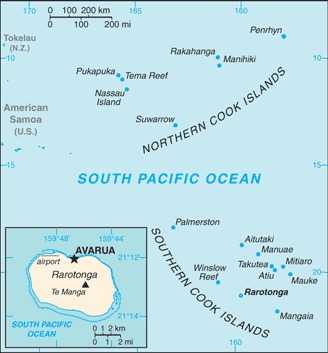
the northern Cook Islands are seven low-lying, sparsely populated, coral atolls; the southern Cook Islands, where most of the population lives, consist of eight elevated, fertile, volcanic isles, including the largest, Rarotonga, at 67 sq km
Terrain
low coral atolls in north; volcanic, hilly islands in south
Location
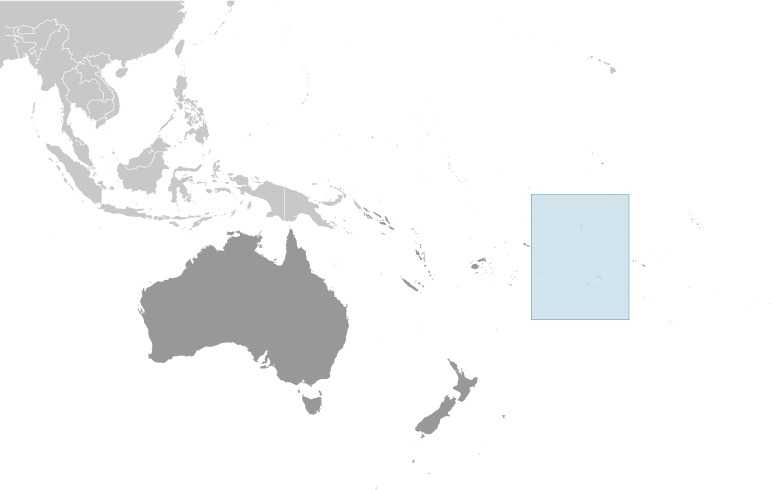
Oceania, group of islands in the South Pacific Ocean, about halfway between Hawaii and New Zealand
Map references
Oceania
Irrigated land
NA
Population distribution
most of the population is found on the island of Rarotonga
Elevation
Highest point: Te Manga 652 m
Lowest point: Pacific Ocean 0 m
Lowest point: Pacific Ocean 0 m
Area
Total : 236 sq km
Land: 236 sq km
Water: 0 sq km
Land: 236 sq km
Water: 0 sq km
Age structure
0-14 years: 18.2% (male 738/female 671)
15-64 years: 65.9% (male 2,634/female 2,479)
65 years and over: 16% (2024 est.) (male 608/female 631)
15-64 years: 65.9% (male 2,634/female 2,479)
65 years and over: 16% (2024 est.) (male 608/female 631)
Sex ratio
At birth: 1.04 male(s)/female
0-14 years: 1.1 male(s)/female
15-64 years: 1.06 male(s)/female
65 years and over: 0.96 male(s)/female
Total population: 1.05 male(s)/female (2024 est.)
0-14 years: 1.1 male(s)/female
15-64 years: 1.06 male(s)/female
65 years and over: 0.96 male(s)/female
Total population: 1.05 male(s)/female (2024 est.)
Nationality
Noun: Cook Islander(s)
Adjective: Cook Islander
Adjective: Cook Islander
School life expectancy (primary to tertiary education)
Total: 15 years (2023 est.)
Male: 15 years (2023 est.)
Female: 15 years (2023 est.)
Male: 15 years (2023 est.)
Female: 15 years (2023 est.)
Urbanization
Urban population: 76.2% of total population (2023)
Rate of urbanization: 0.52% annual rate of change (2020-25 est.)
Rate of urbanization: 0.52% annual rate of change (2020-25 est.)
Drinking water source
Improved:
Urban: NA
Rural: NA
Total: 100% of population (2022 est.)
Unimproved:
Urban: NA
Rural: NA
Total: 0% of population (2022 est.)
Urban: NA
Rural: NA
Total: 100% of population (2022 est.)
Unimproved:
Urban: NA
Rural: NA
Total: 0% of population (2022 est.)
Physician density
1.67 physicians/1,000 population (2020)
Sanitation facility access
Improved:
Total: 96.8% of population (2022 est.)
Unimproved:
Total: 3.2% of population (2022 est.)
Total: 96.8% of population (2022 est.)
Unimproved:
Total: 3.2% of population (2022 est.)
Ethnic groups
Cook Island Maori 77.4%, part Cook Island Maori 8.3%, Fijian 3.6%, New Zealand Maori/European 3.4%, Filipino 2.9%, other Pacific Islands 1.8%, other 2.6% (2021 est.)
Religions
Protestant 55% (Cook Islands Christian Church 43.1%, Seventh Day Adventist 8.3%, Assemblies of God 3.6%), Roman Catholic 16.7%, Church of Jesus Christ 3.9%, Jehovah's Witness 2.2%, Apostolic Church 2.1%, other 4.5%, none/unspecified 15.6% (2021 est.)
Languages
English (official) 86.4%, Cook Islands Maori (Rarotongan) (official) 76.2%, other 8.3% (2011 est.)
Note: Shares sum to more than 100% because some respondents gave more than one answer on the census
Note: Shares sum to more than 100% because some respondents gave more than one answer on the census
Health expenditure
3.2% of GDP (2020)
11.9% of national budget (2022 est.)
11.9% of national budget (2022 est.)
Dependency ratios
Total dependency ratio: 51.8 (2024 est.)
Youth dependency ratio: 27.6 (2024 est.)
Elderly dependency ratio: 24.2 (2024 est.)
Potential support ratio: 4.1 (2024 est.)
Youth dependency ratio: 27.6 (2024 est.)
Elderly dependency ratio: 24.2 (2024 est.)
Potential support ratio: 4.1 (2024 est.)
Hospital bed density
8.2 beds/1,000 population (2021 est.)
Gross reproduction rate
0.99 (2024 est.)
Currently married women (ages 15-49)
42.6% (2023 est.)
Net migration rate
-25.1 migrant(s)/1,000 population (2024 est.)
Median age
Total: 41.1 years (2024 est.)
Male: 40.7 years
Female: 41.4 years
Male: 40.7 years
Female: 41.4 years
Maternal mortality ratio
0 deaths/100,000 live births (2023 est.)
Total fertility rate
2.02 children born/woman (2024 est.)
Population
Total: 7,761 (2024 est.)
Male: 3,980
Female: 3,781
Male: 3,980
Female: 3,781
Infant mortality rate
Total: 15.1 deaths/1,000 live births (2024 est.)
Male: 19 deaths/1,000 live births
Female: 11.1 deaths/1,000 live births
Male: 19 deaths/1,000 live births
Female: 11.1 deaths/1,000 live births
Tobacco use
Total: 24% (2025 est.)
Male: 28.6% (2025 est.)
Female: 20.1% (2025 est.)
Male: 28.6% (2025 est.)
Female: 20.1% (2025 est.)
Obesity - adult prevalence rate
55.9% (2016)
Death rate
9.4 deaths/1,000 population (2024 est.)
Birth rate
12.1 births/1,000 population (2024 est.)
Alcohol consumption per capita
Total: 12.97 liters of pure alcohol (2019 est.)
Beer: 3.62 liters of pure alcohol (2019 est.)
Wine: 2.28 liters of pure alcohol (2019 est.)
Spirits: 7.07 liters of pure alcohol (2019 est.)
Other alcohols: 0 liters of pure alcohol (2019 est.)
Beer: 3.62 liters of pure alcohol (2019 est.)
Wine: 2.28 liters of pure alcohol (2019 est.)
Spirits: 7.07 liters of pure alcohol (2019 est.)
Other alcohols: 0 liters of pure alcohol (2019 est.)
Life expectancy at birth
Total population: 77.6 years (2024 est.)
Male: 74.8 years
Female: 80.6 years
Male: 74.8 years
Female: 80.6 years
Education expenditure
4.6% of GDP (2023 est.)
8.7% national budget (2024 est.)
8.7% national budget (2024 est.)
Population growth rate
-2.24% (2024 est.)
Particulate matter emissions
7.8 micrograms per cubic meter (2019 est.)
Carbon dioxide emissions
103,000 metric tonnes of CO2 (2023 est.)
From petroleum and other liquids: 103,000 metric tonnes of CO2 (2023 est.)
From petroleum and other liquids: 103,000 metric tonnes of CO2 (2023 est.)
Diplomatic representation from the US
Embassy: None (self-governing in free association with New Zealand)
Note: On 25 September 2023, the US officially established diplomatic relations with Cook Islands
Note: On 25 September 2023, the US officially established diplomatic relations with Cook Islands
Administrative divisions
none
Capital
Name: Avarua
Geographic coordinates: 21 12 S, 159 46 W
Time difference: UTC-10 (5 hours behind Washington, DC, during Standard Time)
Etymology: Translates as "two harbors" in Maori
Geographic coordinates: 21 12 S, 159 46 W
Time difference: UTC-10 (5 hours behind Washington, DC, during Standard Time)
Etymology: Translates as "two harbors" in Maori
Constitution
History: 4 August 1965 (Cook Islands Constitution Act 1964)
Amendment process: Proposed by Parliament; passage requires at least two-thirds majority vote by the Parliament membership in each of several readings and assent of the chief of state’s representative; passage of amendments relating to the chief of state also requires two-thirds majority approval in a referendum
Amendment process: Proposed by Parliament; passage requires at least two-thirds majority vote by the Parliament membership in each of several readings and assent of the chief of state’s representative; passage of amendments relating to the chief of state also requires two-thirds majority approval in a referendum
Executive branch
Chief of state: King CHARLES III (since 8 September 2022); represented by Sir Tom J. MARSTERS (since 9 August 2013); New Zealand High Commissioner Catherine GRAHAM (since 8 September 2024)
Head of government: Prime Minister Mark BROWN (since 1 October 2020)
Cabinet: Cabinet chosen by the prime minister
Election/appointment process: The monarchy is hereditary; UK representative appointed by the monarch; New Zealand high commissioner appointed by the New Zealand Government; following legislative elections, the leader of the majority party or majority coalition usually becomes prime minister
Head of government: Prime Minister Mark BROWN (since 1 October 2020)
Cabinet: Cabinet chosen by the prime minister
Election/appointment process: The monarchy is hereditary; UK representative appointed by the monarch; New Zealand high commissioner appointed by the New Zealand Government; following legislative elections, the leader of the majority party or majority coalition usually becomes prime minister
Flag
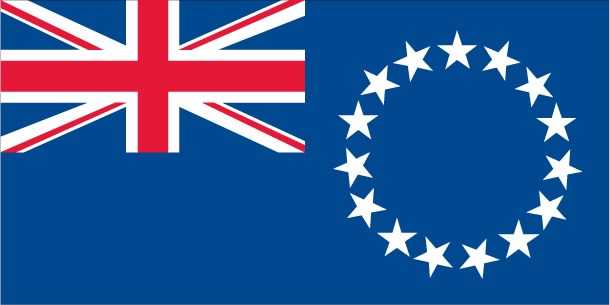
Description: Blue with the UK flag in the upper-left quadrant and a large circle of 15 five-pointed white stars (one for each island) centered in the right half of the flag
Independence
4 August 1965 (Cook Islands became self-governing state in free association with New Zealand)
Judicial branch
Highest court(s): Court of Appeal (consists of the chief justice and 3 judges of the High Court); High Court (consists of the chief justice and at least 4 judges and organized into civil, criminal, and land divisions)
Judge selection and term of office: High Court chief justice appointed by the Queen's Representative on the advice of the Executive Council tendered by the prime minister; other judges appointed by the Queen's Representative, on the advice of the Executive Council tendered by the chief justice, High Court chief justice, and the minister of justice; chief justice and judges appointed for 3-year renewable terms
Subordinate courts: Justices of the peace
Note: appeals beyond the Cook Islands Court of Appeal are heard by the Judicial Committee of the Privy Council (in London)
Judge selection and term of office: High Court chief justice appointed by the Queen's Representative on the advice of the Executive Council tendered by the prime minister; other judges appointed by the Queen's Representative, on the advice of the Executive Council tendered by the chief justice, High Court chief justice, and the minister of justice; chief justice and judges appointed for 3-year renewable terms
Subordinate courts: Justices of the peace
Note: appeals beyond the Cook Islands Court of Appeal are heard by the Judicial Committee of the Privy Council (in London)
Legal system
common law similar to New Zealand common law
Legislative branch
Legislature name: Parliament
Legislative structure: Unicameral
Number of seats: 24 (directly elected)
Electoral system: Plurality/majority
Scope of elections: Full renewal
Term in office: 4 years
Most recent election date: 8/1/2022
Parties elected and seats per party: CIP (12); Demo (5); Cook Islands United Party (3); OCI (1); independent (3)
Percentage of women in chamber: 25%
Expected date of next election: 2026
Note: the House of Ariki, a 24-member parliamentary body of traditional leaders appointed by the King's representative, serves as a consultative body to the Parliament
Legislative structure: Unicameral
Number of seats: 24 (directly elected)
Electoral system: Plurality/majority
Scope of elections: Full renewal
Term in office: 4 years
Most recent election date: 8/1/2022
Parties elected and seats per party: CIP (12); Demo (5); Cook Islands United Party (3); OCI (1); independent (3)
Percentage of women in chamber: 25%
Expected date of next election: 2026
Note: the House of Ariki, a 24-member parliamentary body of traditional leaders appointed by the King's representative, serves as a consultative body to the Parliament
International organization participation
ACP, ADB, AOSIS, FAO, ICAO, ICCt, ICRM, IFAD, IFRCS, IMO, IMSO, IOC, ITUC (NGOs), OPCW, PIF, Sparteca, SPC, UNESCO, UPU, WHO, WMO
National holiday
Constitution Day, the first Monday in August (1965)
Political parties
Cook Islands Party or CIP
Cook Islands United Party
Democratic Party or Demo
One Cook Islands Movement or OCI
Cook Islands United Party
Democratic Party or Demo
One Cook Islands Movement or OCI
Suffrage
18 years of age; universal
Government type
parliamentary democracy
Country name
Conventional long form: None
Conventional short form: Cook Islands
Former: Hervey Islands
Etymology: Named after Captain James COOK, the British explorer who visited the islands in 1773 and 1777
Conventional short form: Cook Islands
Former: Hervey Islands
Etymology: Named after Captain James COOK, the British explorer who visited the islands in 1773 and 1777
Diplomatic representation in the US
none (self-governing in free association with New Zealand)
National anthem(s)
Title: "Te Atua Mou E" (To God Almighty)
Lyrics/music: Tepaeru Te RITO/Thomas DAVIS
History: Adopted 1982; as prime minister, Sir Thomas DAVIS composed the anthem; Pa Tepaeru Terito Ariki, his wife and a tribal chief, wrote the lyrics
Title: "God Save the King"
Lyrics/music: Unknown
History: Royal anthem
Lyrics/music: Tepaeru Te RITO/Thomas DAVIS
History: Adopted 1982; as prime minister, Sir Thomas DAVIS composed the anthem; Pa Tepaeru Terito Ariki, his wife and a tribal chief, wrote the lyrics
Title: "God Save the King"
Lyrics/music: Unknown
History: Royal anthem
International law organization participation
has not submitted an ICJ jurisdiction declaration (New Zealand normally retains responsibility for external affairs); accepts ICCt jurisdiction
National symbol(s)
a circle of 15 five-pointed white stars on a blue field, tiare maori flower (Gardenia taitensis)
National color(s)
green, white
Exports - commodities
fish, ships, garments, shellfish (2023)
Note: Top export commodities based on value in dollars over $500,000
Note: Top export commodities based on value in dollars over $500,000
Agricultural products
coconuts, vegetables, papayas, pork, sweet potatoes, tomatoes, fruits, mangoes/guavas, watermelons, chicken (2023)
note: top ten agricultural products based on tonnage
note: top ten agricultural products based on tonnage
Budget
Revenues: $113.687 million (2022 est.)
Expenditures: $143.391 million (2022 est.)
note: central government revenues and expenses (excluding grants/extrabudgetary units/social security funds) converted to US dollars at average official exchange rate for year indicated
Expenditures: $143.391 million (2022 est.)
note: central government revenues and expenses (excluding grants/extrabudgetary units/social security funds) converted to US dollars at average official exchange rate for year indicated
Imports - commodities
ships, refined petroleum, cars, plastic products, additive manufacturing machines (2023)
note: top five import commodities based on value in dollars
note: top five import commodities based on value in dollars
Exchange rates
New Zealand dollars (NZD) per US dollar -
Exchange rates:
1.652 (2024 est.)
1.628 (2023 est.)
1.577 (2022 est.)
1.414 (2021 est.)
1.542 (2020 est.)
Exchange rates:
1.652 (2024 est.)
1.628 (2023 est.)
1.577 (2022 est.)
1.414 (2021 est.)
1.542 (2020 est.)
Industries
fishing, fruit processing, tourism, clothing, handicrafts
Economic overview
high-income self-governing New Zealand territorial economy; tourism-based activity but diversifying; severely curtailed by COVID-19 pandemic; copra and tropical fruit exporter; Asian Development Bank aid recipient
GDP (official exchange rate)
$409.077 million (2024 est.)
Note: Data in current dollars at official exchange rate
Note: Data in current dollars at official exchange rate
Imports - partners
NZ 44%, Italy 26%, Fiji 9%, China 7%, Australia 3% (2023)
note: top five import partners based on percentage share of imports
note: top five import partners based on percentage share of imports
Exports - partners
Japan 33%, Thailand 15%, Greece 15%, France 11%, China 8% (2023)
note: top five export partners based on percentage share of exports
note: top five export partners based on percentage share of exports
Real GDP (purchasing power parity)
$401.155 million (2024 est.)
$364.686 million (2023 est.)
$306.285 million (2022 est.)
Note: Data are in 2015 dollars
$364.686 million (2023 est.)
$306.285 million (2022 est.)
Note: Data are in 2015 dollars
Inflation rate (consumer prices)
10.6% (2022 est.)
1.9% (2021 est.)
1% (2020 est.)
Note: Annual % change based on consumer prices
1.9% (2021 est.)
1% (2020 est.)
Note: Annual % change based on consumer prices
Real GDP per capita
$29,800 (2024 est.)
$25,700 (2023 est.)
$19,700 (2022 est.)
Note: Data in 2015 dollars
$25,700 (2023 est.)
$19,700 (2022 est.)
Note: Data in 2015 dollars
Real GDP growth rate
10.5% (2022 est.)
-24.5% (2021 est.)
-5.2% (2020 est.)
-24.5% (2021 est.)
-5.2% (2020 est.)
Coal
Imports: 1 metric tons (2022 est.)
Electricity generation sources
Fossil fuels: 60.9% of total installed capacity (2023 est.)
Solar: 39.1% of total installed capacity (2023 est.)
Solar: 39.1% of total installed capacity (2023 est.)
Petroleum
Refined petroleum consumption: 700 bbl/day (2023 est.)
Electricity
Installed generating capacity: 17,000 kW (2023 est.)
Consumption: 37.5 million kWh (2023 est.)
Transmission/distribution losses: 3.2 million kWh (2023 est.)
Consumption: 37.5 million kWh (2023 est.)
Transmission/distribution losses: 3.2 million kWh (2023 est.)
Internet users
Percent of population: 64.8% (2021 est.)
Internet country code
.ck
Broadcast media
1 privately owned TV station in Rarotonga provides a mix of local news and overseas-sourced programs (2019)
Telephones - mobile cellular
Total subscriptions: 17,000 (2021 est.)
Subscriptions per 100 inhabitants: 100 (2021 est.)
Subscriptions per 100 inhabitants: 100 (2021 est.)
Broadband - fixed subscriptions
Total: 2,700 (2018 est.)
Subscriptions per 100 inhabitants: 15 (2018 est.)
Subscriptions per 100 inhabitants: 15 (2018 est.)
Telephones - fixed lines
Total subscriptions: 7,000 (2021 est.)
Subscriptions per 100 inhabitants: 41 (2021 est.)
Subscriptions per 100 inhabitants: 41 (2021 est.)
Civil aircraft registration country code prefix
E5
Airports
10 (2025)
Merchant marine
Total: 190 (2023)
By type: Bulk carrier 19, general cargo 44, oil tanker 58, other 69
By type: Bulk carrier 19, general cargo 44, oil tanker 58, other 69
Military and security forces
no regular military forces; Cook Islands Police Service
Military - note
defense is the responsibility of New Zealand in consultation with the Cook Islands and at its request
The Cook Islands have a "shiprider" agreement with the US, which allows local maritime law enforcement officers to embark on US Coast Guard (USCG) and US Navy (USN) vessels, including to board and search vessels suspected of violating laws or regulations within its designated exclusive economic zone (EEZ) or on the high seas; "shiprider" agreements also enable USCG personnel and USN vessels with embarked USCG law enforcement personnel to work with host nations to protect critical regional resources (2025)
The Cook Islands have a "shiprider" agreement with the US, which allows local maritime law enforcement officers to embark on US Coast Guard (USCG) and US Navy (USN) vessels, including to board and search vessels suspected of violating laws or regulations within its designated exclusive economic zone (EEZ) or on the high seas; "shiprider" agreements also enable USCG personnel and USN vessels with embarked USCG law enforcement personnel to work with host nations to protect critical regional resources (2025)
Dependency status
self-governing in free association with New Zealand; Cook Islands is fully responsible for internal affairs and conducts its own international relations, including establishing diplomatic relationships with foreign countries; New Zealand has a constitutional responsibility to respond to requests for assistance with foreign affairs, disasters, and defense
Ports
Total ports: 1 (2024)
Large: 0
Medium: 0
Small: 0
Very small: 1
Ports with oil terminals: 1
Key ports: Avatiu
Large: 0
Medium: 0
Small: 0
Very small: 1
Ports with oil terminals: 1
Key ports: Avatiu